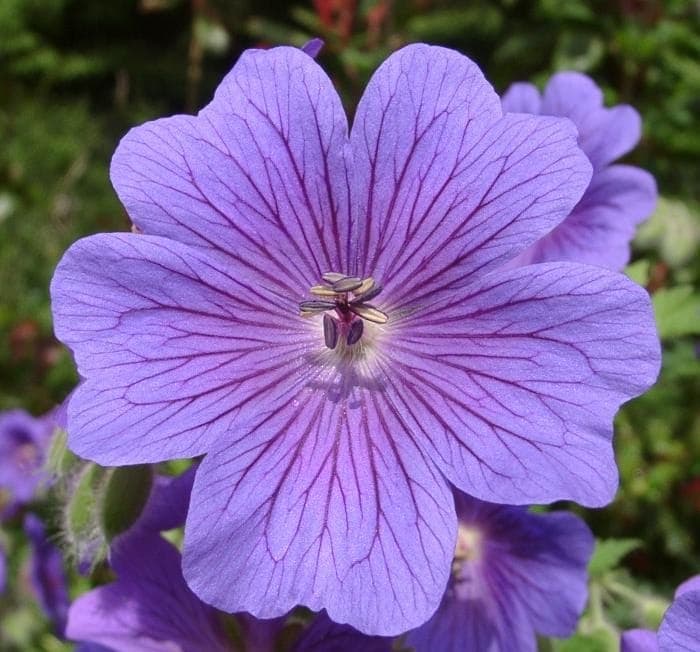
Ramin Nakisa at English Wikipedia / CC BY-SA 3.0, via Wikimedia Commons
Purple cranesbill: complete guide
Geranium × magnificum
Want to see Purple cranesbill: complete guide in your garden?
Full design in HD: €7.99
Look after your Purple cranesbill with the GardenWorld app
Identify plants with your camera and get a care calendar with reminders for this plant.


Overview
Purple cranesbill (Geranium × magnificum) lives up to its botanical name. In June this perennial covers itself in large violet-blue flowers with dark veins, so many that the foliage underneath almost disappears. It is one of the oldest and most dependable hardy geraniums in our gardens: tough, long-lived and practically indestructible.
Geranium × magnificum is a cross between Geranium ibericum and Geranium platypetalum, two species from the Caucasus and Turkey. The hybrid is sterile: it sets no seed and therefore never self-sows. All its energy goes into flowering and into a dense clump of leaves. It belongs to the cranesbill family (Geraniaceae). Do not confuse it with the pelargonium, the tender patio plant that many people also call a geranium but which belongs to an entirely different genus.
The plant grows 50 to 60 cm tall and at least as wide, slowly spreading through short rhizomes into a broad clump. That makes it ideal as a filler in borders, along paths and beneath roses or shrubs. On gardenworld.app you can have a garden design made in which hardy geraniums like this one fill the gaps between larger plants, leaving weeds very little room. A well-known selection is 'Rosemoor', a little more compact and with deep violet-blue flowers.
Appearance and bloom cycle
The leaves are rounded to palmate, deeply cut into seven to nine lobes, 10 to 20 cm across and softly hairy on both sides. They form a dense, mounded clump that already covers the ground by April. In autumn the foliage turns a beautiful mix of orange, red and brown, which keeps the plant attractive long after flowering.
Flowering mainly takes place in June and early July. The flowers are saucer-shaped, 4 to 5 cm across, with five broad petals in a warm violet-blue, threaded with dark purple veins. Dark stamens sit in the centre. The photo at the top shows that pattern up close: a violet-blue flower with deep purple veins against a green background.
The main flush lasts three to five weeks. That is shorter than some modern hardy geraniums, but the display during that period is overwhelming. After cutting back, a light second flush sometimes follows in late summer. Bees and bumblebees visit the flowers eagerly, even though no seed is produced.
Hardy geraniums are not known to be toxic to people, dogs or cats. The same cannot be said of pelargoniums, which can be mildly toxic to pets, which is one more reason not to mix up the names.
Ideal location
Geranium × magnificum flowers most freely in full sun but also does well in partial shade. In full sun the clump stays more compact and the flowers are more numerous; in light shade the foliage stays fresher during hot summers. Deep shade is less suitable, as the plant becomes thin and hardly flowers.
The plant is extremely versatile. Use it at the front or middle of a border, in broad drifts as ground cover, along a garden path, at the foot of roses or beneath light shrubs. Plant three to five per square metre, 45 to 60 cm apart. After two or three years the clumps knit together into a dense carpet that suppresses weeds very effectively.
Soil requirements
Purple cranesbill is undemanding and grows in almost any garden soil, from sand to heavy clay. An ordinary, moderately fertile soil that does not dry out completely in summer and does not sit waterlogged in winter is ideal. On poor sandy soil, add some compost to the planting hole; on heavy clay, good drainage matters more than extra feeding.
Soil pH is not critical: slightly acid to chalky is all fine. Feeding is hardly necessary, and a layer of compost in spring is more than enough. Too much fertiliser makes the stems soft, so the clump flops open after heavy rain.
Free preview
Want to see Purple cranesbill: complete guide in your garden? Make a free preview of your design.
Watering
Water regularly during the first season after planting, especially in dry spells: around 3 to 5 litres per plant, once or twice a week. Once the plant is well rooted, it is fairly drought tolerant. Only during prolonged drought and heat will you see the leaves start to droop, and then one thorough soak is enough to revive it.
Water in the morning where possible and at the base of the plant, so the hairy leaves dry quickly. That reduces the risk of powdery mildew, which sometimes appears on hardy geraniums in late summer, particularly when the roots are dry and the air is humid. This cranesbill can also be grown in a large pot, but it will then need more water in summer.
Pruning
Pruning is the key to a good-looking plant after flowering. After the main flush, usually by mid-July, the clump often splays open and the foliage looks tired. Cut all stems and leaves back to a hand's breadth above the ground. Within a few weeks a fresh, compact mound of new leaves appears, and with luck a few more flowers follow in August or September. Give the plant a good soak and a spadeful of compost after this cut.
In late autumn, leave the coloured foliage in place; it protects the roots in winter and looks good too. Clear the remains in February or March, before the new shoots appear. Every four or five years, or when the centre of the clump becomes bare, divide the plant in spring or early autumn. Split the clump into pieces with a few buds each and replant them. That way you also gain extra young plants for elsewhere in the garden.
Maintenance calendar
January to February: Dormant period. In late February, cut away old leaf remains.
March to April: New leaves appear. Spread a thin layer of compost around the clumps. A good time to plant or divide.
May: Rapid growth. In a windy spot, you can place a few low plant supports around the clump.
June to early July: Full flower. Water during dry weather.
Mid-July to August: Cut the whole plant back after flowering. Water and add a little compost. Fresh foliage appears quickly.
September to November: Sometimes a light second flush. The leaves turn orange and red. A good time for planting. The plant calendar on gardenworld.app lists these jobs month by month, tailored to the plants in your garden.
December: Leave the foliage standing as winter protection.
Winter hardiness
Geranium × magnificum is fully hardy and tolerates temperatures down to -30 °C. Anywhere in Britain and the Low Countries it never needs winter protection. Most of the foliage dies back in winter, but the rhizomes survive safely underground and reliably shoot again in spring.
The plant usually copes well with wet winters too, as long as water does not lie around the roots for weeks on end. In a pot it is slightly more vulnerable, so move containers against a wall for the winter. Because it is sterile and spreads only slowly, it poses no risk whatsoever to the surrounding countryside.
Companion plants
Purple cranesbill is the perfect partner for roses. Its violet-blue flowers open at the same time as the first rose flush and hide the often bare base of rose bushes. Combine it with the apothecary's rose (Rosa gallica) or modern shrub roses in pink, white or apricot.
In the border it forms a lovely duo with lady's mantle (Alchemilla mollis), whose lime-green flower heads provide a fresh contrast. Peonies (Paeonia lactiflora) flower at around the same time and add large, lush blooms above the low clump. Foxgloves (Digitalis purpurea) bring height, and catmint (Nepeta × faassenii) carries the blue theme on once the cranesbill has finished.
Final thoughts
Geranium × magnificum is a perennial for every garden and every gardener. It is strong, almost indestructible, grows in any soil and asks for just one real job a year: a cut back after flowering. In return you get a sea of violet-blue flowers in June, a dense carpet of foliage that keeps weeds down and, in autumn, a warm glow of orange and red. If you are just starting out with perennials, you could hardly make a better choice.
Frequently asked questions about Purple cranesbill
Is Purple cranesbill winter hardy?
Geranium × magnificum is fully hardy and tolerates temperatures down to -30 °C. Anywhere in Britain and the Low Countries it never needs winter protection.
When and how do you prune Purple cranesbill?
Pruning is the key to a good-looking plant after flowering. After the main flush, usually by mid-July, the clump often splays open and the foliage looks tired.
How much water does Purple cranesbill need?
Water regularly during the first season after planting, especially in dry spells: around 3 to 5 litres per plant, once or twice a week. Once the plant is well rooted, it is fairly drought tolerant.
Where does Purple cranesbill grow best?
Geranium × magnificum flowers most freely in full sun but also does well in partial shade. In full sun the clump stays more compact and the flowers are more numerous; in light shade the foliage stays fresher during hot summers.
What soil does Purple cranesbill need?
Purple cranesbill is undemanding and grows in almost any garden soil, from sand to heavy clay. An ordinary, moderately fertile soil that does not dry out completely in summer and does not sit waterlogged in winter is ideal.

See it in your garden
See Purple cranesbill in your garden
One photo of your garden and a few questions. You see the result in about a minute.
Try it with a photoIdentify this plant in your own garden. Identify a plant
Similar plants
Garden lady's-mantle: complete guide
Alchemilla mollis
Alchemilla mollis, or garden lady's-mantle, is a graceful perennial perfect for borders, shade gardens, and low-maintenance landscapes. Grows 15–30 cm tall, blooms June–August.
Garden peony: complete guide
Paeonia lactiflora
Everything about the garden peony (Paeonia lactiflora): planting depth, fragrant blooms, cultivars and long-term care. Expert tips for flowers that last a lifetime.
Catmint: complete guide
Nepeta faassenii
Everything about catmint (Nepeta faassenii): long-blooming blue flowers, drought-proof, ideal rose companion. Expert tips for a carefree, pollinator-rich border.
