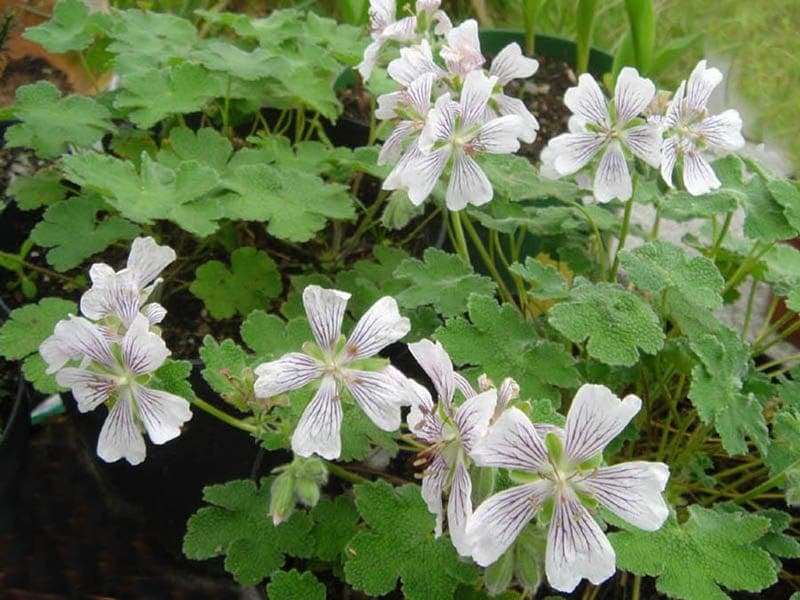
Ghislain118 http://www.fleurs-des-montagnes.net / CC BY-SA 3.0, via Wikimedia Commons
Geranium renardii: the velvet-leaved cranesbill
Geranium renardii
Want to see Geranium renardii: the velvet-leaved cranesbill in your garden?
Full design in HD: €7.99
Look after your Geranium renardii with the GardenWorld app
Identify plants with your camera and get a care calendar with reminders for this plant.


Overview
Geranium renardii is one of those perennials you first buy for its leaves and only later come to love for its flowers. This cranesbill comes from the Caucasus, where it grows on rocky slopes in stony, free-draining soil, and that tells you straight away what it wants in a garden: sun, good drainage and not too much feeding. It forms a low, dense mound of rounded, shallowly lobed leaves with a velvety, quilted texture and a soft sage to grey-green colour. From late spring into early summer, white to palest lilac flowers appear above the foliage, each one boldly pencilled with violet veins.
The plant stays small, usually 25 to 30 cm tall and 30 to 40 cm across, which makes it ideal for the front of a border, a rock garden, the edge of a patio or a gravel garden. It holds the RHS Award of Garden Merit, a good sign that it performs reliably in ordinary gardens. There are a few selections and hybrids too, such as 'Zetterlund', with a touch more lilac in the flower, and 'Philippe Vapelle', a cross with Geranium platypetalum that has blue-violet flowers above the same handsome foliage.
If you are unsure where such a compact foliage plant would look best, on gardenworld.app you can create a garden design that takes sun, soil and the existing shapes in your plot into account. As far as is known, Geranium renardii is not toxic to people or pets. Do not confuse it with the bedding or windowsill "geranium" (Pelargonium), which belongs to a different genus altogether.
Appearance and bloom cycle
The foliage is the main attraction. Each leaf is 5 to 10 cm wide, rounded to kidney-shaped, with five to seven shallow lobes and a scalloped edge. The surface is deeply veined and feels like soft suede. Through summer the leaves stay fresh, and in a mild autumn they sometimes turn a pale yellow or rusty tone before largely dying back for winter. In gentle winters part of the rosette remains.
Flowering usually runs from late May into July, peaking in June. The flowers are about 3 cm across, saucer-shaped, with five slightly notched petals. The base colour is white or very pale lilac, and fine dark purple veins run over every petal, giving the bloom a drawn, almost graphic look. Bees and hoverflies visit them readily. The display is not as lavish as that of some hybrid cranesbills, but the combination of white, violet and grey-green is wonderfully refined. After flowering, the beak-shaped seed heads that give the genus its common name appear.
Ideal location
Give Geranium renardii full sun or light, dappled shade. In full sun the mound stays compact and flowers most freely; in light shade it grows a little looser and flowers less, but the foliage still looks good. Avoid deep shade and spots under a dense tree canopy, where growth is slow and the plant becomes more prone to fungal problems.
Good places include the front of a south- or west-facing border, a rockery, a raised bed, a sunny bank or a gravel garden. It is also happy in a roomy, well-drained container on a terrace. Plant 30 to 35 cm apart if you want a continuous carpet; six to eight plants per square metre will knit together into dense ground cover after two seasons.
Soil requirements
This is a plant for lean, free-draining soil. Sandy soil, light loam and chalky ground all suit it. On heavy clay that stays wet in winter the rootstock can rot. In that case, work coarse grit, gravel or small lava stones into the top 20 to 30 cm, or plant on a slightly raised mound.
A neutral to slightly alkaline pH is ideal, although mildly acidic soil is tolerated. Feeding is rarely needed and can even be counterproductive: in rich soil the leaves grow larger and floppier, the mound falls open and the plant loses exactly the compact, velvety character that makes it special. A thin layer of compost at planting time is plenty.
Free preview
Want to see Geranium renardii: the velvet-leaved cranesbill in your garden? Make a free preview of your design.
Watering
After planting, water regularly for the first few weeks until the plant is visibly producing new leaves. From then on Geranium renardii is notably drought tolerant. In a typical British or Northern European summer, plants in open ground rarely need watering. Only during a long dry spell of several weeks, especially on sandy soil, give an occasional deep soak at the base of the plant.
It is better to water rarely and thoroughly than little and often. Wet roots in winter are far more dangerous than a dry summer. Containers dry out faster: check every few days in summer and let the top layer dry out between waterings. Make sure the pot has a good drainage hole.
Pruning
This cranesbill needs very little pruning. After flowering you can snip off the spent flower stems to keep the mound tidy; that is mostly a matter of appearance. If the foliage looks tired after a hot, dry spell, cut the plant back to a hand's width above the ground in July or August. It will quickly produce a fresh flush of leaves.
In autumn, simply leave the foliage in place, as it protects the crown. In early March, remove dead leaves just before new growth starts. Every four or five years, when the centre of the clump becomes bare, lift and divide the plant in spring. Replant the youngest pieces and keep them watered until they have rooted.
Maintenance calendar
March: Clear away dead foliage. A good time to plant new specimens or divide old clumps.
April: New rosettes emerge. Weed around young plants; a layer of gravel keeps the base dry and clean.
May: First flower buds. Water only in prolonged drought and for plants set out this year.
June: Peak flowering. Enjoy the veined flowers and watch the bees at work.
July: Remove spent flower stems. If the foliage is scorched or limp after a heatwave, cut back for a new crown of leaves.
August–September: A quiet period. Sow home-collected seed in a tray of gritty compost if you like.
October–November: Leave the foliage standing. Autumn planting is fine as long as the soil is not waterlogged.
December–February: Winter rest. Make sure water does not collect around the plants.
To keep track of these jobs month by month, the planting calendar on gardenworld.app reminds you what needs doing and when.
Winter hardiness
Geranium renardii is fully hardy. The RHS rates it H6, which corresponds to temperatures down to about -20 °C, and in practice it survives harder frosts in dry soil. Across the British Isles and the Low Countries it comes through winter without any protection.
As with many plants from dry mountain regions, cold is not the real threat; wet is. On clay that becomes saturated in winter the plant can slowly decline. Free-draining soil and a collar of gravel around the crown therefore matter far more than any winter cover. Move containers against a wall or under an overhang in winter so the compost does not become sodden.
Companion plants
The grey-green, velvety leaves of Geranium renardii suit other plants of sunny, dry places perfectly. Pair it with lamb's ears (Stachys byzantina) for a soft, silvery picture, or with blue fescue (Festuca glauca) for a crisp contrast between round leaves and fine grass blades. Bloody cranesbill (Geranium sanguineum) flowers for longer and adds magenta-pink to the edge, while renardii brings calm with its white.
For height behind the cranesbill, choose catmint (Nepeta × faassenii) or Balkan clary (Salvia nemorosa). Their violet-blue spikes echo the colour of the veins in the flowers. In a gravel garden it looks lovely among small alliums, thyme and sedums. Avoid large, spreading perennials that will smother it: this little cranesbill needs light and space.
Final thoughts
Geranium renardii is a modest but exceptionally elegant perennial. Its velvety foliage looks good all season, the veined flowers add a refined detail in June, and maintenance comes down to one trim a year. The conditions are simple: plenty of light, lean soil and no wet feet in winter.
If you have a sunny border, a rock garden or a gravel bed, this cranesbill from the Caucasus makes a dependable front-of-border plant that lasts for years. Plant a group of three or five along the edge of your patio and within a season you will see how the soft leaves take the edge off hard lines of paving and stone.
Frequently asked questions about Geranium renardii
Is Geranium renardii winter hardy?
Geranium renardii is fully hardy. The RHS rates it H6, which corresponds to temperatures down to about -20 °C, and in practice it survives harder frosts in dry soil.
When and how do you prune Geranium renardii?
This cranesbill needs very little pruning. After flowering you can snip off the spent flower stems to keep the mound tidy; that is mostly a matter of appearance.
How much water does Geranium renardii need?
After planting, water regularly for the first few weeks until the plant is visibly producing new leaves. From then on Geranium renardii is notably drought tolerant.
Where does Geranium renardii grow best?
Give Geranium renardii full sun or light, dappled shade. In full sun the mound stays compact and flowers most freely; in light shade it grows a little looser and flowers less, but the foliage still looks good.
What soil does Geranium renardii need?
This is a plant for lean, free-draining soil. Sandy soil, light loam and chalky ground all suit it.

See it in your garden
See Geranium renardii in your garden
One photo of your garden and a few questions. You see the result in about a minute.
Try it with a photoIdentify this plant in your own garden. Identify a plant
Similar plants
Bloody cranesbill: complete guide
Geranium sanguineum
Bloody cranesbill offers intense magenta-pink flowers and fall color. This hardy plant blooms tirelessly from May through October.
Lamb's-ear: complete guide
Stachys byzantina
Stachys byzantina, known as lamb's-ear or lamb's-tongue, is a hardy perennial from the mint family. This popular plant is especially valued for its soft, silvery-white hairy foliage and purple flowers.
Woodland sage: complete guide
Salvia nemorosa
Everything about Woodland Sage (Salvia nemorosa): planting, care, pruning and combinations. Expert tips for months of blue-violet flower spikes.
