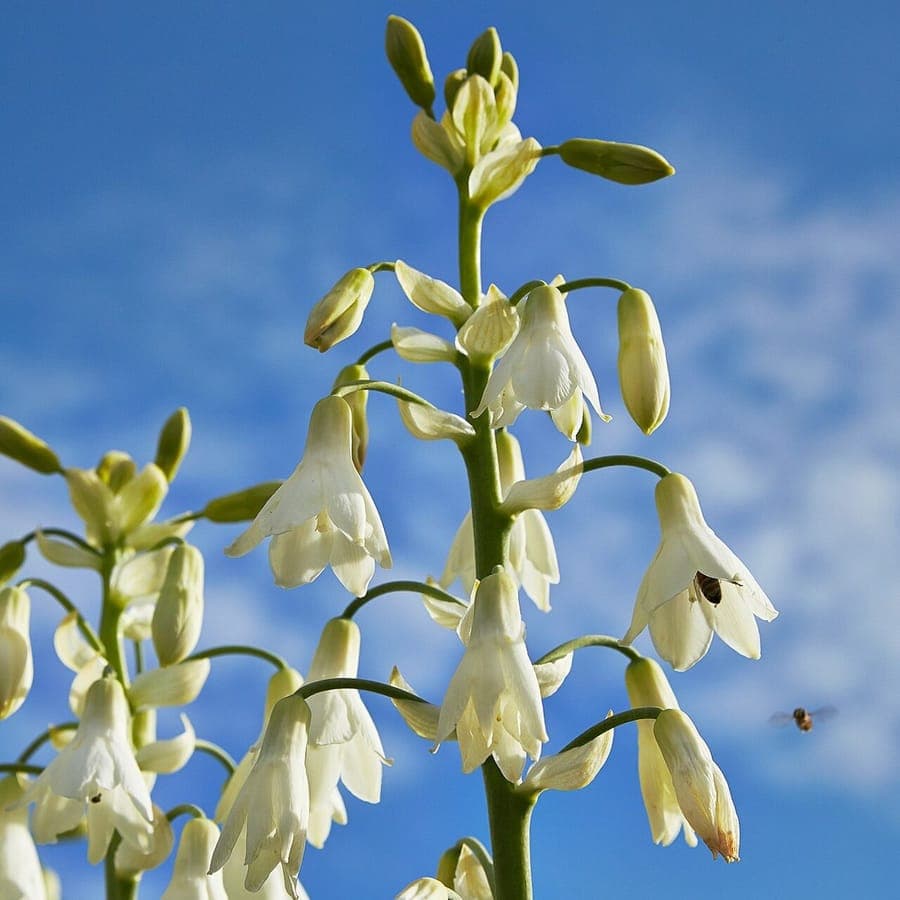
C T Johansson / CC BY 3.0, via Wikimedia Commons
Summer hyacinth (Galtonia candicans): planting, care and overwintering
Galtonia candicans
Want to see Summer hyacinth (Galtonia candicans): planting, care and overwintering in your garden?
Full design in HD: €7.99
Look after your Summer hyacinth with the GardenWorld app
Identify plants with your camera and get a care calendar with reminders for this plant.


Overview
The summer hyacinth (Galtonia candicans) is a stately bulb from South Africa that sends tall stems hung with white bells above the border in late summer. Just when many perennials start to look tired in August, this plant brings freshness and light. The flowers have a soft scent and draw in bees and bumblebees, as the photo shows.
Botanists now place the plant in the genus Ornithogalum, as Ornithogalum candicans. In garden centres and bulb catalogues, however, you will almost always find it sold as Galtonia candicans, and that is the name used here. It belongs to the Asparagaceae. In the wild it grows in damp grassland in the Drakensberg and eastern South Africa, where rain falls in summer and winters are cold and dry. As a result it tolerates more cold than many other South African bulbs. It is sometimes also called Cape hyacinth.
A mature plant reaches 80 to 120 cm in height and spreads only 20 to 30 cm. Because it takes up so little room, it slots easily between existing perennials. If you are unsure where it would fit best, you can have a garden design made on gardenworld.app that looks at the whole border.
A word of caution: related plants in the genus Ornithogalum are poisonous. Treat the bulb of the summer hyacinth as toxic to people and animals too, never eat it, and wear gloves if you have sensitive skin.
Appearance and flowering season
The leaves are grey-green, narrowly strap-shaped, slightly fleshy and 50 to 90 cm long. They grow upright at first and later arch gracefully. In July a sturdy, leafless flower stem rises from the centre.
Flowering runs from late July into September. Each stem carries twenty to thirty bell-shaped flowers 3 to 4 cm long, hanging from short curved stalks. They are pure white with a greenish base and open from the bottom upwards, so the display lasts for weeks. The scent is light and sweet and most noticeable on warm evenings.
After flowering, upright seed capsules form, packed with flat black seeds. Leave them in place and the plant will occasionally self-sow in a spot it likes. As a cut flower, the summer hyacinth is surprisingly elegant and long-lasting.
Garden centres sometimes also offer the related Galtonia viridiflora (now Ornithogalum viridiflorum), with pale green flowers and a slightly shorter habit. It is less hardy and better suited to pots. For a reliable white late-summer bulb in open ground, Galtonia candicans remains the better choice.
Ideal position
Plant the summer hyacinth in full sun or light shade. In shade the stems turn weak and flowering is sparse. An open spot with some shelter from strong wind is ideal, because the tall stems can be knocked over in a summer storm.
Thanks to its slender shape it works beautifully in the middle or towards the back of a border, among plants that will later hide the yellowing leaves at its base. It also does well in large containers, provided it gets enough water there. Always plant in groups of five to nine bulbs: a single stem gets lost, whereas a group gives a crisp white accent.
Soil requirements
The summer hyacinth wants fertile, humus-rich soil that stays moist in summer. Drought during the growing season results in short stems and few flowers. In winter, on the other hand, the soil must drain well, because cold, wet ground makes the bulb rot.
A loamy soil enriched with garden compost is ideal. On heavy clay, work coarse grit and compost into the top 30 cm. On poor, sandy soil, add plenty of compost or well-rotted manure to help hold moisture. Slightly acidic to slightly alkaline soil is fine.
Free preview
Want to see Summer hyacinth (Galtonia candicans): planting, care and overwintering in your garden? Make a free preview of your design.
Planting the bulbs
Plant the bulbs in March or April, once the ground is no longer frozen or waterlogged. Set them 12 to 15 cm deep, measured to the tip of the bulb, pointed end up, and 20 to 30 cm apart. The bulbs are fairly large, 5 to 8 cm across, and should feel firm: throw away any that are soft or mouldy.
In a container, plant three to five bulbs in a pot at least 30 cm wide and 30 cm deep, with a good drainage layer. Water once after planting and then keep the compost just moist. The leaves usually appear in May.
Watering
From May to the end of August the summer hyacinth needs regular water. In dry weather, give a thorough soak once or twice a week so the water reaches deep into the soil. Check plants in pots daily. A mulch of compost or leaf mould keeps the soil cool and moist.
Feed in May and June with an organic fertiliser, or every two weeks with a liquid feed. Stop watering from late September. The plant then dies back and needs its rest.
Pruning and tidying
Cut off the spent stems if you do not want seed, or leave them for the attractive seed heads and the chance of a few seedlings. Leave the leaves until they yellow naturally so the bulb can build up reserves for the following year, then remove them.
Slugs and snails love the young foliage in spring, so check particularly in the evening and after rain. Clumps that become congested after four or five years can be lifted and divided in spring.
Maintenance calendar
March and April: Plant the bulbs, preparing the soil with compost.
May: Leaves appear. Watch for slugs and snails and give a first feed.
June: Water regularly and apply a mulch.
July to September: Flowering. Support tall stems in windy spots.
October: Let the foliage die back, then clear it. Stop watering.
November to February: Dormancy. Cover bulbs in the ground or store lifted bulbs dry.
Winter hardiness
The RHS rates Galtonia candicans H4, which corresponds to roughly -5 to -10 °C. In practice, in free-draining soil with a winter mulch, the bulb survives without trouble in most gardens in Britain and the Low Countries, helped by the fact that it is fully dormant in winter. Hard frost on wet, heavy ground is the real risk.
Overwintering
Cover bulbs left in the ground with 10 cm of leaf mould, straw or bark in November. On wet or heavy soil, lift them once the foliage has died down. Let them dry, remove the old leaves and store them in a box of dry peat-free compost or wood shavings in a cool, frost-free place. Check them during the winter and throw out any that have started to rot.
Move containers somewhere dry and frost-free in October, such as a garage or shed. In March, start watering again and bring them back into the light.
Companion plants
The white silhouette of the summer hyacinth stands out beautifully against blue and purple. African lily (Agapanthus africanus), Russian sage (Perovskia atriplicifolia) and globe thistle (Echinops ritro) make a classic late-summer combination. The airy purple heads of Verbena bonariensis drift lightly around it.
For a calm white border, pair it with white garden phlox (Phlox paniculata) and silver foliage. Low perennials at its feet hide the leaves that yellow at the end of summer. Think of hardy geraniums, catmint or low ornamental grasses, which also keep the soil cool and shaded.
Final thoughts
The summer hyacinth is an easy-going bulb that lights up the border in August with its white bells. Give it sun, moist soil in summer and a dry winter, and it will return year after year.
To find out when to plant, feed or lift the bulbs, have a look at the planting calendar on gardenworld.app. That way you can enjoy Galtonia candicans in your garden for many years.
Frequently asked questions about Summer hyacinth
Is Summer hyacinth winter hardy?
The RHS rates Galtonia candicans H4, which corresponds to roughly -5 to -10 °C. In practice, in free-draining soil with a winter mulch, the bulb survives without trouble in most gardens in Britain and the Low Countries, helped by the fact that it is fully dormant in winter.
When and how do you prune Summer hyacinth?
Cut off the spent stems if you do not want seed, or leave them for the attractive seed heads and the chance of a few seedlings. Leave the leaves until they yellow naturally so the bulb can build up reserves for the following year, then remove them.
How much water does Summer hyacinth need?
From May to the end of August the summer hyacinth needs regular water. In dry weather, give a thorough soak once or twice a week so the water reaches deep into the soil.
What soil does Summer hyacinth need?
The summer hyacinth wants fertile, humus-rich soil that stays moist in summer. Drought during the growing season results in short stems and few flowers.

See it in your garden
See Summer hyacinth in your garden
One photo of your garden and a few questions. You see the result in about a minute.
Try it with a photoIdentify this plant in your own garden. Identify a plant
Similar plants
Lily-of-the-Nile: complete guide
Agapanthus africanus
Everything you need to grow Agapanthus africanus: ideal conditions, watering, winter care, and companion planting for UK and US gardens.
Perovskia atriplicifolia: complete guide
Perovskia atriplicifolia
Russian sage is a semi-shrub with purple-blue flowers and grey-green foliage that blooms from July to October. Perfect for dry gardens and landscape design.
Globe thistle: complete guide
Echinops ritro
Everything about globe thistle (Echinops ritro): cultivation, flowers, bees and drought tolerance. Tips for this classic perennial in mixed borders.
