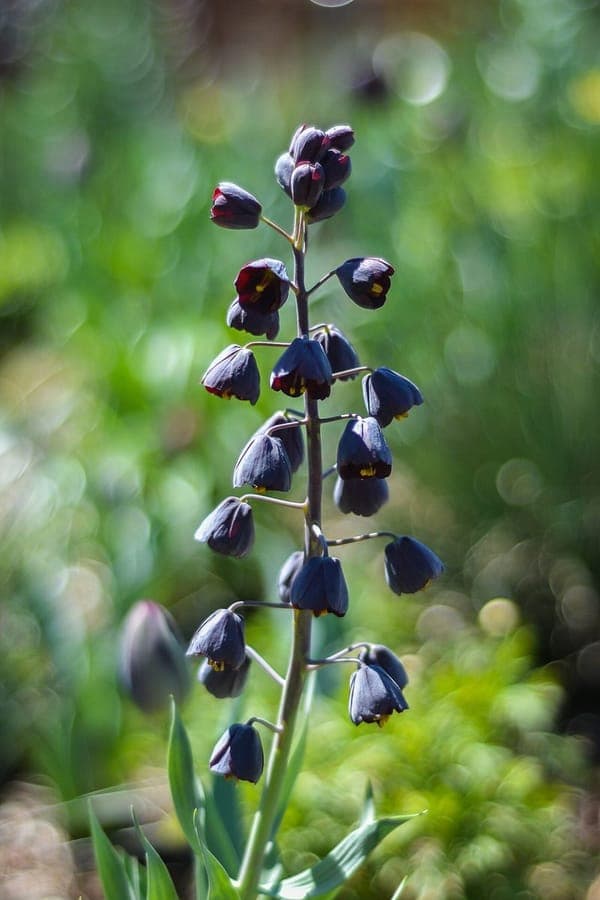
Hari Krishnan / CC BY-SA 4.0, via Wikimedia Commons
Persian lily (Fritillaria persica): planting and care
Fritillaria persica
Want to see Persian lily (Fritillaria persica): planting and care in your garden?
Full design in HD: €7.99
Look after your Persian lily with the GardenWorld app
Identify plants with your camera and get a care calendar with reminders for this plant.


Overview
Fritillaria persica, the Persian lily, is a bulb that raises a sturdy stem hung with dark purple bells above the spring border in April. It is a relative of the crown imperial and the snake's head fritillary, but it has a character all of its own: no bright colours or chequered pattern, just a restrained, almost black beauty that stands out at once among tulips and daffodils.
The species belongs to the lily family (Liliaceae) and comes from sunny, stony slopes in southern Turkey, Iran, Iraq and the Levant. The name persica refers to Persia. In that region winters are cool and wet and summers are hot and bone dry, so the bulb grows in autumn and spring, flowers in spring and rests through the summer in warm, dry soil.
A flowering plant reaches 60 to 100 cm in height and 20 to 30 cm across. The most widely sold selection is 'Adiyaman', which grows more strongly and flowers more reliably than many wild forms and holds the RHS Award of Garden Merit. There is also 'Ivory Bells', with creamy white to greenish bells. If you would like to see where this striking bulb fits best among your other spring flowers, you can have a garden design made on gardenworld.app.
An important point first: every part of Fritillaria persica is poisonous, the bulb most of all. It contains bitter alkaloids that can cause nausea, vomiting and heart rhythm problems if swallowed, in people and in pets. Plant the bulbs out of reach of small children and dogs that like to dig, and wear gloves when handling them.
Appearance and flowering season
In March the stems push through, densely clothed in lance-shaped, blue-grey leaves 8 to 15 cm long. They are arranged spirally around the stem and often slightly twisted, which gives the plant a sculptural look well before it flowers.
From mid-April to mid-May a long raceme of twenty to thirty or more nodding bells, each 1.5 to 2 cm long, appears at the top. They are deep plum to aubergine and covered with a fine grey bloom, so that in some lights they look almost blue. Look underneath a bell and you will see a yellow to greenish interior with nectaries, clearly visible in the photo. The flowers open from the bottom upwards, so the raceme is always a mix of buds and open bells.
Bumblebees and early bees visit the flowers. Flowering lasts about three weeks, after which upright, six-sided seed capsules develop.
Ideal position
Full sun is essential. Choose a spot that gets at least six hours of sun a day and warms up in summer, such as a south-facing border, the edge of a gravel garden or a strip in front of a wall. In a cool, shady spot the bulb may flower in its first year but afterwards often produces only leaves.
Because the plant dies down after flowering and leaves a bare patch, place it among perennials that fill the space from June onwards without casting heavy shade over the bulb. Shelter from strong wind helps too, as the tall raceme can snap in a spring gale.
Soil requirements
Fritillaria persica needs well-drained, rather dry soil. Sandy or stony ground is ideal. In heavy, wet clay the large, fleshy bulb soon rots, especially during its summer rest. On such soil, mix a generous spadeful of coarse sand or fine gravel into each planting hole, or grow it in a raised bed or a large container.
Neutral to alkaline soil is fine. The bulb is only moderately hungry. Avoid fresh manure; a handful of bonemeal or an organic bulb fertiliser at planting time is enough.
Planting the bulbs
Plant in September or October, as soon as possible after buying. Fritillary bulbs have no protective tunic and dry out more quickly than tulip bulbs. Leave any soft or shrivelled bulb in the shop.
Dig a hole 15 to 20 cm deep, about three times the height of the bulb. Put a 3 to 5 cm layer of coarse sand or grit in the bottom, set the bulb on it with the tip upwards and backfill with soil. On heavy ground some gardeners tilt the bulb slightly on its side so that no water sits on top of it. Space the bulbs 25 to 30 cm apart and plant them in groups of three to five for a fuller display.
Free preview
Want to see Persian lily (Fritillaria persica): planting and care in your garden? Make a free preview of your design.
Watering
In open ground you rarely need to water. Autumn and winter rain is enough. In an exceptionally dry spring you can give a can of water now and then in April, while the plant is growing and flowering.
After flowering, cut back on water, and stop completely once the leaves start to yellow. Bulbs in pots get moderate watering from October to May and are kept dry under cover in summer.
After flowering
Cut off the faded raceme unless you want seed, so the bulb does not put its energy into seed production. Leave the leaves and stem until they are completely yellow and withered. During those weeks the plant replenishes its bulb for next year's flowers. Remove the foliage too early and you will get a small plant with no flowers the following year.
From April onwards keep an eye out for lily beetles: these bright red beetles and their dung-covered larvae strip fritillaries as readily as lilies. Pick them off, ideally in the morning.
Dormancy
From June to September the bulb is dormant. This is where Fritillaria persica differs most from an ordinary garden bulb: it really wants a warm, dry summer. In a border watered every day, or in wet soil, the bulb rots or stops flowering.
If you have no suitably dry spot, you can lift the bulbs once the foliage has died down, store them somewhere airy, dry and warm in barely damp vermiculite or dry sand, and replant them in September. Bulbs in pots can simply stay dry under cover or in a greenhouse over summer. A plant that grows well forms small offsets after a few years. You can detach these while it is dormant and grow them on separately; they flower after two to three years.
Maintenance calendar
January to February: resting underground. Keep leaves and wet mulch off the planting spot.
March: shoots appear. Protect them with fleece during hard night frost and watch out for slugs.
April to May: flowering. Check for lily beetles and water during prolonged drought.
May to June: cut off the spent raceme and let the leaves die down naturally.
June to August: dormancy. No watering, and lift bulbs from wet ground if needed.
September to October: plant new bulbs or replant stored ones. Add the planting time and the lily beetle checks to your plant calendar on gardenworld.app, so you remember both.
November to December: resting. In cold, wet spots a layer of dry leaves or conifer branches can help.
Winter hardiness
The RHS rates Fritillaria persica H4, which means hardy to about -10 °C. In well-drained, dry soil the deeply planted bulb often survives harder winters in practice. The greatest danger is not cold itself but cold combined with wet soil. The young shoots can be damaged by a late, hard frost in March; a layer of fleece on cold nights is enough.
Companion plants
The dark bells need a light background to stand out. The lime-green flowers and foliage of spurges such as Euphorbia characias or the low Euphorbia myrsinites make a classic, striking pairing. Species tulips such as Tulipa clusiana, with their red and white flowers, also look lovely alongside.
Later in the season ornamental onions such as Allium hollandicum take over, with purple globes that echo the colour of the fritillary. A large grass such as Stipa gigantea fills the gap in summer and keeps the soil warm and airy without casting too much shade.
Final thoughts
Fritillaria persica is a bulb for anyone who wants something different from the familiar spring colours. Plant early in autumn, deep and on a bed of grit, in a sunny spot that stays dry in summer. Let the foliage die down quietly after flowering and keep an eye out for lily beetles. Remember that the bulb is poisonous. Follow these rules and every spring you will have a raceme of dark purple bells that look nearly black in shade and velvety plum in the sun.
Frequently asked questions about Persian lily
Is Persian lily winter hardy?
The RHS rates Fritillaria persica H4, which means hardy to about -10 °C. In well-drained, dry soil the deeply planted bulb often survives harder winters in practice.
How much water does Persian lily need?
In open ground you rarely need to water. Autumn and winter rain is enough.
What soil does Persian lily need?
Fritillaria persica needs well-drained, rather dry soil. Sandy or stony ground is ideal.

See it in your garden
See Persian lily in your garden
One photo of your garden and a few questions. You see the result in about a minute.
Try it with a photoIdentify this plant in your own garden. Identify a plant
Similar plants
Mediterranean spurge: complete guide
Euphorbia characias
Everything you need to know about Euphorbia characias: care, blooming cycle, ideal placement, and companion plants for dry gardens.
Lady tulip: complete guide
Tulipa clusiana
Everything you need to know about Tulipa clusiana: bloom time, sunlight needs, soil, care. Ideal for rock gardens and borders. Design ideas on gardenworld.app.
Persian onion: complete guide
Allium hollandicum
Persian onion (Allium hollandicum) blooms with striking purple spherical flower heads. Learn how to grow this spectacular bulb plant and enjoy its dramatic spring display.
