
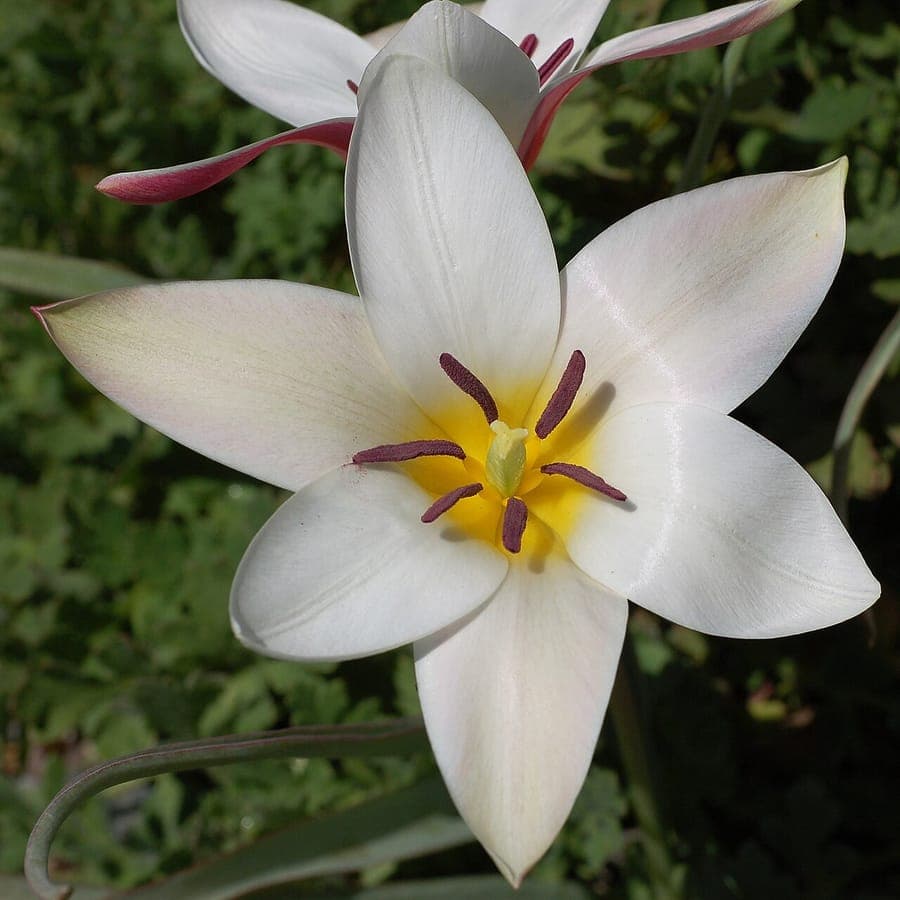
Photo by and (c)2007 Derek Ramsey (Ram-Man). Location credit to the Chanticleer Garden. / CC BY-SA 3.0, via Wikimedia Commons
Lady tulip: complete guide
Tulipa clusiana
Want to see Lady tulip: complete guide in your garden?
1 minute, no credit card
Overview
Tulipa clusiana, commonly known as the Lady tulip, stands apart from flashy hybrid tulips with its graceful, understated beauty. Native to mountainous regions of Afghanistan, Iran, Iraq, Pakistan, and the West Himalaya, this perennial bulb thrives in well-drained soils and full sun. It's a natural fit for rock gardens, gravel beds, and dry borders where its resilience and charm can shine. Part of the Liliaceae family, it grows as a herbaceous forb and reliably returns each spring when planted in suitable conditions.
Gardeners in USDA zones 5 to 8 will find this tulip particularly reliable. Unlike many tulips that act as annuals, Tulipa clusiana naturalizes well, spreading gently over the years through seed and bulb offsets. It's a low-maintenance choice for those who value long-term performance over instant spectacle.
On gardenworld.app, you can generate a custom planting plan that considers sunlight, spacing, and companion plants for Tulipa clusiana.
Appearance & bloom cycle
Blooms appear from March through May, depending on your climate. The flowers are cup-shaped, reaching about 4–5 cm in diameter, with pure white inner petals and striking reddish-purple outer tepals. This contrast gives them a delicate, almost lantern-like glow in morning light. Each stem produces a single flower atop a slender 25–35 cm tall stalk.
The narrow, glaucous-green leaves emerge with the flower buds and remain until the plant dies back in early summer. After flowering, let the foliage yellow naturally - cutting it too early weakens the bulb. Full dieback usually occurs by late June.
Ideal location
This tulip needs full sun - aim for level 7 to 10 on the light scale. A south- or southeast-facing slope, rock wall, or raised bed works best. Avoid shady spots under trees or near buildings, as poor light leads to weak stems and reduced flowering. Good air circulation helps prevent fungal issues, so don't overcrowd.
Plant bulbs in autumn, from September to November, at a depth of 10–15 cm and spaced 10 cm apart. Well-chosen garden centres often stock them in late summer, but order early as supplies are limited.
Use gardenworld.app to create a seasonal calendar tailored to your local frost dates and soil type.
Soil requirements
Tulipa clusiana demands sharply drained soil with a pH of 7.0 to 7.5. Heavy clay or water-retentive loam will rot the bulbs. Improve poor soil by mixing in horticultural grit, coarse sand, or pumice. A lean mix of garden soil, compost, and sharp drainage material works best. Avoid rich, manure-heavy soils - they promote lush foliage but fewer flowers.
Raised beds or alpine troughs are ideal in wetter climates. In containers, use a gritty bulb mix and ensure drainage holes are unblocked.
Free design
Want to see Lady tulip: complete guide in your garden? Make a free design now.
Watering
This species is drought tolerant once established. Water only during prolonged dry spells in late winter or early spring. After flowering, reduce watering as the plant enters dormancy. In summer, keep bulbs completely dry - moist soil during dormancy is the leading cause of rot.
If irrigating, use a drip method to avoid wetting the foliage. Morning watering allows leaves to dry before nightfall.
Pruning
No pruning is required. Do not cut back foliage until it has fully yellowed and withered, usually by late June. Removing leaves too soon reduces bulb vigour and future blooming. Deadheading is optional - if you want to collect seeds, leave the spent flowers. However, seed propagation is slow and may take 5–7 years to produce blooms.
Maintenance calendar
- September: Start planting bulbs
- October–November: Complete planting
- February–March: Watch for emerging shoots; protect from slugs
- March–May: Flowering period; minimal watering
- June: Foliage dies back; stop watering
- July–August: Dormant period; leave bulbs in ground
Winter hardiness
Hardy in USDA zones 5–8. In zone 5, a light mulch of straw or gravel can help in wet winters. In zones 6–8, bulbs can overwinter in the ground without protection, provided drainage is excellent. No need to lift bulbs unless your garden suffers from waterlogged soil in summer.
Companion plants
Pair Tulipa clusiana with early alliums like Allium karataviense, dwarf narcissus such as 'Tête-à-Tête', or creeping thyme (Thymus serpyllum). Low-growing euphorbias like Euphorbia myrsinites provide structural contrast. For a naturalistic look, mix with sedums, sempervivums, or Stipa tenuissima.
Avoid aggressive spreaders like mint or goutweed that can crowd out bulbs. Garden centres often group compatible plants in spring displays - look for drought-tolerant combos.
Closing
Tulipa clusiana isn't the tulip for a formal parterre, but it's perfect for gardeners who appreciate quiet beauty and long-term resilience. It asks for little and gives back with reliable spring colour, graceful form, and a naturalizing habit that improves over time. Once settled, it can thrive for decades with minimal care.
For planting inspiration and garden layouts, visit gardenworld.app and design a space where Tulipa clusiana can truly flourish.
Want to see Lady tulip: complete guide in your garden? Make a free design now.
Upload a photo, pick a style, and get a photorealistic design with plant list in under a minute.
No credit card required


Similar plants
Reverchon's gagea: complete guide
Gagea reverchonii
Full guide to Gagea reverchonii, Reverchon's gagea: rare Pyrenean bulb with bright yellow spring flowers, soil needs and companion planting.
Leafy gagea: complete guide
Gagea foliosa
Gagea foliosa is a rare Mediterranean bulb with bright yellow star-shaped flowers blooming February to March in well-drained rocky settings.
Tubular gagea: complete guide
Gagea fragifera
Gagea fragifera is a mountain bulb with golden-yellow star flowers blooming May to July on subalpine slopes from Europe to the Himalaya.