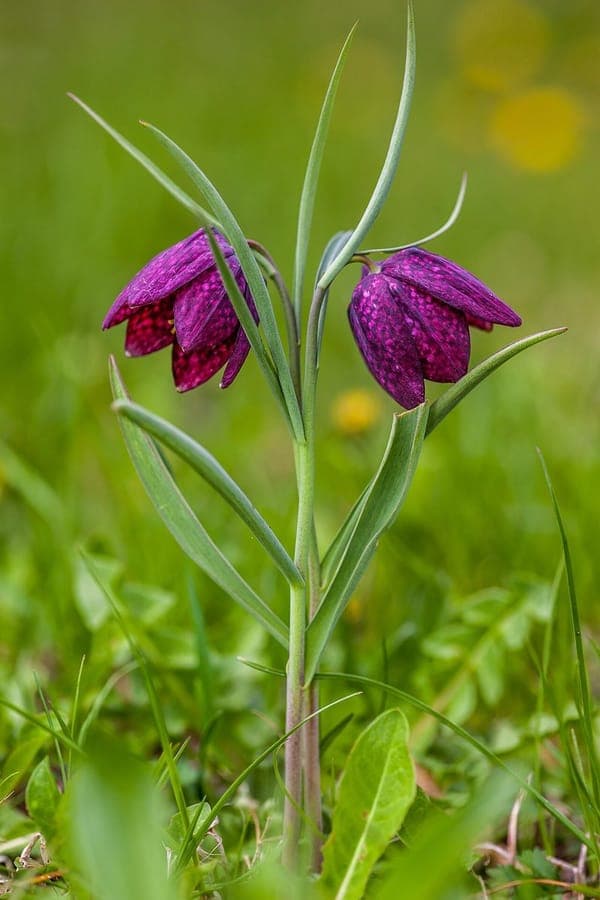
Michael Apel / CC BY 3.0, via Wikimedia Commons
Snake's head fritillary: complete guide
Fritillaria meleagris
Want to see Snake's head fritillary: complete guide in your garden?
Full design in HD: €7.99
Look after your Snake's head fritillary with the GardenWorld app
Identify plants with your camera and get a care calendar with reminders for this plant.


Overview
Snake's head fritillary (Fritillaria meleagris) is one of the most remarkable spring bulbs. In April a slender stem 20 to 40 cm tall carries a nodding bell patterned in squares of purple and paler pink, as if someone had drawn a chessboard on it. No other garden plant has markings quite like it. The name meleagris refers to the guinea fowl, whose feathers have a similar speckled pattern.
In the wild, snake's head fritillary grows in damp hay meadows and river floodplains from Western Europe to Russia. Drainage and fertilising of grassland have destroyed many of these sites, and in several European countries the wild plant is now rare and legally protected. Never dig up plants or bulbs from the wild. The bulbs you find in garden centres and bulb catalogues each autumn are nursery-grown, and with this garden form you can recreate a little piece of riverside meadow at home.
On gardenworld.app you can create a garden design with a flowery lawn or a damp corner where fritillaries will feel at home. Besides the purple form there is a white one, often sold as 'Alba', with creamy bells and faint green chequering. Mixed packs give a playful blend of purple and white.
Appearance and bloom cycle
In March, narrow grey-green leaves appear along a thin stem. In late March or April a single nodding bell opens at the top, occasionally two. The bell is 3 to 4 cm long and made up of six tepals with a chequered pattern in purple, plum and pale pink. On the white form the pattern is barely visible. Inside are nectaries that attract bumblebees and early bees.
Flowering lasts about three to four weeks, from early April to early May depending on the weather. Afterwards the stem straightens and an upright seed capsule forms. In June the plant dies back above ground and the bulb rests until the following spring.
Where it is happy, snake's head fritillary self-seeds. Seedlings take three to four years to flower, but over time a natural, loose colony develops and keeps growing.
Ideal location
Choose a spot in sun or light shade where the soil stays moist in spring. A lawn beside a pond, a low-lying damp corner of the garden or a border with humus-rich soil are all ideal. The plant does not mind brief winter flooding, as long as the water drains away in spring.
Fritillaries look their best naturalised in grass that is not too dense or heavily fed. Plant them in loose groups rather than straight lines, so they look as though they have always been there. In a border they suit the front, among low perennials. They can also be grown in pots, provided the compost never dries out.
Soil requirements
Snake's head fritillary likes moist, humus-rich soil that does not dry out completely in summer. Light clay, loam and moisture-retentive sandy soil with plenty of organic matter are ideal. A neutral to slightly acidic pH suits it, but it also tolerates some lime.
The bulbs are small, 1 to 2 cm, and have no protective tunic, so they dry out quickly. Buy them as fresh as possible and plant them straight away, in September or October. Set them 8 to 10 cm deep and 10 cm apart. In grass, make a hole with a narrow trowel or bulb planter, drop in the bulb and firm the turf back down.
Improve dry sandy soil with compost or leaf mould. Heavy, wet clay that bakes hard in summer can be opened up with compost. Fertiliser is unnecessary in grass; too much feeding makes the grass so vigorous that it smothers the bulbs.
Free preview
Want to see Snake's head fritillary: complete guide in your garden? Make a free preview of your design.
Watering
Water matters more to this fritillary than to most spring bulbs. Water well after planting, and in a dry spring water regularly during growth and flowering so the soil stays moist.
In summer the bulb rests. It does not need to be wet, but it should not dry out completely either. In an ordinary garden with normal summer rain this takes care of itself. Move pots to a shady spot in summer and give them a little water now and then so the compost never turns bone dry.
Pruning
No pruning is needed. What matters most is letting the foliage die back. Mow fritillaries in grass only in late June or early July, once the seed capsules are ripe and open. That way the plant can self-seed and the bulb can rebuild its reserves. Mow in May and the colony will dwindle within a few years.
In a border, cut the stems once they are yellow and dry. Wear gloves when you do. Like most fritillaries, Fritillaria meleagris contains toxic alkaloids, especially in the bulb. Eating it can cause vomiting and other symptoms in people and in pets such as dogs and cats. Keep children and pets away from the bulbs at planting time.
Maintenance calendar
September–October: Plant fresh bulbs 8 to 10 cm deep in loose groups. Water in well.
November–February: Dormant. Do not let pots under cover dry out completely.
March: Leaves appear. Check for lily beetles, bright red beetles that also attack fritillaries, and pick them off by hand.
April–early May: Flowering. Water during dry spells.
June: The foliage yellows and the seed capsules ripen. Leave the grass uncut.
Late June–July: Mow once the capsules have opened. Clear dry stems from borders.
August: To enlarge a colony, collect ripe seed and sow it straight away in a tray of moist seed compost.
Winter hardiness
Fritillaria meleagris is extremely hardy and tolerates frost down to -25 °C and below. It needs no protection in the ground anywhere in Britain or the Low Countries. As a plant of river meadows it is used to cold, wet winters, which makes it one of the few bulbs that cope well with damp winter soil.
A late frost during flowering rarely damages the bells. Bulbs in pots are a little more vulnerable; in a severe winter, move them to a sheltered spot against a wall.
Companion plants
Snake's head fritillary is perfect for a natural spring meadow. Wild daffodil (Narcissus pseudonarcissus) flowers slightly earlier and provides a yellow lead-in. Cowslip (Primula veris) and summer snowflake (Leucojum aestivum) enjoy the same moist conditions. Summer snowflake flowers in late April and May with white, green-tipped bells.
To follow on in May, camassia (Camassia quamash) is ideal: its blue spikes take over just as the fritillaries finish, and it too likes moist ground. Along the edge of a pond, water forget-me-not (Myosotis scorpioides) and low sedges sit nicely alongside the fritillaries.
In a border, lady's mantle, lungwort and small ferns make good neighbours, filling the space when the fritillary disappears underground in June.
Final thoughts
Snake's head fritillary is a plant with a story: a rare wildflower of river meadows that you can grow at home from nursery-raised bulbs. Give it a moist, humus-rich spot, plant the bulbs fresh and promptly, and only mow the grass once the seed capsules have opened. A small group will then spread within a few years into a chequered carpet.
Always use bulbs from the trade and leave wild sites undisturbed. Want to know when to plant or mow? The plant calendar on gardenworld.app shows each month what to do for your bulbs and your meadow. Plant a handful of fritillaries in a damp corner this autumn and watch the chequered bells rise above the grass next spring.
Frequently asked questions about Snake's head fritillary
Is Snake's head fritillary winter hardy?
Fritillaria meleagris is extremely hardy and tolerates frost down to -25 °C and below. It needs no protection in the ground anywhere in Britain or the Low Countries.
When and how do you prune Snake's head fritillary?
No pruning is needed. What matters most is letting the foliage die back.
How much water does Snake's head fritillary need?
Water matters more to this fritillary than to most spring bulbs. Water well after planting, and in a dry spring water regularly during growth and flowering so the soil stays moist.
Where does Snake's head fritillary grow best?
Choose a spot in sun or light shade where the soil stays moist in spring. A lawn beside a pond, a low-lying damp corner of the garden or a border with humus-rich soil are all ideal.
What soil does Snake's head fritillary need?
Snake's head fritillary likes moist, humus-rich soil that does not dry out completely in summer. Light clay, loam and moisture-retentive sandy soil with plenty of organic matter are ideal.

See it in your garden
See Snake's head fritillary in your garden
One photo of your garden and a few questions. You see the result in about a minute.
Try it with a photoIdentify this plant in your own garden. Identify a plant
Similar plants
Daffodil: complete guide
Narcissus pseudonarcissus
Everything about the daffodil (Narcissus pseudonarcissus): planting, care, naturalising and the best cultivars. Practical tips for a radiant spring garden.
Camash (Camassia quamash): complete guide
Camassia quamash
Camassia quamash delivers stunning blue star-flower clusters in May-June. This North American bulb thrives effortlessly in moist soil. Ideal for borders, meadows, and wet corners.
Summer snowflake: complete guide
Leucojum aestivum
Summer snowflake (Leucojum aestivum) is an elegant spring bulb with refined white flowers tipped in green. Discover planting, care, and ideal garden combinations.
