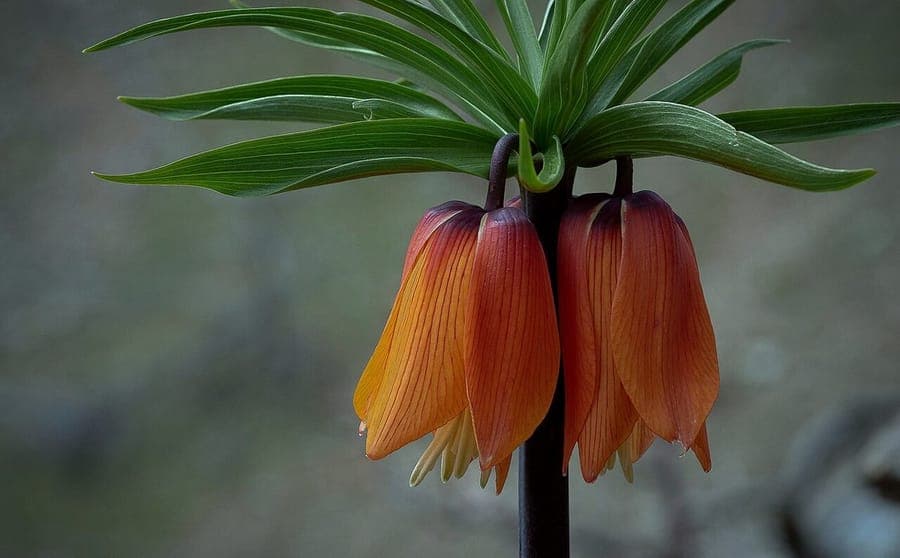
Engin Tavlı / CC BY-SA 4.0, via Wikimedia Commons
Crown imperial: complete guide
Fritillaria imperialis
Want to see Crown imperial: complete guide in your garden?
Full design in HD: €7.99
Look after your Crown imperial with the GardenWorld app
Identify plants with your camera and get a care calendar with reminders for this plant.


Overview
Crown imperial (Fritillaria imperialis) is one of the boldest spring bulbs you can grow. While crocuses and grape hyacinths stay close to the ground, this plant shoots up in a matter of weeks in early spring to a height of 80 to 120 cm. At the top of its sturdy stem hangs a ring of large, bell-shaped flowers in orange, red or yellow, crowned by a topknot of green leaves. The whole effect resembles a crown, which is where the common name comes from.
The species grows wild in the mountains of south-eastern Turkey, Iran and Iraq, and further east into Afghanistan and the western Himalaya. There it lives on stony slopes with cold winters and hot, dry summers. It reached Western Europe in the late sixteenth century and soon became a favourite subject of Dutch and Flemish flower painters.
On gardenworld.app you can create a garden design that gives crown imperial the right spot: towards the back of a sunny border, among perennials that will later hide its fading foliage. Well-known cultivars include 'Rubra Maxima' (deep orange-red and particularly robust), 'Maxima Lutea' (clear lemon yellow), 'Aurora' (warm orange), 'Sulpureum' (soft yellow) and 'Striped Beauty' (pale yellow with fine orange veining). The plant is at its best from early April to mid-May.
Appearance and bloom cycle
In March, thick, glossy shoots push through the soil. The stem is round and stout, often flushed purplish brown. Along its lower half sit whorls of glossy green, lance-shaped leaves. At the top, in late April, three to eight drooping flowers appear, each 5 to 6 cm long. They are bell-shaped and veined, and if you tip one up you will see a bright drop of nectar at the base of each tepal. These drops cling on even in a breeze, and folklore calls them the tears of the crown imperial.
Above the flowers stands a tuft of ten to twenty short, upright leaves. That topknot makes the plant unmistakable. After flowering, upright six-sided seed capsules develop. Around mid-June the foliage yellows and the whole plant dies back above ground. From then on the bulb rests until the following spring.
One trait not everyone expects: the bulb and the young stems have a strong musky smell that many people compare to a fox. This scent lies behind the old belief that crown imperials keep voles and moles out of the garden. There is no firm evidence for that, although rabbits generally leave the plant alone.
Ideal location
Give crown imperial a spot in full sun or light shade. The more sun the bulb receives in summer, the better it forms next year's flower. In its native habitat the bulb bakes in dry, warm soil after flowering, and a position against a south-facing wall or on a gently sloping, free-draining border comes closest to that.
Choose a sheltered place, because the tall stems can snap in a strong spring gale. Plant them at the back of a border or between shrubs that leaf up later in the season. That way the flowers stand out in April and the dying leaves vanish behind fresh perennial growth in June. Allow 25 to 30 cm between bulbs; groups of three or five look best.
Soil requirements
Crown imperial wants fertile but above all well-drained soil. The bulb is large, up to 10 cm across, and has a hollow in the centre where the old flower stem sat. Water easily collects in that hollow, and the bulb then rots. For that reason it is best planted slightly tilted so that rain runs off, on a layer of coarse sand or fine gravel at the bottom of the hole.
Plant the bulb about 20 cm deep, measured to its base. That may sound deep, but deeply planted bulbs stand firmer and flower for longer. A neutral to slightly alkaline soil with a pH between 6.5 and 7.5 is ideal. Improve heavy clay with compost and grit. On poor sandy soil, work some well-rotted compost into the top layer so the bulb finds enough nourishment.
Plant in September or October, while the soil is still warm. Do not leave it too late, because the bulbs dry out quickly in the shop. A firm, heavy bulb with no mould is the best choice.
Free preview
Want to see Crown imperial: complete guide in your garden? Make a free preview of your design.
Watering
After planting in autumn, water once thoroughly so the soil settles around the bulb. Autumn and winter rain will do the rest. In spring, during the rapid growth of March and April, the plant needs plenty of moisture. In a dry spring, give each group 5 to 10 litres of water a week.
Once flowering is over, stop watering. From the moment the foliage turns yellow in June, the bulb wants a dry, warm rest. Too much water in summer is the main reason crown imperials fade away after a few years, so avoid planting them in beds that are irrigated every day.
Pruning
There is no pruning in the usual sense. After flowering, though, cut off the seed capsules unless you want to sow seed yourself. Setting seed costs the bulb a lot of energy that it would rather use to build up strength for next year. Leave the stem and leaves standing until they are completely yellow and dry. The foliage produces sugars that the bulb stores, and cutting too early means leaves but no flowers next spring.
Once the foliage has died back completely, usually in late June or July, cut or pull away the dry stem. Wear gloves when handling the bulbs. All parts of crown imperial, and especially the bulb, contain toxic alkaloids. If eaten, they can cause vomiting and heart rhythm problems in people and in pets such as dogs and cats. Avoid planting them where small children or digging dogs play unsupervised.
Maintenance calendar
September–October: Plant new bulbs 20 cm deep, slightly tilted on a bed of sand. Water once.
November–February: Dormant below ground. A mulch of leaf mould gives extra protection in cold areas.
March: Shoots emerge. Scatter a potash-rich bulb fertiliser or a little wood ash around the plants. Watch for lily beetles, small scarlet beetles that chew the leaves, and pick them off by hand.
April–May: Full flower. Water during dry spells. Tall cultivars can be tied to a discreet cane in exposed spots.
June: Remove the seed capsules and let the foliage die back. Stop watering.
July–August: Clear away the dry stems. If you want to move or divide the bulbs, lift them now and replant them straight away.
Winter hardiness
Fritillaria imperialis is reliably hardy and tolerates frost down to about -20 °C, which is more than enough for most of Britain and Western Europe. Cold winters are normal in its native range. The real danger is not frost but wet: a bulb sitting in cold, waterlogged clay over winter will rot.
Summer warmth matters too. A cool, wet summer leaves the bulb with too few reserves, and next year it produces only leaves. That is not a disease. A sunnier position, better drainage and a dose of potash in March usually solve it. If it keeps happening year after year, lift the bulbs in July and replant them somewhere warmer.
Companion plants
Crown imperial has a strong personality and needs partners that work with it rather than against it. Low spring bulbs are excellent at its feet. Grape hyacinths (Muscari armeniacum) form a vivid blue carpet that makes the orange flowers glow. Daffodils (Narcissus pseudonarcissus) and early tulips (Tulipa gesneriana) fill the border during the same weeks.
After flowering, you need plants to fill the gap. Ornamental onion (Allium hollandicum) flowers in May and June and takes over as the focal point. Mediterranean spurge (Euphorbia characias), with its blue-green foliage and lime-yellow spring flowers, gives a fine contrast and stays green all year. Perennials such as hardy geraniums, lady's mantle and catmint are also useful: they surge into growth in May and cover the fading crown imperial leaves.
For extra drama, plant 'Rubra Maxima' in front of a dark yew hedge, where the orange-red really stands out.
Final thoughts
Crown imperial is a plant for gardeners who like a statement in spring. It does not ask for much, but it does need the right place: full sun, free-draining soil and a dry summer rest for the bulb. Plant deep and slightly tilted, let the foliage die down quietly after flowering and give some potash in spring. The same bulb will then flower for many years.
Bear in mind its toxicity and the musky smell of the bulb, and choose a spot where later perennials will hide the withered leaves. Want to know when to do what? The plant calendar on gardenworld.app lists monthly tasks for your bulbs and perennials. Plant a group of crown imperials at the back of your border this autumn, and in April you will see a row of orange crowns rising above the garden.
Frequently asked questions about Crown imperial
Is Crown imperial winter hardy?
Fritillaria imperialis is reliably hardy and tolerates frost down to about -20 °C, which is more than enough for most of Britain and Western Europe. Cold winters are normal in its native range.
When and how do you prune Crown imperial?
There is no pruning in the usual sense. After flowering, though, cut off the seed capsules unless you want to sow seed yourself.
How much water does Crown imperial need?
After planting in autumn, water once thoroughly so the soil settles around the bulb. Autumn and winter rain will do the rest.
Where does Crown imperial grow best?
Give crown imperial a spot in full sun or light shade. The more sun the bulb receives in summer, the better it forms next year's flower.
What soil does Crown imperial need?
Crown imperial wants fertile but above all well-drained soil. The bulb is large, up to 10 cm across, and has a hollow in the centre where the old flower stem sat.

See it in your garden
See Crown imperial in your garden
One photo of your garden and a few questions. You see the result in about a minute.
Try it with a photoIdentify this plant in your own garden. Identify a plant
Similar plants
Tulip: complete guide
Tulipa gesneriana
Everything about the tulip (Tulipa gesneriana): planting, care, the finest groups and cultivars. Practical tips for a colourful spring full of tulips.
Daffodil: complete guide
Narcissus pseudonarcissus
Everything about the daffodil (Narcissus pseudonarcissus): planting, care, naturalising and the best cultivars. Practical tips for a radiant spring garden.
Persian onion: complete guide
Allium hollandicum
Persian onion (Allium hollandicum) blooms with striking purple spherical flower heads. Learn how to grow this spectacular bulb plant and enjoy its dramatic spring display.
