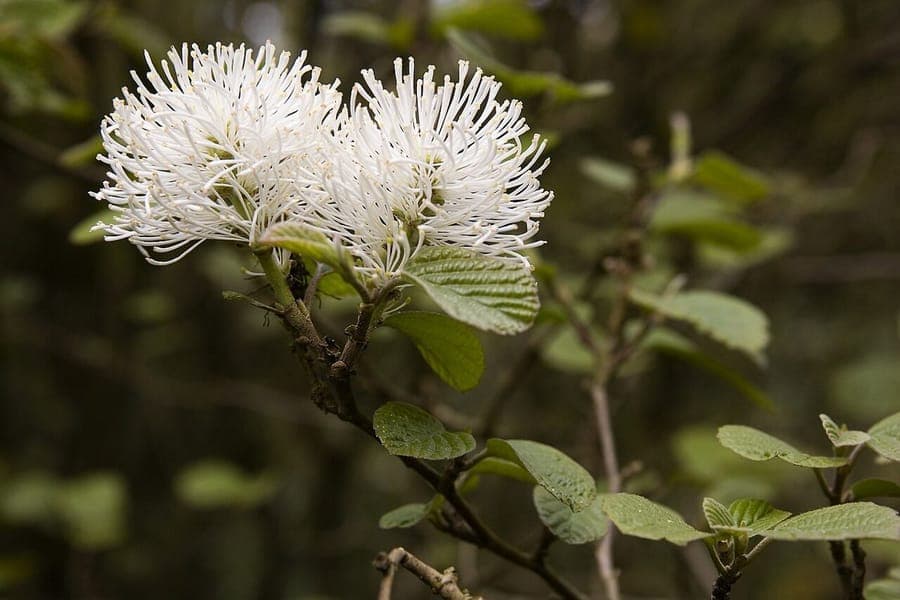
MichaelMaggs / CC BY-SA 2.5, via Wikimedia Commons
Large fothergilla (Fothergilla major): complete guide
Fothergilla major
Want to see Large fothergilla (Fothergilla major): complete guide in your garden?
Full design in HD: €7.99
Look after your Large fothergilla with the GardenWorld app
Identify plants with your camera and get a care calendar with reminders for this plant.


Overview
Large fothergilla (Fothergilla major) is one of those shrubs that steals the show twice a year. In April and May it is covered in fluffy white bottlebrush flowers that smell of honey, and in October its leaves turn yellow, orange and scarlet, often all at once on the same plant. In between it is a neat, rounded shrub with fresh green foliage that asks for very little attention. In its American homeland it is also known as mountain witch alder, a nod to its alder-like leaves and its place in the witch hazel family.
Fothergilla major belongs to the Hamamelidaceae and comes from the south-eastern United States, where it grows wild in the Appalachian Mountains on dry, rocky slopes and in open woodland. The genus is named after John Fothergill, an eighteenth-century English physician and plant collector. Some recent botanical works list the species as Fothergilla latifolia, but Fothergilla major remains the name you will see on nursery labels.
In gardens it usually reaches 1.5 to 2.5 m in height with a similar spread, eventually up to 3 m. It grows slowly and keeps a pleasing rounded to upright shape all by itself, which makes it a good choice for smaller gardens and for the front of a shrub border. If you are not sure where it would look best on your plot, you can have a garden design made on gardenworld.app that takes your soil type and the sun into account.
Appearance and bloom cycle
Flowering starts in April, just before or as the leaves unfold, and carries on until mid-May. The flowers have no petals. What you see are dozens of white stamens tipped with tiny yellow anthers, gathered in upright spikes 3 to 6 cm long. Up close they have a sweet, honeyed scent, and bees and bumblebees appreciate them early in the season.
The leaves are broadly oval to almost round, 5 to 10 cm long, with a wavy, coarsely toothed margin rather like a hazel leaf. They are dull green above and bluish green and slightly hairy beneath. In summer the shrub blends quietly into the border, but from late September the autumn colour begins, and it is among the finest of any garden shrub: yellow, orange, red and sometimes purple, often in patches on a single leaf. The more sun the plant gets, the brighter the display. Small, hairy seed capsules follow the flowers but add little ornamental value.
You may also come across Fothergilla × intermedia, a hybrid with the smaller Fothergilla gardenii, with popular selections such as 'Mount Airy' and the blue-grey leaved 'Blue Shadow'.
Ideal location
For the best flowering and the brightest autumn colour, plant Fothergilla major in full sun or light partial shade. It will grow in shade, but then the autumn colour often stays yellow and there are fewer flowers. A spot with morning sun and light shade in the heat of the afternoon is ideal.
Some shelter is helpful, because late frosts in April can damage the flowers. The shrub itself is not bothered by wind. It works well at the edge of a woodland-style border, as a specimen in a small garden or in a group of three in a larger bed. Space plants about 1.5 m apart.
Soil requirements
This is the main thing to get right: Fothergilla major needs acid to slightly acid soil, ideally with a pH between 5 and 6.5. On chalky ground the leaves turn yellow between the veins (lime-induced chlorosis) and the shrub never thrives. On sandy soils and humus-rich loams it usually does well. On alkaline clay it is better to choose another shrub; filling a planting hole with ericaceous compost only helps for a few years.
The soil should be rich in organic matter and moisture-retentive, but never waterlogged. When planting, work leaf mould, garden compost or peat-free ericaceous compost into the top 30 cm. A 5 cm mulch of leaf mould or composted pine bark keeps the soil cool, moist and slightly acid. Plant in autumn or early spring when the ground is not frozen.
Free preview
Want to see Large fothergilla (Fothergilla major): complete guide in your garden? Make a free preview of your design.
Watering
For the first two years, water about 10 litres per plant once a week during dry spells. After that Fothergilla major is fairly drought tolerant; after all, it grows on dry slopes in the wild. During a long hot spell in July and August it is still worth giving an occasional deep soak, because a stressed plant drops its leaves early and you lose the autumn colour.
Use rainwater where you can, especially if your tap water is hard. Over time, limy water raises the pH around the roots. Avoid standing water: the shrub dislikes wet feet in winter.
Pruning
Pruning is hardly ever needed. The plant grows slowly and keeps a good shape on its own. If you do want to intervene, do it straight after flowering, in late May or early June. Next year's flower buds form during summer, so pruning in winter or early spring removes the blooms.
Take out dead wood and the odd branch that spoils the outline. Older plants can be thinned now and then by removing one old stem at the base to let light into the centre. Suckering is limited in this species.
Maintenance calendar
March: Renew the mulch and apply some organic fertiliser for acid-loving plants.
April: Flowering begins. If a hard night frost is forecast, cover the plant with fleece.
May: Flowering ends and the leaves unfold fully. Prune, if necessary, straight after flowering.
June to August: Water during prolonged drought, preferably with rainwater.
September and October: Autumn colour, usually at its best in mid-October. A good time to plant.
November: Leave fallen leaves under the shrub as a natural mulch.
December to February: Dormant season. No protection needed in open ground.
Winter hardiness
Fothergilla major is very hardy and tolerates frosts down to about -25 °C. In the UK and the Low Countries you need not worry about the shrub itself, even in harsh winters. Only late frosts in April may brown the open flowers; the plant is unharmed.
In a container it is a little more vulnerable, because roots in a pot freeze more quickly. Stand a pot against a wall in winter and wrap it in hessian.
There are no reports of toxicity. Fothergilla major does not appear on the usual lists of plants poisonous to people, dogs or cats, though, as with any garden plant, it is best to stop children and pets eating leaves or seed capsules. It is not invasive anywhere in Europe.
Companion plants
Fothergilla major is at home among other plants that like acid, humus-rich soil. Chinese witch hazel (Hamamelis mollis), a relative, flowers in winter and turns yellow in autumn, giving a long season of interest. Snowy mespilus (Amelanchier lamarckii) flowers white at the same time in April and also has superb autumn colour.
Rhododendrons and azaleas enjoy the same soil and provide an evergreen backdrop. Pieris japonica adds red young growth in spring, and the Japanese dogwood (Cornus kousa) flowers in June, just as the fothergilla takes a rest. At its feet, try barrenwort (Epimedium), ferns and Japanese forest grass (Hakonechloa macra). Spring bulbs such as glory-of-the-snow (Chionodoxa) and Anemone blanda flower beautifully beneath the bare branches before the leaves appear.
Final thoughts
Fothergilla major is an underrated shrub: compact, healthy and with two genuine high points every year. If you have acid to slightly acid soil and a sunny spot, it will be a faithful garden companion that asks for little and gives a great deal.
Want to know when to prune or feed? The plant calendar on gardenworld.app shows what to do in your garden month by month. Plant a large fothergilla this autumn and look forward to white bottlebrushes in April and fireworks in October.
Frequently asked questions about Large fothergilla
Is Large fothergilla winter hardy?
Fothergilla major is very hardy and tolerates frosts down to about -25 °C. In the UK and the Low Countries you need not worry about the shrub itself, even in harsh winters.
When and how do you prune Large fothergilla?
Pruning is hardly ever needed. The plant grows slowly and keeps a good shape on its own.
How much water does Large fothergilla need?
For the first two years, water about 10 litres per plant once a week during dry spells. After that Fothergilla major is fairly drought tolerant; after all, it grows on dry slopes in the wild.
Where does Large fothergilla grow best?
For the best flowering and the brightest autumn colour, plant Fothergilla major in full sun or light partial shade. It will grow in shade, but then the autumn colour often stays yellow and there are fewer flowers.
What soil does Large fothergilla need?
This is the main thing to get right: Fothergilla major needs acid to slightly acid soil, ideally with a pH between 5 and 6.5. On chalky ground the leaves turn yellow between the veins (lime-induced chlorosis) and the shrub never thrives.

See it in your garden
See Large fothergilla in your garden
One photo of your garden and a few questions. You see the result in about a minute.
Try it with a photoIdentify this plant in your own garden. Identify a plant
Similar plants
Chinese Witch Hazel: complete guide
Hamamelis mollis
Chinese witch hazel blooms in January-February with fragrant yellow flowers even in deep winter. Master care, site selection, and pruning to enjoy 30+ years of winter color.
Juneberry: complete guide
Amelanchier lamarckii
Everything about the Juneberry (Amelanchier lamarckii): spring blossom, autumn colour, edible berries and care. Expert tips for this versatile four-season tree.
Rhododendron: complete guide
Rhododendron
Everything about Rhododendron: planting, care, pruning and the right soil. Practical tips for an abundant spring display.
