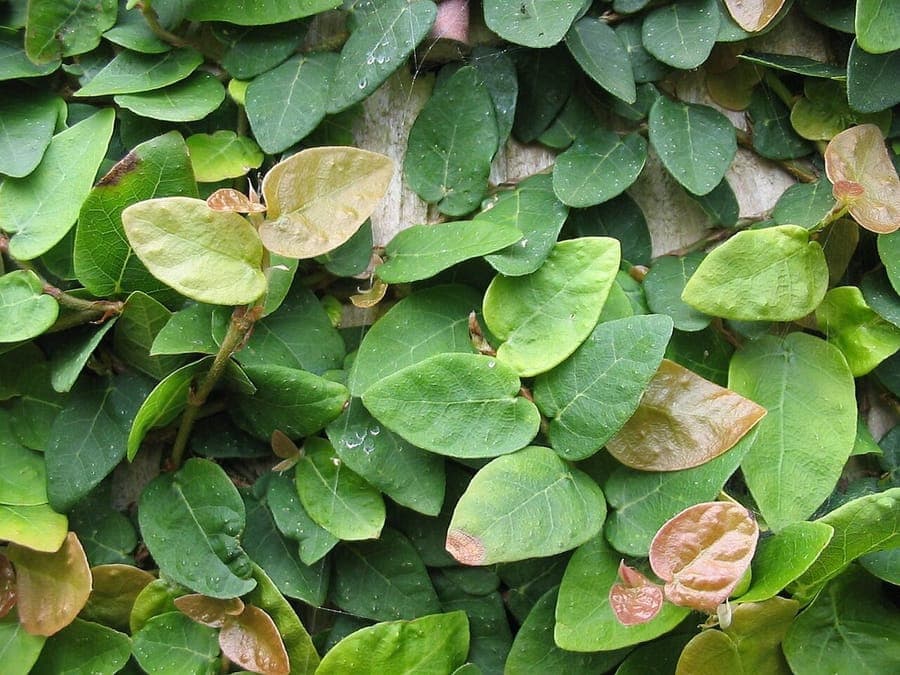
Ixitixel / CC BY-SA 3.0, via Wikimedia Commons
Creeping Fig: complete guide
Ficus pumila
Want to see Creeping Fig: complete guide in your garden?
Full design in HD: €7.99
Look after your Creeping Fig with the GardenWorld app
Identify plants with your camera and get a care calendar with reminders for this plant.


Overview
Creeping fig (Ficus pumila) is a climbing, trailing fig from East Asia, native to China, Japan, Taiwan and Vietnam. In the wild it smothers rock faces, tree trunks and old walls in a flat carpet of small, heart-shaped leaves. In Britain and the rest of north-west Europe it is grown mainly as a houseplant: trailing from a hanging pot, spreading as ground cover beneath taller plants, or trained up a moss pole or a wire topiary frame. In the mildest coastal gardens it is occasionally planted outdoors against a sheltered wall, but in most of the region it is too tender for that.
Ficus pumila belongs to the mulberry family (Moraceae), which makes it a relative of the edible fig and the weeping fig. Its most curious trait is that it has two distinct life stages. The young plant you buy has thin, flexible stems with leaves of 2 to 4 cm, and it clings to any rough surface with short aerial roots. Only after many years does it produce stiff branches with larger, leathery leaves and fruit. Indoors you will practically never see that adult stage.
It grows quickly, forgives most mistakes as long as it never dries out, and takes beautifully to clipping. With gardenworld.app you can have a garden design drawn up that includes your patio, conservatory or covered courtyard, so you can see where a green wall of creeping fig would really earn its place.
Appearance and growth
The juvenile leaves are small, oval to heart-shaped, slightly lopsided and finely puckered between the veins. New growth often emerges bronze or reddish before turning fresh green. The wiry stems root as they go, gripping stone, wood or bark with tiny aerial roots.
Indoors a single stem easily reaches 1 to 2 metres, and against a damp conservatory wall the plant can climb several metres. In a hanging basket the trails simply cascade. Several cultivars are widely sold: 'Sunny' and 'White Sunny' have a broad cream margin, 'Variegata' is finely marbled with white, 'Minima' has extra-small leaves, and 'Quercifolia' has lobed leaves that look like miniature oak leaves.
You will not see flowers on a houseplant. As with all figs, the flowers are hidden inside a fleshy receptacle that only forms on mature branches of old plants in warm climates. Creeping fig is grown for its foliage.
Ideal location
Creeping fig likes bright, indirect light. A spot 1 to 2 metres from an east- or west-facing window is ideal. Strong midday sun through glass scorches the thin leaves, while a dark corner produces long, bare stems with sparse, small leaves. Variegated forms need slightly more light.
Humidity matters even more than light. This plant comes from humid forests and dislikes dry indoor air, especially in winter when the heating is on. A bathroom with a window, a conservatory or a spot grouped with other plants suits it far better than a windowsill above a radiator.
If you want it to climb, give it a rough surface. A moss pole, a slab of bark, the back wall of a terrarium or a wire frame stuffed with sphagnum moss all work well. Avoid painted walls: the roots leave marks.
Compost and repotting
Use a good, open houseplant compost with some extra perlite or fine bark, so that water drains freely while the mix still holds moisture. A pH between 6 and 7 is fine. Always choose a pot with a drainage hole; waterlogged roots rot quickly.
The root system is modest compared with the top growth, so repot only when roots fill the pot, usually every second spring. Move up just 2 to 4 cm in diameter. Propagation is easy at the same time: 10 cm stem pieces with a few aerial roots root within weeks in moist compost or a glass of water.
Watering and humidity
This is the secret of a good-looking creeping fig. The thin leaves have very little reserve, so if the root ball dries out completely even once, whole stems shrivel and do not recover. From April to September keep the compost lightly moist but never soggy. Water as soon as the top centimetre feels dry, which in summer may be twice a week. Rainwater or tap water left to stand overnight at room temperature is best.
In winter growth slows and the plant needs less water, but the root ball should still never dry out entirely. Aim for humidity of at least 50 %. Stand the pot on a tray of wet pebbles, group it with other plants or use a humidifier. Misting mainly helps plants on a moss pole.
Feed every two to three weeks from April to September with a half-strength liquid houseplant fertiliser. Do not feed in autumn and winter.
Free preview
Want to see Creeping Fig: complete guide in your garden? Make a free preview of your design.
Pruning
Creeping fig takes pruning extremely well, and regular trimming keeps it dense and youthful. Cut overlong or bare stems back to just above a leaf; new side shoots will break just below the cut. On topiary frames, trim anything that strays outside the outline every few weeks.
Variegated cultivars sometimes throw out shoots with plain green leaves. Remove these at their base as soon as you spot them, otherwise their stronger growth will take over the plant.
Wear gloves when pruning. The cut stems bleed a white, milky sap that can irritate the skin, particularly sensitive skin exposed to sunlight afterwards.
Maintenance calendar
March-April: The growing season begins. Repot if needed, trim to shape and take cuttings. Start feeding.
May-June: Full growth. Keep the compost evenly moist and make sure the plant is not getting harsh midday sun now that the sun is higher.
July-August: Water more often in hot spells. Check the undersides of the leaves for red spider mite, which thrives in dry air. Trim straggly trails.
September-October: Reduce and then stop feeding. Move the plant to a brighter position for the darker months if necessary.
November-February: Rest period. Water less and do not feed. Keep the plant away from radiators and boost humidity. A cooler room between 12 and 16 °C is ideal.
Temperature and hardiness
As a houseplant Ficus pumila is happiest at 16 to 24 °C. In winter it appreciates a cooler spell between 10 and 15 °C, provided the air does not become too dry. Below about 5 °C young shoots are damaged.
Outdoors it is only marginally hardy. Established plants on a warm, sheltered wall survive brief frosts of around -5 °C; harder or prolonged frost cuts them back or kills them outright. In most of Britain and the Low Countries it is therefore best grown indoors or in a frost-free conservatory.
Toxicity to pets
Creeping fig is toxic to cats and dogs. The milky sap contains compounds that irritate the digestive tract, so a pet that chews the leaves may drool, vomit or have diarrhoea, and contact with the sap can also irritate the skin or mouth. Serious poisoning is rare, but keep the plant out of reach, for instance in a hanging pot or on a high shelf, if you have cats that like to nibble greenery. For people the sap is mainly a skin irritant, so wash your hands after pruning.
Companion plants
Creeping fig makes an excellent green underplanting in a large container with a taller plant, such as Japanese aralia (Fatsia japonica) in a cool, bright hallway. It also pairs well with plants that enjoy the same humid air and regular watering: spider plant (Chlorophytum comosum) as a hanging companion, and mind-your-own-business (Soleirolia soleirolii) as ground cover in a bottle garden or terrarium.
For a green wall in a conservatory, ivy (Hedera helix) is a strong partner, although it grows even more vigorously and needs keeping in check. In a frost-free garden room, star jasmine (Trachelospermum jasminoides) adds scented flowers next to the fine leaves of the fig. Avoid sharing a pot with cacti or succulents: they want to dry out between waterings, which is exactly what creeping fig cannot tolerate.
Final thoughts
Creeping fig is a small plant with plenty of character. It quickly turns a moss pole, a terrarium or a bare conservatory wall into a living green surface, and it can be shaped exactly as you wish. The one thing it never forgives is drought: keep the compost lightly moist and the air reasonably humid, and its neat little leaves will reward you for years.
Not sure when to repot, prune or feed? The plant calendar on gardenworld.app shows month by month what your plants need, houseplants included. Give your Ficus pumila a bright spot out of harsh sun this spring, offer it something to climb, and watch it find its way.
Frequently asked questions about Creeping Fig
Is Creeping Fig winter hardy?
As a houseplant Ficus pumila is happiest at 16 to 24 °C. In winter it appreciates a cooler spell between 10 and 15 °C, provided the air does not become too dry.
When and how do you prune Creeping Fig?
Creeping fig takes pruning extremely well, and regular trimming keeps it dense and youthful. Cut overlong or bare stems back to just above a leaf; new side shoots will break just below the cut.
How much water does Creeping Fig need?
This is the secret of a good-looking creeping fig. The thin leaves have very little reserve, so if the root ball dries out completely even once, whole stems shrivel and do not recover.
Where does Creeping Fig grow best?
Creeping fig likes bright, indirect light. A spot 1 to 2 metres from an east- or west-facing window is ideal.

See it in your garden
See Creeping Fig in your garden
One photo of your garden and a few questions. You see the result in about a minute.
Try it with a photoIdentify this plant in your own garden. Identify a plant
Similar plants
Ivy: complete guide
Hedera helix
Everything about Common Ivy (Hedera helix): planting, pruning, climbing and ground cover. Practical tips for green walls and weed-free underplanting.
Star jasmine: complete guide
Trachelospermum jasminoides
Everything about Star Jasmine (Trachelospermum jasminoides): planting, care, pruning and winter protection. Expert tips for a fragrant evergreen climber.
Chlorophytum comosum: complete guide
Chlorophytum comosum
Discover everything about Chlorophytum comosum (spider plant). Learn care requirements, propagation, location and maintenance for thriving indoor plants.
