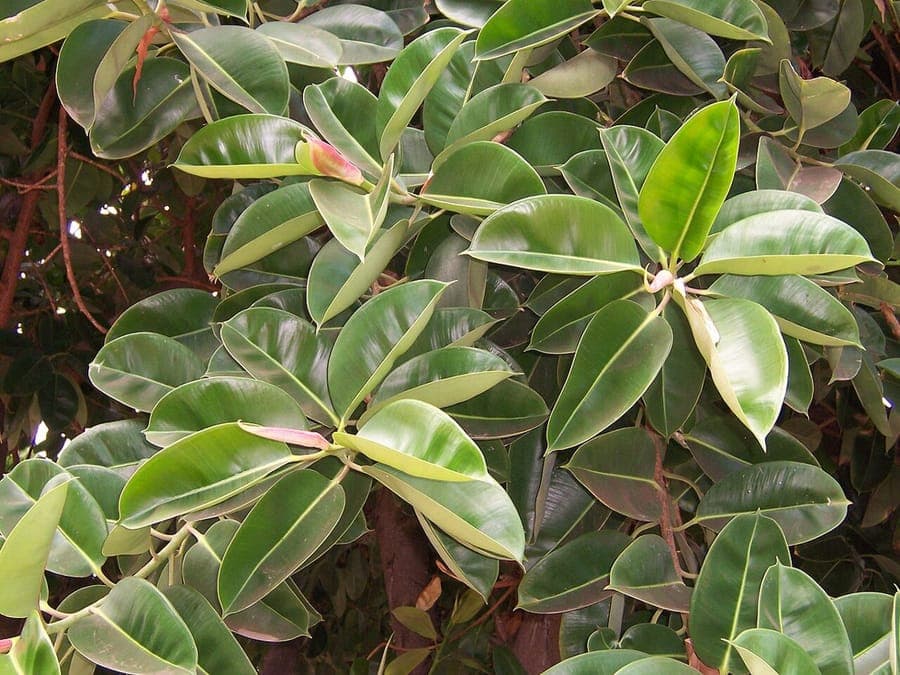
B.navez / CC BY-SA 3.0, via Wikimedia Commons
Rubber Plant: complete guide
Ficus elastica
Want to see Rubber Plant: complete guide in your garden?
Full design in HD: €7.99
Look after your Rubber Plant with the GardenWorld app
Identify plants with your camera and get a care calendar with reminders for this plant.


Overview
The rubber plant (Ficus elastica) has been a fixture of living rooms for generations, and it is enjoying a well-deserved revival. Its large, leathery leaves give a room a calm, grown-up look, it grows at a satisfying pace, and it shrugs off the odd missed watering.
Ficus elastica belongs to the mulberry family (Moraceae). In the wild it grows from north-east India and the foothills of the Himalayas through Myanmar to Malaysia and Indonesia, where it becomes a forest giant of 30 metres or more, dropping aerial roots from its branches. Its milky sap was once tapped for rubber, which explains the name. Indoors it stays far smaller: 1 to 3 metres is typical, depending on pot size and light.
Plenty of selections are available. 'Robusta' and 'Decora' have big, deep green leaves. 'Abidjan' and 'Burgundy' are an almost black-red, 'Tineke' is marbled with cream and pale green, and 'Belize' mixes green, cream and pink. The variegated forms are striking but need more light to keep their colouring.
Appearance and foliage
The foliage is the whole point of this plant. The leaves are oval to elliptical, 15 to 30 cm long, thick and glossy, with a prominent central vein. Each new leaf emerges from a tight roll at the stem tip, wrapped in a sheath called a stipule. On most varieties that sheath is pink to red and drops off as the new leaf unfurls.
Indoors, Ficus elastica almost never flowers. In its native habitat it produces small, inconspicuous figs that can only be pollinated by a specialised fig wasp. So what you are growing is shape and shine. A young plant usually rises on a single straight stem; if you want a bushier, branched specimen you will need to prune it, as explained below.
A word of caution: every part of the plant contains white latex sap. It can irritate skin and is harmful if swallowed. Cats and dogs that chew the leaves may drool, vomit or get diarrhoea. Anyone with a latex allergy should wear gloves when pruning or repotting.
Position indoors
Light matters more than anything else. A rubber plant wants a bright spot, ideally close to an east- or west-facing window. It copes well with some direct morning or evening sun, and the dark-leaved varieties can even sit in a south-facing window behind a sheer curtain. Fierce midday sun through glass in summer can scorch the leaves, especially on variegated plants.
In too little light the stems stretch and turn weak, the gaps between leaves grow longer and new leaves come out smaller. On 'Tineke' and 'Belize' the variegation fades.
A room temperature between 16 and 24 °C is ideal. Keep the plant away from a door that is opened constantly and do not stand it directly above a radiator: sudden blasts of cold or hot air are the classic cause of leaf drop. Give the pot a quarter turn every few weeks so the plant grows evenly rather than leaning towards the window.
Potting mix and repotting
Use an open, well-draining mix. A good-quality houseplant compost blended with roughly one fifth perlite or fine clay granules works well. The pot must have a drainage hole; if it sits inside a decorative cover, tip out any water that has collected about fifteen minutes after watering.
Repot young plants every one to two years in spring and older ones every two to three years. Choose a pot only 3 to 5 cm wider than the last. An oversized pot stays wet for too long, which is bad news for the roots. For very large plants that can no longer be repotted, replace the top 3 to 5 cm of compost with fresh mix each spring.
Watering
Overwatering is the biggest threat to Ficus elastica. Only water once the top 2 to 3 cm of compost feels dry. In summer that usually means about once a week; in winter it may be every two or three weeks. When you do water, do it thoroughly until water runs from the drainage hole, and never leave the pot standing in water.
Yellow lower leaves that come away easily usually point to wet roots. Limp, drooping leaves that feel soft and dry tend to mean the plant is thirsty. Use water at room temperature; rainwater or tap water left to stand overnight is ideal.
Wipe the leaves with a damp cloth every few weeks. This is about more than shine: a layer of dust reduces photosynthesis.
From April to September, feed every two to four weeks with a liquid houseplant fertiliser at half the recommended strength. Stop feeding in autumn and winter. The plant calendar at gardenworld.app shows month by month what your houseplants and garden plants need, so feeding and repotting do not slip your mind.
Free preview
Want to see Rubber Plant: complete guide in your garden? Make a free preview of your design.
Pruning and propagation
A rubber plant does not need pruning, but it responds well to it. If you would rather it branched out than grew like a pole towards the ceiling, cut out the tip in spring just above a leaf or leaf node. Two or three side shoots usually break from the buds below. Overlong stems can be shortened to whatever height suits you.
White sap will well up from the cut straight away. Dab it with kitchen paper or press a damp cloth against it; it stops on its own within a few minutes.
The removed tip makes a ready-made cutting. Let the cut surface dry for an hour, strip the lower leaves and stand the cutting in water or in a moist mix of compost and perlite. Somewhere warm, around 22 to 25 °C, roots appear within four to six weeks. Air layering is the traditional alternative: make a small cut in the stem, wrap it in damp sphagnum moss and plastic, and sever the top once roots show in the moss.
Care calendar
March to April: The growing season begins. Repot if needed, prune into shape and take cuttings. Start feeding.
May to June: Strong growth. Check weekly whether the compost has dried out. If you want to move the plant outdoors for summer, wait until nights stay above 15 °C and pick a sheltered spot out of hot midday sun.
July to August: Water regularly and keep feeding. Inspect the undersides of the leaves for spider mite, scale insects and mealybugs, especially in a warm, dry home.
September to October: Last feed in September. Bring plants that summered outdoors back in before nights fall below 12 °C.
November to February: Rest period. Water less, do not feed and give the plant as much light as possible. Keep it clear of radiators and draughty windows. Losing a few yellow leaves in winter is normal.
Temperature and winter
Ficus elastica is a tropical plant and not frost hardy. It suffers below 10 °C and frost kills it. Indoors that is rarely an issue, but watch out for cold windowsills behind drawn curtains and for winter transport: ten minutes in a cold car can be enough to trigger leaf drop.
Along the coasts of Spain and Portugal the rubber plant grows outdoors as a tree, but in Britain and the Low Countries it is strictly a houseplant, with a summer on the patio at most. The ideal winter conditions indoors are 15 to 20 °C with as much light as you can give it.
Companion plants
A rubber plant works beautifully as a single statement, but grouped with houseplants of contrasting leaf shapes the whole display gains depth. Its big, glossy leaves contrast nicely with the cut leaves of the Swiss cheese plant (Monstera deliciosa) and the arching, slender foliage of the spider plant (Chlorophytum comosum).
The ZZ plant (Zamioculcas zamiifolia) needs just as little water and makes a neat, dark companion at the foot of a large rubber plant. The peace lily (Spathiphyllum wallisii) brings white flowers into a green corner, although it likes water a little more often. For a bold tropical scene of big leaves, add a bird of paradise (Strelitzia reginae). Keep plants with different watering needs in separate pots.
Do you have large windows looking onto the garden? At gardenworld.app you can have a garden design made so that the patio and planting outside pick up the green mood indoors, linking house and garden.
Final thoughts
The rubber plant is a rewarding, robust houseplant that will last for years with very little fuss. Give it a bright spot, water only when the compost is dry and avoid draughts and frequent moves. A spring trim lets you steer its shape, and every tip you remove is a new plant in the making. Keep the sap away from children and pets, and Ficus elastica will remain one of the most dependable green companions you can choose.
Pruning
Frequently asked questions about Rubber Plant
When and how do you prune Rubber Plant?
A rubber plant does not need pruning, but it responds well to it. If you would rather it branched out than grew like a pole towards the ceiling, cut out the tip in spring just above a leaf or leaf node.
How much water does Rubber Plant need?
Overwatering is the biggest threat to Ficus elastica. Only water once the top 2 to 3 cm of compost feels dry.

See it in your garden
See Rubber Plant in your garden
One photo of your garden and a few questions. You see the result in about a minute.
Try it with a photoIdentify this plant in your own garden. Identify a plant
Similar plants
Monstera deliciosa: complete guide
Monstera deliciosa
Discover the fruit-salad plant (Monstera deliciosa) - a popular houseplant with characteristic holes in leaves. Professional care and growing tips for success.
ZZ plant: complete guide
Zamioculcas zamiifolia
Discover Zamioculcas zamiifolia, the easy-care money plant from Africa. Growing and care tips for indoors.
Peace lily: complete guide
Spathiphyllum wallisii
How to grow a peace lily (Spathiphyllum wallisii): light, watering, repotting, getting it to flower again, and why it is toxic to cats and dogs.
