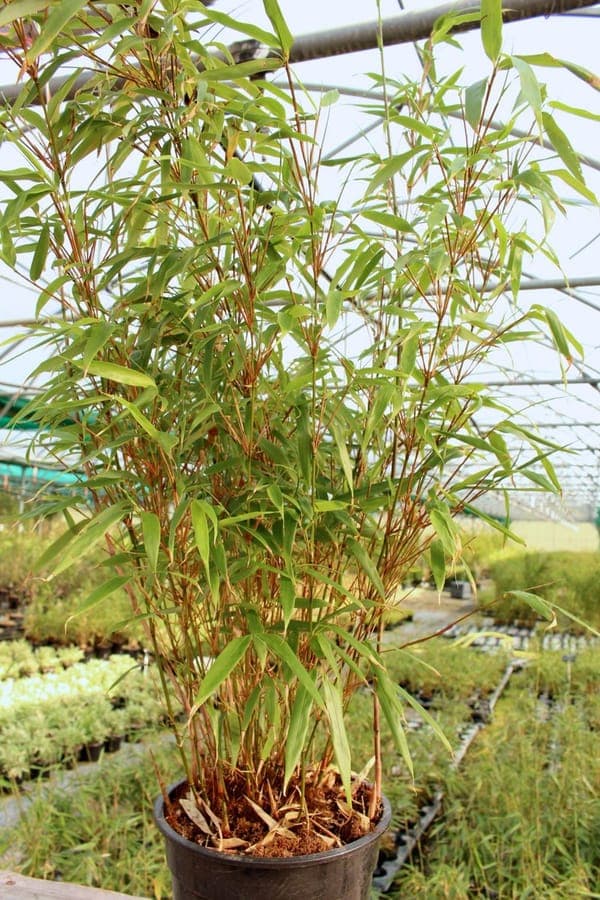
Anne Antoni / CC BY-SA 3.0, via Wikimedia Commons
Fargesia rufa: a non-invasive clumping bamboo
Fargesia rufa
Want to see Fargesia rufa: a non-invasive clumping bamboo in your garden?
Full design in HD: €7.99
Look after your Fargesia rufa with the GardenWorld app
Identify plants with your camera and get a care calendar with reminders for this plant.


Overview
Fargesia rufa is a clump-forming bamboo from the mountain forests of western China, from Gansu and Sichuan, the same region where the giant panda lives. In British and northern European gardens it has become one of the most popular bamboos for anyone who wants a green, rustling screen without an underground invasion. It does not run: the rhizomes are short and thick and stay tightly packed together, so the clump widens only a little each year. Unlike running bamboos such as Phyllostachys or Pleioblastus, it needs no root barrier.
The plant stays compact and fine in texture. In most gardens it reaches 1.5 to 2.5 metres and, after several years, roughly the same in width. That makes it a good choice for small town gardens, an informal screen beside a patio or a feature plant in a large container. It works beautifully as a green backdrop for ferns and hostas, or as a living screen against overlooking neighbours. It is sometimes sold under the common name dragon head bamboo.
A word of caution when buying: names in the trade are not always reliable. Plants sold as 'Green Panda' or 'Rufus' are, according to the Royal Horticultural Society, better placed under the related Fargesia dracocephala. That species is also clump-forming and needs the same care, so in practice the difference is small. If you want the true species, ask for Fargesia rufa without a cultivar name and look for the reddish-brown culm sheaths.
Appearance and flowering
The most distinctive feature of Fargesia rufa is its culm sheaths. When new canes push up in late spring, they are wrapped in sheaths of orange-red to russet brown. That colour gives the species its name: rufa means reddish. Against the fresh green foliage they glow warmly, especially in the low sun of May and June. The canes themselves are slender, no thicker than a pencil, and on mature plants they arch gently outwards to create a fountain-like outline.
The leaves are small and narrow, about 5 to 9 cm long, bright green and densely carried on fine side branches. The result is an airy, delicate look, and the plant moves in the slightest breeze. Fargesia rufa is evergreen. In hard frost or drought the leaves roll up into narrow cigars to reduce moisture loss. This is a defence mechanism, not a sign that the plant is dying, and the leaves unfurl again once the weather softens or the plant is watered.
Flowering is a rare event in bamboos. Many Fargesia species flower only once every few decades, sometimes all at the same time, and can be badly weakened afterwards. No regular flowering cycle is known for Fargesia rufa. If yours does flower, cut out the flowering canes, water and feed generously, and give the plant time to recover.
Ideal position
Fargesia rufa copes with more sun than the familiar umbrella bamboo, Fargesia murielae. Partial shade is ideal, but full sun is fine as long as the soil never dries out. Against a hot south-facing wall with little water, the leaves will roll more often and the plant will look tired by August. In deep shade it grows more slowly and more sparsely, though it will survive.
A spot sheltered from bitter easterly winds and harsh winter sun does help to prevent brown leaf edges. For an informal hedge, plant 80 to 100 cm apart; for a dense screen more quickly, space plants at 60 cm. As a specimen, allow about 1.5 square metres per plant.
In a container this bamboo does well, but choose a generous pot of at least 50 to 60 litres, ideally wider than it is tall.
Soil requirements
The ideal soil is humus-rich and moisture-retentive yet well drained. Ordinary garden soil improved with compost or leaf mould is perfectly adequate. On sandy soil, add plenty of compost so that it holds more water. On heavy clay, work some grit and organic matter into the planting hole, because waterlogging in winter leads to root rot.
Soil pH is not critical; anything between roughly 5.5 and 7.5 is fine. A 5 cm mulch of bark or leaf mould keeps the roots cool and moist.
Bamboo is a grass and enjoys nitrogen. In April, give compost or an organic feed for lawns or evergreens, with an optional smaller second dose in June. Stop feeding after July so that new growth can harden off before winter.
Free preview
Want to see Fargesia rufa: a non-invasive clumping bamboo in your garden? Make a free preview of your design.
Watering
Water is the key to a handsome Fargesia rufa. For the first two years after planting, keep the root ball evenly moist. In dry weather water deeply once or twice a week, around 10 litres per plant, rather than a little every day.
An established plant in open ground usually copes on its own, except during long summer dry spells. Rolled leaves are a clear signal: give the plant a good soak in the evening. Container plants need far more attention, and daily watering in summer is not unusual. Make sure there is a drainage hole and a layer of gravel at the bottom, because the plant dislikes standing in water just as much.
Do not forget winter. Bamboo stays green and keeps losing water through its leaves even in frost. When the ground is frozen and the sun is shining, the plant can dry out. In a dry winter, give a drink on frost-free days, especially to plants in pots.
Pruning
Fargesia rufa needs little pruning. The main job is an annual thinning in March or April: cut dead, dried and very old canes close to the ground.
As a hedge, the plant can also be clipped to shape. Bear in mind that a shortened cane will not grow any taller; it branches below the cut and becomes bushier instead. Never cut lower than the final height you want. The best time for shaping is after the new canes have finished growing, in July.
An old clump that has become too wide can be reduced in April or May by slicing off a section at the edge with a sharp spade. That piece can be replanted elsewhere. Divide or repot container plants every three to four years.
Care calendar
March–April: Thin the clump and remove dead canes. Apply compost or a nitrogen-rich organic feed. The best time for planting and dividing.
May–June: New canes with their russet sheaths appear. Keep the soil moist and give a second feed if you wish.
July–August: Clip hedges into shape. Water deeply in dry spells, especially container plants. Watch for rolled leaves as a sign of drought.
September–October: Last planting window of the year. No more feeding. Leave fallen leaves as mulch.
November–February: Dormant season. In dry frosty spells, water on mild days. Protect pots from freezing through with hessian or bubble wrap.
If you would like reminders for jobs like these in your own garden, use the planting calendar at gardenworld.app, which shows month by month what your plants need.
Hardiness
Fargesia rufa is reliably hardy. An established plant in open ground tolerates frost down to about -20 °C, and growers quote as low as -25 °C. In severe frost the leaves may brown and partly drop, but the canes and rhizomes simply reshoot in spring.
Young plants in their first winter and plants in pots are more vulnerable, because their roots are less protected. Stand containers against a wall, raise them on pot feet so water can drain, and wrap them during prolonged frost below -8 °C.
Bamboo is not poisonous. Fargesia rufa is safe in a garden with children, dogs and cats.
Companion plants
The fine texture of Fargesia rufa shows best next to plants with large or contrasting foliage. Japanese maple (Acer palmatum) is a classic partner in an Asian-inspired garden: its red or orange autumn colour stands out against the green curtain of bamboo. At the base, hostas with broad blue-green or variegated leaves look superb, as does the fern Dryopteris erythrosora, which unfurls in coppery tones in spring.
As a low, evergreen ground cover under or beside the clump, mondo grass (Ophiopogon japonicus) works well. For autumn and winter colour, add heavenly bamboo (Nandina domestica); despite its name it is not a true bamboo, but its red berries and colouring leaves pick up the russet tones of Fargesia rufa nicely.
Final thoughts
Fargesia rufa is one of the best choices for anyone who wants bamboo without worrying about spreading roots. It stays compact, it is fully hardy and it takes more sun than many other clump-forming bamboos. Give it humus-rich, moisture-retentive soil, plenty of water in dry spells and a yearly thinning, and it will form a living, rustling screen for many years. At gardenworld.app you can have a garden design made in which this bamboo is combined with suitable perennials and shrubs into a calm, green whole. Plant it in April and enjoy the first russet shoots the following spring.
Frequently asked questions about Fargesia rufa
Is Fargesia rufa winter hardy?
Fargesia rufa is reliably hardy. An established plant in open ground tolerates frost down to about -20 °C, and growers quote as low as -25 °C.
When and how do you prune Fargesia rufa?
Fargesia rufa needs little pruning. The main job is an annual thinning in March or April: cut dead, dried and very old canes close to the ground.
How much water does Fargesia rufa need?
Water is the key to a handsome Fargesia rufa. For the first two years after planting, keep the root ball evenly moist.
What soil does Fargesia rufa need?
The ideal soil is humus-rich and moisture-retentive yet well drained. Ordinary garden soil improved with compost or leaf mould is perfectly adequate.

See it in your garden
See Fargesia rufa in your garden
One photo of your garden and a few questions. You see the result in about a minute.
Try it with a photoIdentify this plant in your own garden. Identify a plant
Similar plants
Japanese Maple: complete guide
Acer palmatum
Everything about Japanese Maple (Acer palmatum): planting, pruning, cultivars and autumn colour. Expert tips for a spectacular ornamental tree in your garden.
Hosta: complete guide
Hosta
Everything about hostas (plantain lilies): varieties, planting, care and slug control. Expert tips for stunning foliage in shade gardens.
Autumn fern: complete guide
Dryopteris erythrosora
A semi-evergreen fern with copper-red young fronds perfect for shady gardens. Ideal for ground cover applications. Very low maintenance and sustainable.
