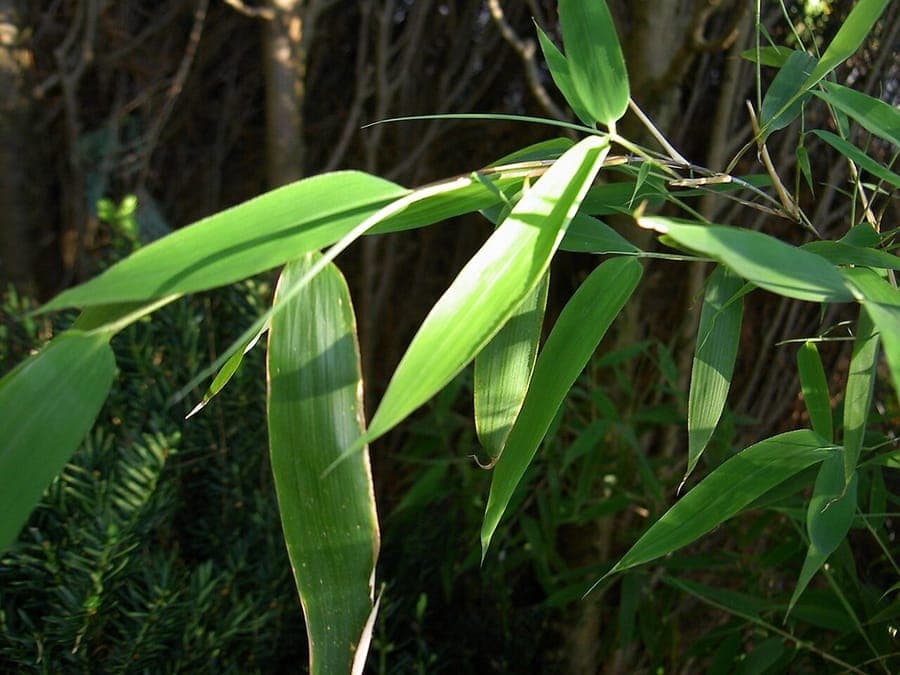
IKAl / CC BY-SA 2.5, via Wikimedia Commons
Umbrella bamboo (Fargesia murielae): complete guide
Fargesia murielae
Want to see Umbrella bamboo (Fargesia murielae): complete guide in your garden?
Full design in HD: €7.99
Look after your Umbrella bamboo with the GardenWorld app
Identify plants with your camera and get a care calendar with reminders for this plant.


Overview
Say bamboo and many gardeners picture roots creeping under the fence and taking over next door's lawn. Umbrella bamboo does nothing of the sort. Fargesia murielae is a clump-forming bamboo from the mountains of central China that stays in a compact clump. It produces a dense cluster of graceful canes 2.5 to 4 metres tall that arch outwards at the top like the ribs of an umbrella, which is where its common name comes from.
The plant was found in 1907 by the British plant hunter Ernest Wilson, who named it after his daughter Muriel. It has grown in British and European gardens since the 1910s and became the most widely planted bamboo in our climate. You may meet it under other names: older books call it Thamnocalamus spathaceus or Sinarundinaria murielae, while nurseries almost always sell it as Fargesia murielae. In the wild it belongs to the group of mountain bamboos that the giant panda feeds on.
Umbrella bamboo is evergreen, very hardy and works as a specimen, an informal hedge, a screen around a patio or in a large container. If you would like to know where it would look best in your plot, gardenworld.app can create a garden design for you that allows for the eventual width of the clump and the plants that sit well beside it.
Does Fargesia spread? Clump-forming explained
The difference lies in the rhizomes. Running bamboos such as Phyllostachys have long, creeping rhizomes (leptomorph) that travel metres underground and send up new shoots along the way. Fargesia has short, thick rhizomes (pachymorph). Each new cane emerges right beside the previous one, so the clump widens by only a few centimetres a year. After ten years an umbrella bamboo is usually 1 to 1.5 metres across at the base.
A rhizome barrier is therefore unnecessary, which makes Fargesia murielae suitable for small gardens and for spots close to a path or patio. If you want to keep the clump narrow, slice off the outer canes with a sharp spade every few years in spring.
Appearance, canes and foliage
The canes are 1 to 1.5 cm thick. When young they are green with a white, waxy bloom; with age they turn yellow-green to soft yellow in the sun. They branch in their first year. The leaves are lance-shaped, 6 to 15 cm long and 1 to 1.5 cm wide, fresh matt green with a long, slender tip. The photograph above shows that typical foliage: pale in colour with a drawn-out point.
New shoots appear in May and June. They reach full height within a few weeks and in their second year bend outwards under the weight of their leaves. A mature clump therefore takes on a loose, fountain-to-umbrella shape, wider and airier than Fargesia nitida, which grows more upright and has dark canes.
Bamboo is not toxic to dogs and cats. Raw bamboo shoots do contain compounds that release cyanide, so never eat the young shoots of your garden bamboo without boiling them thoroughly.
Flowering and dying back
Bamboo rarely flowers, but when it does, all plants of a species often flower at the same time around the world. For Fargesia murielae this happened from the 1980s and above all in the 1990s. Nearly all plants in European gardens descended from the seed Wilson had collected generations earlier, and almost all of them flowered and died within the same period. After such mass flowering a bamboo pours all its energy into seed and the clump usually dies.
New plants and cultivars were raised from that seed, including 'Simba', 'Jumbo' and 'Bimbo'. What you buy today is therefore a young generation whose next mass flowering is not expected for many decades. If you do see flowers and the plant begins to die, nothing will save it; let the seed ripen or replace the plant.
Free preview
Want to see Umbrella bamboo (Fargesia murielae): complete guide in your garden? Make a free preview of your design.
Ideal location
Umbrella bamboo tolerates more sun than most Fargesia species. Sun to partial shade is ideal; in deep shade it grows thinner. Shelter from drying easterly winds in winter helps, as they desiccate the leaves. In full midday sun on a dry site the leaves roll up to reduce water loss. That is a protective response, not a disease, but it does tell you the plant is thirsty.
For a hedge, plant 60 to 80 cm apart; it will close up after three or four years. As a specimen, give it at least 1.5 metres of space. It also grows in a container: choose one of at least 50 litres with drainage holes.
Soil requirements
Fargesia murielae likes humus-rich soil that holds moisture yet drains well. Loam and improved sandy soil are ideal, slightly acidic to neutral. On poor sand, mix plenty of compost into the planting hole; on heavy clay, add grit for drainage, as waterlogged roots rot. A mulch of leaves, bark chips or the bamboo's own fallen leaves keeps the soil cool and moist.
Feed in April and again in June if you wish with a nitrogen-rich organic fertiliser or a dedicated bamboo or lawn feed. Stop feeding after July so the canes can ripen before winter.
Watering
The first year is crucial: in dry spells give a thorough soaking of 10 to 20 litres twice a week. An established clump copes with short dry periods, but in prolonged drought it will roll its leaves and shed some of them. Check containers daily in summer.
Do not forget winter. On sunny frosty days the evergreen leaves lose water while the frozen soil supplies none. In a dry winter, water now and then on frost-free days, especially plants in pots.
Pruning
No regular pruning is needed. In March or April, cut dead, weak and old canes off at ground level; this lets light and air into the clump. A cane you shorten will not grow taller again but will branch more densely. That is how you keep a hedge at height: trim to the desired height in spring and lightly again in summer if needed. If the clump leans too far over a path, remove the outer canes entirely rather than shortening them.
Maintenance calendar
March-April: Remove old and dead canes, trim hedges to height and give the first feed. A good time for planting.
May-June: New shoots appear. Water in dry weather and feed again if you wish.
July-August: Full growth. Water generously in drought; rolled leaves are a warning sign.
September-October: Top up the mulch. Planting is still possible until mid-October.
November-February: In dry frosty spells, water occasionally on frost-free days. Protect containers.
To keep track of these moments, the planting calendar on gardenworld.app shows month by month what to do for umbrella bamboo and the other plants in your garden.
Winter hardiness
Fargesia murielae is one of the hardiest bamboos and tolerates frost to about -25 °C. It survives every normal winter throughout Britain and the Low Countries. In severe frost combined with sun and wind the leaves can brown and drop, but the clump reshoots in spring. Containers are more vulnerable: wrap the pot during hard frost and move it out of the wind.
Companion plants
The light, moving foliage of umbrella bamboo looks lovely with Japanese maple (Acer palmatum) and panicle hydrangea (Hydrangea paniculata). At its feet, shade-tolerant ground cover such as Japanese spurge (Pachysandra terminalis) or large hostas (Hosta sieboldiana) works well. For an Asian-inspired corner, combine it with Chinese silver grass (Miscanthus sinensis), ferns and large boulders. As a backdrop to a border of white and blue flowers it is calm and elegant.
Final thoughts
Umbrella bamboo gives you the look and the rustle of bamboo without the worry of running roots. It is hardy, evergreen, happy in sun or partial shade and asks for little more than water in dry spells and a spring tidy-up. Choose a young selection such as 'Simba' or 'Jumbo', plant it in moisture-retentive soil and enjoy its graceful, arching canes for many years.
Frequently asked questions about Umbrella bamboo
Is Umbrella bamboo winter hardy?
Fargesia murielae is one of the hardiest bamboos and tolerates frost to about -25 °C. It survives every normal winter throughout Britain and the Low Countries.
When and how do you prune Umbrella bamboo?
No regular pruning is needed. In March or April, cut dead, weak and old canes off at ground level; this lets light and air into the clump.
How much water does Umbrella bamboo need?
The first year is crucial: in dry spells give a thorough soaking of 10 to 20 litres twice a week. An established clump copes with short dry periods, but in prolonged drought it will roll its leaves and shed some of them.
Where does Umbrella bamboo grow best?
Umbrella bamboo tolerates more sun than most Fargesia species. Sun to partial shade is ideal; in deep shade it grows thinner.
What soil does Umbrella bamboo need?
Fargesia murielae likes humus-rich soil that holds moisture yet drains well. Loam and improved sandy soil are ideal, slightly acidic to neutral.

See it in your garden
See Umbrella bamboo in your garden
One photo of your garden and a few questions. You see the result in about a minute.
Try it with a photoIdentify this plant in your own garden. Identify a plant
Similar plants
Japanese Maple: complete guide
Acer palmatum
Everything about Japanese Maple (Acer palmatum): planting, pruning, cultivars and autumn colour. Expert tips for a spectacular ornamental tree in your garden.
Panicle hydrangea: complete guide
Hydrangea paniculata
Master the panicle hydrangea (Hydrangea paniculata): cultivation tips, summer blooming, pruning techniques, soil requirements and hardiness. A versatile shrub for modern gardens.
Chinese Silver Grass: complete guide
Miscanthus sinensis
Everything about Chinese Silver Grass (Miscanthus sinensis): planting, cutting back, cultivars and winter silhouette. Expert tips for a spectacular ornamental grass.
