
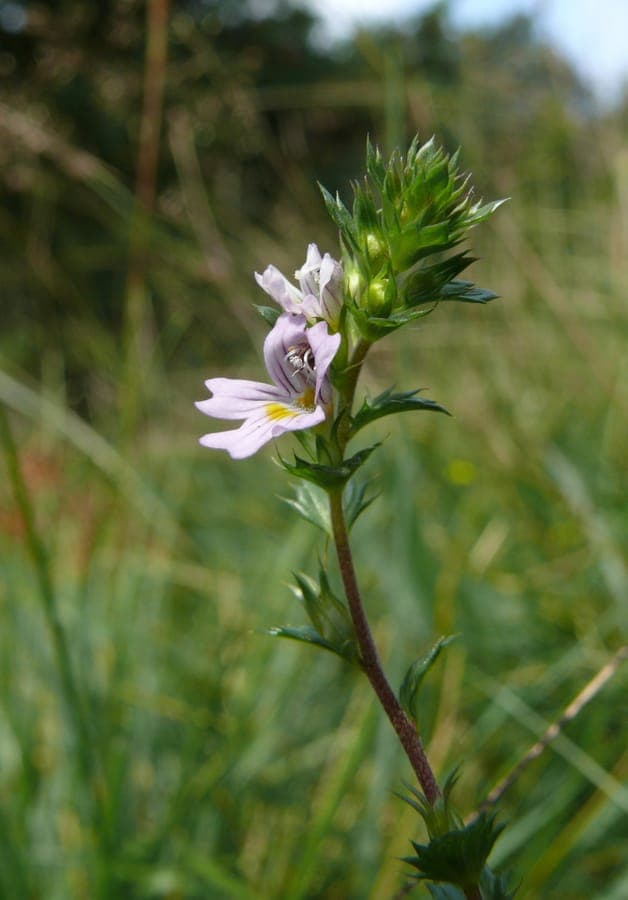
Bernd Haynold / CC BY 2.5, via Wikimedia Commons
Drug eyebright: complete guide
Euphrasia stricta
Want to see Drug eyebright: complete guide in your garden?
1 minute, no credit card
Overview
Drug eyebright (Euphrasia stricta) is a slender, upright herb native to alpine and temperate regions of Europe, including the Alps, Baltic states, and parts of Eastern Europe. Though not widely known in ornamental gardening, it's a resilient wildflower that thrives in open, dry habitats. It's perfect for gardeners aiming to support native biodiversity and create naturalistic planting schemes. At just 10–30 cm tall, it doesn't dominate the border, but its striking blue flowers and long blooming period make it a subtle standout. On gardenworld.app, you can design a low-water garden layout where Drug eyebright fits seamlessly with other sun-loving perennials.
Appearance & bloom cycle
Drug eyebright produces slender, rigid stems with narrow, toothed leaves arranged oppositely along the stem. The flowers are soft blue, often with purple veining and a white patch on the lower lip, resembling a tiny snapdragon. Blooming begins in June and continues through October, peaking in July and August. Each flower lasts a few days, but new buds open steadily, ensuring a long display. The plant has a clumping but not aggressive habit, spreading slowly via seed. It works best when planted in drifts among fine grasses or low-growing companions.
Ideal location
This species thrives in full sun - rate 8/10 or higher. Choose a spot that receives direct sunlight for most of the day, with little to no shade from trees or structures. It's ideal for rock gardens, dry borders, or open meadow-style plantings. Avoid shaded lawns or areas with dense tree cover. Good air circulation is essential to prevent fungal diseases. In urban gardens, a south-facing wall or rooftop garden with gravel mulch can mimic its natural habitat. Use gardenworld.app to visualize how Drug eyebright integrates into your existing garden scheme.
Soil requirements
Euphrasia stricta prefers neutral to slightly alkaline soil with a pH of 7.0–7.5. It does not tolerate acidic or waterlogged conditions. The soil should be well-drained - sandy, gravelly, or loamy mixes are ideal. If your garden has heavy clay, amend it with coarse sand or pumice to improve drainage. Avoid rich, compost-heavy soils; this plant prefers low-fertility ground. A light application of garden lime in spring can help maintain the correct pH, especially in areas with acidic rainfall.
Watering
Once established, Drug eyebright is highly drought-tolerant. It requires minimal watering and performs best when left alone during dry spells. Overwatering is a common mistake - soggy soil leads to root rot and fungal issues. Water only during prolonged droughts (three weeks without rain), and even then, apply water sparingly at the base. Natural rainfall is usually sufficient in temperate climates. This plant is ideal for xeriscaping or low-input garden designs.
Free design
Want to see Drug eyebright: complete guide in your garden? Make a free design now.
Pruning
No pruning is needed. As an annual or short-lived perennial, it completes its life cycle within one or two seasons. Allow the plant to set seed if you want it to self-sow. To control spread, cut back flower stems before seeds mature. Leaving dead stems over winter provides shelter for overwintering insects and helps mark the spot for next season's seedlings.
Maintenance calendar
- Jan: Dormant; no action
- Feb: Check soil structure, plan amendments
- Mar: Improve drainage in planting beds if needed
- Apr: Sow seeds directly outdoors after frost risk passes
- May: Monitor seedlings; protect from slugs
- Jun: Blooming begins; reduce watering
- Jul: Peak bloom; avoid fertilizing
- Aug: Seed development begins; maintain dry conditions
- Sep: Mature seeds form; allow natural dispersal or collect
- Oct: Plants die back; leave debris for wildlife
- Nov: Clear only if necessary; otherwise leave for winter interest
- Dec: Dormant; no action
Winter hardiness
Drug eyebright is hardy in USDA zones 5–7. It survives winter as seed in the soil. The parent plant dies after setting seed, but new seedlings emerge in spring when temperatures rise. No mulching or protection is required - the seed bank is adapted to natural freeze-thaw cycles. In colder zones (4 or below), light mulching with gravel may help, but avoid organic mulches that retain moisture.
Companion plants
Pair Drug eyebright with other drought-tolerant, sun-loving plants like Thymus serpyllum, Sedum acre, or Leucanthemum vulgare. It also grows well with fine-textured grasses such as Festuca ovina or Helictotrichon sempervirens. Avoid moisture-loving species like ferns or astilbes. In a wildflower meadow, it coexists with Campanula rotundifolia and Plantago lanceolata. These combinations enhance visual texture and support pollinators like bees and hoverflies.
Closing
Drug eyebright isn't a flashy plant, but it's a quietly resilient one. It's ideal for gardeners who value ecological function over showy blooms. Though not commonly stocked in mainstream garden centres, it's available through specialist wildflower nurseries. In the UK and US, check online suppliers or inquire at local garden centres. On gardenworld.app, you can explore planting combinations that highlight its subtle beauty while supporting native ecosystems. With the right conditions - sun, lean soil, and dry feet - Drug eyebright will return year after year, quietly enriching your garden.
Want to see Drug eyebright: complete guide in your garden? Make a free design now.
Upload a photo, pick a style, and get a photorealistic design with plant list in under a minute.
No credit card required


Similar plants
Northwestern Indian paintbrush: complete guide
Castilleja angustifolia
All about Castilleja angustifolia, the northwestern Indian paintbrush from dry western US steppes. Growing, care, and companion plant advice.
Wavyleaf Indian paintbrush: complete guide
Castilleja applegatei
Everything about Castilleja applegatei, the wavyleaf paintbrush from Oregon and California. Host plants, care, location, and garden use covered.
Bushy bird's-beak: complete guide
Cordylanthus ramosus
Complete guide to Cordylanthus ramosus, the hemiparasitic annual of western US steppes: ecology, host plants, cultivation and uses.