
Joshua Lincoln / CC BY 4.0, via Wikimedia Commons
Tawny cottongrass: complete guide
Eriophorum virginicum
Want to see Tawny cottongrass: complete guide in your garden?
1 minute, no credit card
Overview
Eriophorum virginicum, commonly called tawny cottongrass or Virginia cottongrass, is a distinctive wetland sedge in the family Cyperaceae. Native to eastern North America, from Labrador and Quebec in Canada south through the Appalachian states to North Carolina and Tennessee, it occupies acidic bogs, fens, wet meadows, and stream margins. Its French name is linaigrette de Virginie.
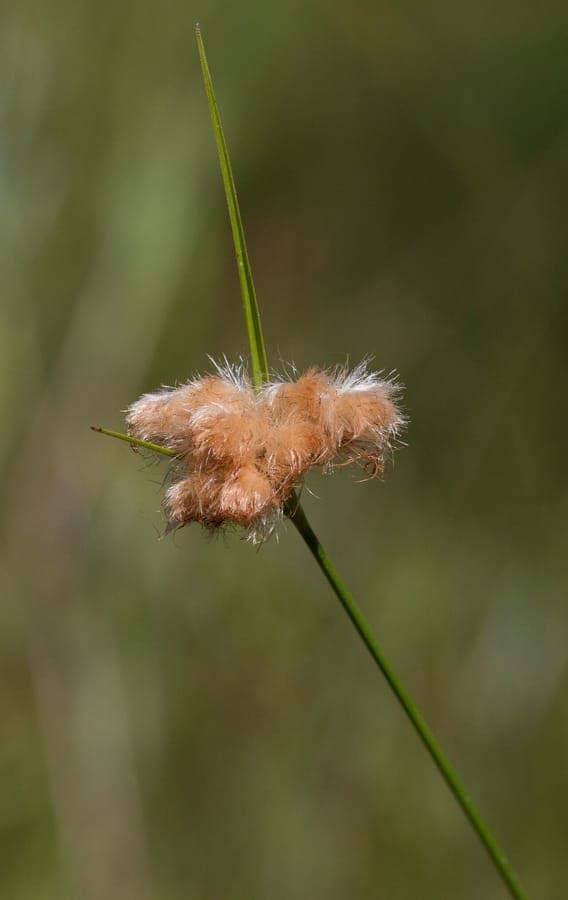
What makes this species stand out among the cottongrasses is the color of its seed tufts. While most cottongrass species produce white or cream-white cotton heads, Eriophorum virginicum bears tufts in tawny rust-brown to bronze tones - a unique quality that gives the plant a warm, autumnal character at a time of year when few plants offer such rich color in wet garden settings.
Beyond its ornamental value, the plant contributes meaningfully to garden ecology. The cotton tufts are used as nesting material by several bird species, and the dense tussocks provide shelter for insects and small invertebrates. Planted at pond margins and bog gardens, it helps stabilize the bank and supports biodiversity in a way that purely ornamental plants rarely do.
The species belongs to the sedge family and grows in single-crown form with moderate growth rate. It performs best in consistently moist to wet, acidic soils - conditions that reflect its natural habitat preferences.
Appearance & bloom cycle
Eriophorum virginicum forms upright tussocks of narrow, strap-like foliage in medium green. Plants reach 40-80 cm in height depending on moisture levels and soil conditions. The linear leaves are characteristic of the sedge family: tough, slightly keeled, and retained through most of the growing season.
The floral display unfolds in two stages. Small greenish flowers appear in July and August on slender stems above the foliage. These are inconspicuous in themselves, but they give way from August onward to the plant's signature feature: the cotton tufts. Each tuft consists of elongated, soft bristles surrounding the tiny fruit, growing up to 3 cm long and forming a rounded head of rust-brown to copper color.
The tufts persist well into autumn and early winter, providing extended ornamental interest. In fruit, the plant reads beautifully against clear autumn skies or alongside late-season moisture-loving companions. The foliage retains its green color through autumn before gradually fading to pale buff in winter.
Ideal location
Tawny cottongrass performs best in full sun to light shade. Full sun encourages generous tuft production; light shade is tolerated but heavy shade significantly reduces flowering and fruiting. The plant is well suited to open pond margins, bog garden areas, and wet meadow settings where it receives good light.
In garden terms, ideal placements include the shallow margins of wildlife ponds, rain gardens that collect and hold water, constructed bog areas adjacent to ponds, and container plantings maintained with constant moisture. The plant is also excellent for naturalizing wet corners of the garden where conventional plants struggle due to waterlogging.
Avoid positions with high fertility - this sedge is naturally adapted to nutrient-poor, acidic conditions and becomes rank and less floriferous in rich soil.
Soil
Soil preferences are specific and non-negotiable for good results. Eriophorum virginicum requires acidic to moderately acidic soil with a pH between 3.8 and 6.5. Alkaline or lime-rich soils are unsuitable and will cause the plant to decline.
Permanently moist to wet conditions are essential. The plant tolerates shallow standing water up to about 5 cm deep at its base, making it well suited to the shallow shelf of a wildlife pond. In bog garden settings, incorporate ericaceous compost or peat to lower pH and improve moisture retention.
Nutrient-poor substrates are preferred. Rich, nitrogen-heavy soil encourages excessive leaf growth at the expense of the attractive fruiting heads that are the plant's main ornamental asset.
Free design
Want to see Tawny cottongrass: complete guide in your garden? Make a free design now.
Watering
As a bog plant, Eriophorum virginicum should never be allowed to dry out. In pond margin plantings, the water table provides constant moisture. In container or raised bog plantings, maintain a water reservoir and check regularly that the growing medium remains saturated.
During dry summers, failure to maintain adequate moisture levels causes wilting, reduced tuft formation, and potential crown damage. A simple saucer or water tray beneath a container planting provides a practical solution.
The species tolerates periods of shallow flooding without harm - a useful tolerance for gardens where water levels fluctuate after heavy rainfall. In very wet winters with standing water, the plant copes well provided the soil is acidic and not overly fertile.
Pruning
Eriophorum virginicum requires minimal maintenance. In early spring - March or April - cut back the previous year's foliage and stems to just above soil level before new growth begins. This keeps the plant tidy and prevents dead material from smothering new shoots.
Alternatively, the dried stems and remaining tufts can be left through winter for structural interest and as wildlife habitat. Remove all old material in early spring before the new season's leaves emerge.
Division of large tussocks can be carried out in spring if the plant outgrows its allotted space. Lift the clump and divide with a sharp spade; replant divisions at the same depth and maintain consistent moisture during re-establishment.
Maintenance calendar
January-February: Rest period. No maintenance required. Leave stems for wildlife benefit. March-April: Cut back old foliage to soil level. Divide large clumps if needed. Check water levels. May-June: New leaf growth begins. Maintain consistently wet conditions. Do not fertilize. July-August: Flowers appear. Ensure water levels remain adequate throughout dry spells. August-October: Cotton tufts develop and reach peak color. Primary ornamental season. November-December: Plant enters dormancy. Foliage fades. Leave or remove as preferred.
Winter hardiness
Eriophorum virginicum is exceptionally cold-hardy. Native to regions with severe winters stretching from Labrador to northern New England and the Great Lakes, it tolerates temperatures as low as -25 degrees Celsius, corresponding to USDA zones 3-7.
In Western European gardens (typically USDA zones 7-8), this is a fully reliable perennial that returns year after year without any winter protection. The rootstock survives frozen ground; above-ground parts die back and regenerate vigorously the following spring.
In container plantings outdoors, the root ball may freeze solid in severe cold. Sink pots into the ground or move them to a sheltered wall position during the coldest weeks to protect the roots. Resume normal care once temperatures stabilize above freezing.
Companion plants
Eriophorum virginicum grows most naturally alongside other acid-loving wetland plants. Reliable companions include Caltha palustris (marsh marigold), Iris pseudacorus, Carex acuta, and Lysimachia thyrsiflora. These share its preference for wet, nutrient-poor conditions and create a cohesive naturalistic planting.
For ornamental contrast, add Lobelia cardinalis for late-season red, Filipendula ulmaria for creamy froth in early summer, and Persicaria bistorta for pink spring flowers. The rust-toned cotton heads of Eriophorum virginicum read particularly well against the deep green of Carex or the yellow flowers of Iris.
For a contemporary ecological pond garden, combine with Dryopteris carthusiana, Juncus effusus, and native sedges for a rich, naturalistic waterside planting. See gardenworld.app for design inspiration showing how cottongrass species can anchor a bog or pond garden scheme.
Closing
Eriophorum virginicum is an underappreciated gem for wet garden situations. Its distinctive rust-bronze cotton tufts in late summer and early autumn bring a color and texture that few other wetland plants can match. Add in its exceptional hardiness, wildlife value, and minimal maintenance needs, and it becomes an obvious choice for any gardener creating or improving a bog garden, pond margin, or rain garden.
For personalized garden design help incorporating Eriophorum virginicum and other wetland plants, visit gardenworld.app. The platform helps you plan planting schemes suited to your specific garden conditions, whether you have a small urban pond or a larger naturalistic water garden.
Want to see Tawny cottongrass: complete guide in your garden? Make a free design now.
Upload a photo, pick a style, and get a photorealistic design with plant list in under a minute.
10,000+ gardens designed already
No credit card required


Similar plants
Flat-stemmed club-rush: complete guide
Bolboschoenus planiculmis
Everything about Bolboschoenus planiculmis: growing conditions, watering, care, and use as a pond margin or wetland plant in garden design.
Great Plains flatsedge: complete guide
Cyperus lupulinus
Everything about Great Plains flatsedge (Cyperus lupulinus): growing conditions, care, garden uses, and ecological value. Tips for pond margins and dry sandy soils.
Golden beak sedge: complete guide
Rhynchospora corymbosa
Everything about golden beak sedge (Rhynchospora corymbosa): a dramatic tropical marginal for pond edges, bog gardens, and wet habitats.