
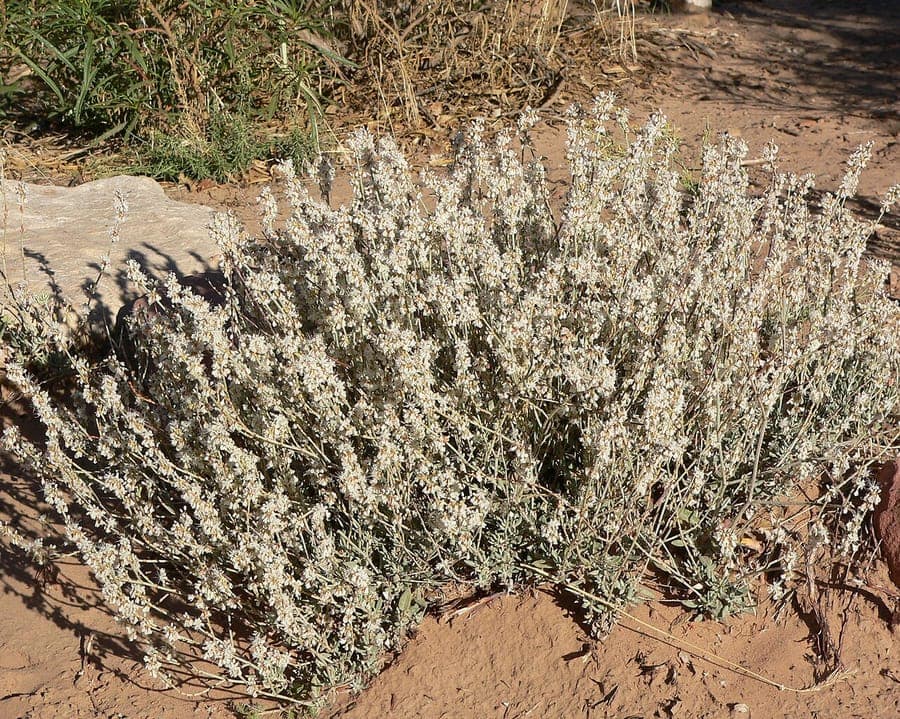
Stan Shebs / CC BY-SA 3.0, via Wikimedia Commons
Wright's buckwheat: complete guide
Eriogonum wrightii
Want to see Wright's buckwheat: complete guide in your garden?
1 minute, no credit card
Overview
Eriogonum wrightii, commonly known as Wright's buckwheat, bastard-sage, or shrubby buckwheat, is a native subshrub or small shrub in the family Polygonaceae. It is named after the American botanist Charles Wright, who collected and documented plants extensively across the southwestern United States and northern Mexico during the mid-nineteenth century. Wild populations of this species span a wide geographic range from California through Arizona, Nevada, Utah, New Mexico and Texas, extending south into parts of Mexico. It inhabits dry, rocky hillsides, limestone ridges, chaparral, pinyon-juniper woodland margins, and desert grassland edges at elevations from near sea level to above 2,000 metres. For gardeners in dry, sunny climates, Wright's buckwheat is one of the most versatile and rewarding natives to grow. Discover drought-tolerant garden design ideas at gardenworld.app.
Appearance and bloom cycle
Wright's buckwheat has a loose, spreading habit, typically growing 30 to 60 cm tall with a spread of 45 to 75 cm. The small, elliptical to spatula-shaped foliage is dull grey-green on the upper surface and densely white-woolly beneath, giving the plant an attractive silver-grey appearance even when not in flower. The bloom period is exceptional in length: flowers appear from August and continue through October and into November, a time when most other garden perennials have finished for the year. The small individual flowers are white to pale cream-pink, held in loose, branching panicles that rise well above the foliage. After the main flush of bloom, the involucres (floral bracts) turn red to rust-brown, extending the ornamental season into early winter. Native bees, honeybees, painted lady butterflies and many other pollinators visit the flowers in large numbers.
Ideal location
Full sun is essential - at least six to eight hours of direct sunlight daily. In partial shade, Wright's buckwheat still grows but produces fewer flowers and a more open, leggy form. In nature, this species is found on exposed, south- or southwest-facing rocky slopes and ridges that receive maximum sun and minimal shade. In the garden, rock gardens, dry-stone retaining walls, gravel borders and xeriscape plantings are ideal placements. The plant handles intense reflected heat from stone, concrete and paving better than almost any other ornamental perennial. Avoid low-lying spots where water collects after rain, as root rot will follow quickly in poorly drained sites.
Soil
Excellent drainage is the primary requirement. In nature, Wright's buckwheat grows in lean, stony loam soils with a pH of 6 to 8 - often on slopes with fast water runoff. Heavy clay soils cause root rot and should be substantially amended with at least 40 to 50 percent coarse grit or perlite before planting, or replaced entirely with a sharply draining mix. Sandy, gravelly and rocky soils require no amendment at all. Rich, moisture-retentive garden soils encourage excessive leafy growth at the expense of flowering and overall plant longevity. A modest application of slow-release organic fertiliser in early spring is sufficient on very poor soils; avoid feeding on moderately fertile ground.
Watering
Establishment typically takes one full growing season, during which weekly deep waterings help the root system develop. From the second year onward, Wright's buckwheat is very drought tolerant and typically requires no supplemental watering in climates with occasional summer rain. In persistently dry summers, a thorough soaking every two to three weeks from July through September is sufficient. Always allow the soil to dry completely between waterings. Overwatering is far more damaging than drought for this species. Standing water at the root crown at any season causes rapid decline. Drip irrigation targeted at the root zone is preferable to overhead sprinklers, and during wet seasons no supplemental water is needed at all. Visit gardenworld.app for garden layout tools suited to dry climate planting.
Free design
Want to see Wright's buckwheat: complete guide in your garden? Make a free design now.
Pruning
Wright's buckwheat needs only light, annual maintenance pruning. In early spring, before new shoots emerge, remove the previous year's dead and brown stems with clean, sharp secateurs. Cut back to just above the living woody framework, taking care not to remove more than one-third of the plant volume at once. After the long bloom period ends in November or December, the spent flower stems may be removed to keep the plant tidy - though the rust-coloured involucres are attractive as winter structure and beneficial insects shelter in them. Young plants can be lightly pinched back in their first two years to encourage a denser, more branched framework. Avoid hard cutting into old, thick stems as recovery from severe pruning is slow.
Maintenance calendar
In March or April, clear away last year's dead material and do the main structural trim. During May and June, watch for excessive moisture at the crown and ensure drainage is sound. From July through November, the plant is in active growth and full bloom: enjoy the pollinator activity and remove spent branches if desired. In November or December, optionally cut back the flowering stems. From December through February, the plant is dormant: ensure drainage remains free and protect the crown from sitting in wet soil. In February, inspect for any frost damage and prepare for the spring trim.
Winter hardiness
Eriogonum wrightii is cold-hardy in USDA zones 5 through 10, tolerating temperatures to approximately -20 degrees Celsius when drainage is adequate. In Western European gardens, where winters are rarely so severe, the main risk is not cold but wet - saturated soil around the root crown during prolonged cool, wet autumn and winter weather causes root rot. On a well-drained site, the plant should survive most European winters without protection. In very rainy winter climates, a collar of coarse grit around the crown deflects excess moisture. Avoid heavy organic mulches that retain water. In continental climates at the edge of zone 5, a sheltered, south-facing position is advisable.
Companion plants
Wright's buckwheat pairs naturally with other plants from arid western North American habitats. Companion buckwheats including Eriogonum umbellatum and Eriogonum thymoides provide visual continuity. Lavandula angustifolia, Salvia greggii, Agastache, Penstemon and Artemisia share similar cultural requirements and extend the season of interest. In a rock garden, Sedum, Sempervivum and small ornamental alliums provide contrasting form and texture. On a dry slope, Wright's buckwheat serves effectively as the mid-tier layer between low mat-forming plants and taller background shrubs such as Ceanothus or native Arctostaphylos. For native pollinators, pairing this plant with other late-season nectar sources such as Aster and Solidago creates a vital wildlife corridor in late summer.
Purchasing and propagation
Wright's buckwheat is best sourced from specialist native plant nurseries or online retailers focused on western North American flora. General garden centres in Europe rarely carry the species, though related Eriogonum selections may appear occasionally. Growing from seed is straightforward: cold-stratify seed for four to six weeks at 2 to 5 degrees Celsius, then sow in March on a light, sandy mix. Germination takes two to four weeks at room temperature. Semi-ripe stem cuttings taken in August root in a perlite and sharp sand mix within six to eight weeks. Self-sown seedlings may appear near established plants if conditions are suitable.
Closing
Wright's buckwheat stands out as one of the finest and most underused native shrubs for dry, sunny gardens. Its exceptional late-season bloom from August to November fills a gap when few other ornamentals are still flowering. The abundant nectar feeds pollinators at a critical time of year. Its grey-silver foliage provides year-round interest, and its low maintenance needs make it an ideal plant for sustainable, water-conscious gardening. Whether you plant it as a specimen, in a mixed xeriscape border, or combined with other natives on a dry slope, Wright's buckwheat delivers consistent beauty and ecological value. Plan your ideal dry garden at gardenworld.app.
Want to see Wright's buckwheat: complete guide in your garden? Make a free design now.
Upload a photo, pick a style, and get a photorealistic design with plant list in under a minute.
10,000+ gardens designed already
No credit card required


Similar plants
Thymeleaf buckwheat: complete guide
Eriogonum thymoides
Full growing guide for Eriogonum thymoides - soil, watering, pruning, winter hardiness and companion plants for this Pacific Northwest native.
Sulfur buckwheat: complete guide
Eriogonum umbellatum
Full guide to sulfur buckwheat: siting, soil, watering, pruning and companion planting for this showstopping yellow-flowered perennial from the American West.
Blue mountain buckwheat: complete guide
Eriogonum strictum
Full guide to blue mountain buckwheat: siting, soil, watering, pruning and companion planting for this striking drought-tolerant perennial from the Pacific Northwest.