
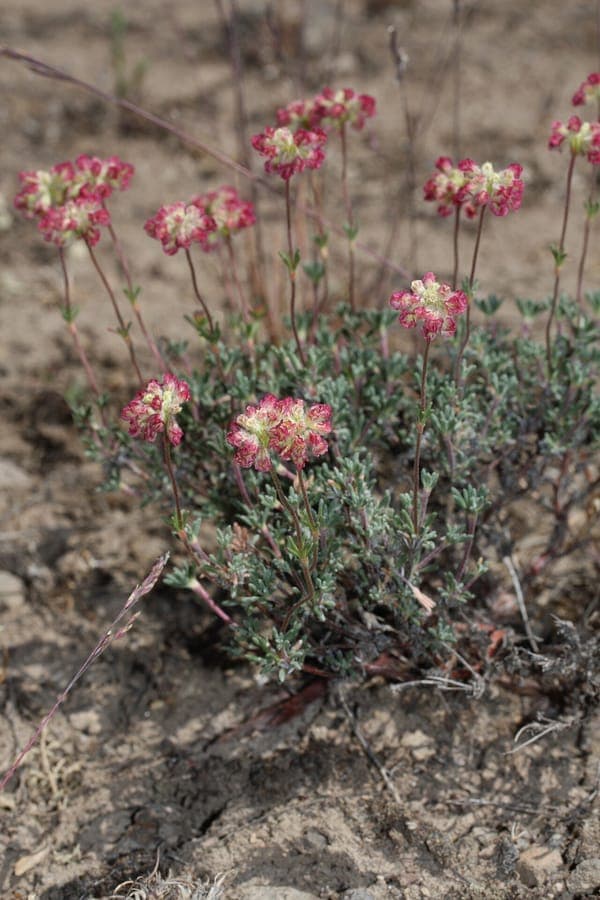
Walter Siegmund (talk) / CC BY-SA 3.0, via Wikimedia Commons
Thymeleaf buckwheat: complete guide
Eriogonum thymoides
Want to see Thymeleaf buckwheat: complete guide in your garden?
1 minute, no credit card
Overview
Eriogonum thymoides, commonly called thyme-leaf wild buckwheat or thymeleaf buckwheat, is a small, mat-forming subshrub in the buckwheat family Polygonaceae. Its species name references the striking resemblance of its leaves to those of common thyme (Thymus vulgaris), both in their small size and their woolly-textured surface. Native to the dry, rocky plateaus and hillsides of Idaho, Oregon and Washington in the Pacific Northwest, this plant occupies some of the most challenging, sun-scorched habitats in the region. It thrives where other perennials struggle: in thin, gravelly soils, on steep south-facing slopes, and in areas that receive little to no summer rainfall. For gardeners working with difficult, dry sites, thymeleaf buckwheat is among the most reliable low-maintenance choices available. Explore companion planting ideas for dry gardens at gardenworld.app.
Appearance and bloom cycle
The plant forms a tight, cushion-like mound typically reaching 10 to 20 cm in height with a spread of 20 to 35 cm. Its small, elliptical to oblong leaves are thick and leathery in texture, grey-green on the upper surface, and coated with a soft white wool on the underside - an adaptation that reflects sunlight and reduces water loss. From April through May and sometimes into early June, the plant produces a profusion of small flowerheads in cream-white to pale yellow tones. The flowers are held in dense, globose clusters on short, upright stems and are highly attractive to native bees, hoverflies and small butterflies seeking early-season nectar. Following bloom, the plant sets small, three-angled achene seeds that are dispersed by wind. The dried flower stems remain on the plant through the winter, offering subtle structural interest in the dormant garden.
Ideal location
Full sun is essential for thymeleaf buckwheat to perform at its best. It requires at least six hours of direct sunlight each day, and in shadier conditions it becomes open and floppy while flowering poorly. In the wild, Eriogonum thymoides grows on steep, south-facing to west-facing slopes at elevations of 200 to 1,500 metres. Replicate this exposure in the garden by choosing an open, well-ventilated position that receives maximum sun. Rock gardens, dry-stone walls, gravel beds, and sunny raised borders are ideal settings. Avoid any location where water pools or collects after rain. The plant handles strong wind without damage and copes well with the reflected heat from stone and paving - conditions that challenge most other perennials.
Soil
Superb drainage is the single non-negotiable requirement for this species. In nature, Eriogonum thymoides grows in thin, stony loamy soils with a pH range of 6 to 8.6, almost always on slopes that shed water quickly. In garden settings, heavy clay or moisture-retaining loam soils will cause root rot within a single wet season. Amend clay soils with at least 50 percent coarse grit or perlite, or replace the planting bed entirely with a lean, free-draining mix. Sandy or gravelly soils need little or no amendment. Container growing works well too: use a cactus and succulent potting mix blended with extra perlite. Avoid feeding this plant with general-purpose fertilisers; the lean soil it prefers produces more compact, floriferous plants.
Watering
Once established - typically after one full growing season - thymeleaf buckwheat is impressively drought tolerant. During the first year after planting, water modestly once a week during dry spells to help the root system become established. From the second year onward, rainfall is usually sufficient except during prolonged dry periods of six weeks or more, when a deep soaking every two weeks is appropriate. Always allow the soil to dry out completely between waterings. Standing water around the root crown at any time of year is the primary cause of plant loss with this species. In regions with reliably wet winters, consider a sheltered position, raised planting, or a covering of coarse grit around the crown.
Free design
Want to see Thymeleaf buckwheat: complete guide in your garden? Make a free design now.
Pruning
Minimal pruning is required for this naturally compact subshrub. In early spring, before new growth begins, remove any dead or damaged stems from the previous year using clean, sharp secateurs. Cut back to just above the living woody base, but never remove more than one-third of the plant volume at once. After flowering in June or July, the spent flower stems can be removed to keep the plant tidy, though this is optional rather than necessary. The dried stems provide winter structure and shelter for beneficial insects. Heavy-handed pruning does not encourage more flowering and can weaken the plant permanently.
Maintenance calendar
In March or April, once the risk of hard frost has passed, clear away the winter's dead material with clean secateurs. During April and May enjoy the flowering display and inspect the plant for any signs of root rot or crown wetness. In June, optionally remove the spent flower stems. From July through September the plant is largely dormant: water only during extended drought. In October and November check that the root area is draining freely ahead of winter. In December and January leave the dried stems standing as quiet winter structure. In February inspect for frost damage and prepare for the spring tidy-up.
Winter hardiness
Eriogonum thymoides is cold-hardy in USDA zones 5 through 9, tolerating temperatures down to approximately -26 degrees Celsius, provided drainage is excellent. Wet winters pose a much greater threat than cold: standing water around the root crown leads quickly to rot in low temperatures. In mild, maritime climates such as those found in much of Western Europe, cold is rarely the limiting factor - poor drainage almost always is. A layer of coarse grit spread around the crown before winter helps deflect excess moisture. Avoid mulching with straw or leaves, which trap moisture and create conditions for fungal disease. Gardeners in very wet winter regions may find success overwintering plants in a cold frame or unheated greenhouse.
Companion plants
Thymeleaf buckwheat partners naturally with other plants from arid western North American habitats. Other buckwheat relatives make ideal neighbours: Eriogonum umbellatum (sulphur buckwheat), Eriogonum wrightii, and Eriogonum strictum are all fine choices for a cohesive native planting. Beyond the genus, lavender (Lavandula angustifolia), Salvia, Artemisia, and Penstemon share similar cultural requirements and complementary flower colours. In a rock garden setting, Sedum, Sempervivum, and low-growing Festuca provide contrasting textures. On a dry slope, thymeleaf buckwheat works well as the lowest, mat-forming layer beneath slightly taller native shrubs. Visit gardenworld.app to plan a harmonious planting layout for your dry garden.
Purchasing and propagation
Thymeleaf buckwheat is primarily available through specialist native plant nurseries and online retailers with a focus on western North American flora. Mainstream garden centres sometimes stock Eriogonum species in the summer months. Growing from seed is the most accessible approach: cold-stratify the seed for four to six weeks at 2 to 5 degrees Celsius before sowing in March on a light, sandy seed mix. Germination takes two to four weeks at room temperature. Semi-ripe stem cuttings taken in August and rooted in a mix of perlite and sharp sand will produce plants identical to the parent, though patience is needed as rooting can take six to eight weeks.
Closing
Eriogonum thymoides may not be the showiest plant in the garden, but its quiet reliability, early season colour, and exceptional tolerance of dry, lean conditions earn it an honoured place in any sun-baked, low-maintenance planting scheme. Whether you are building a rock garden, planting a dry slope, or simply filling a problematic sunny corner, this compact buckwheat delivers season after season with minimal intervention. Its flowers feed pollinators in early spring when food sources are scarce, and its evergreen foliage adds structure through the winter. For a tailored garden design that puts drought-tolerant natives to their best use, explore the tools and inspiration available at gardenworld.app.
Want to see Thymeleaf buckwheat: complete guide in your garden? Make a free design now.
Upload a photo, pick a style, and get a photorealistic design with plant list in under a minute.
10,000+ gardens designed already
No credit card required


Similar plants
Wright's buckwheat: complete guide
Eriogonum wrightii
Complete growing guide for Eriogonum wrightii - a long-blooming drought-tolerant native shrub with white flowers attractive to pollinators from late summer to autumn.
Sulfur buckwheat: complete guide
Eriogonum umbellatum
Full guide to sulfur buckwheat: siting, soil, watering, pruning and companion planting for this showstopping yellow-flowered perennial from the American West.
Blue mountain buckwheat: complete guide
Eriogonum strictum
Full guide to blue mountain buckwheat: siting, soil, watering, pruning and companion planting for this striking drought-tolerant perennial from the Pacific Northwest.