
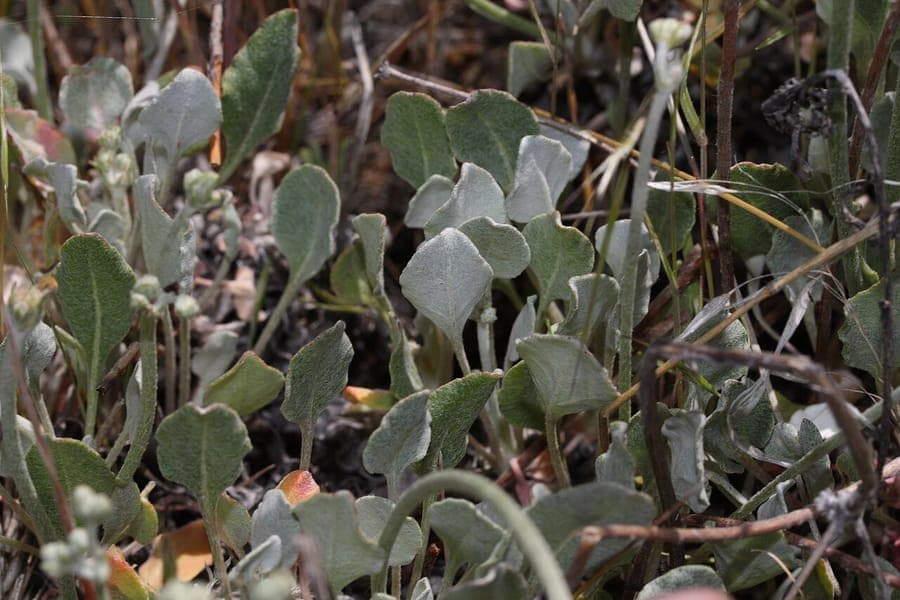
Walter Siegmund (talk) / CC BY-SA 3.0, via Wikimedia Commons
Blue mountain buckwheat: complete guide
Eriogonum strictum
Want to see Blue mountain buckwheat: complete guide in your garden?
1 minute, no credit card
Overview
Blue mountain buckwheat (Eriogonum strictum) is a compact, long-lived subshrub belonging to the family Polygonaceae. Native to the dry hillsides and open steppe landscapes of the Pacific Northwest, it grows naturally across British Columbia, California, Idaho, Montana, Nevada, Oregon, and Washington. In its native range, it colonises rocky slopes, open pine forest meadows, and sagebrush-steppe edges at elevations of 200 to over 2,000 metres above sea level.
The species epithet strictum is Latin for upright or strict, describing the characteristically erect, disciplined growth habit of its stems. This distinguishes it from some sprawling relatives in the Eriogonum genus, which contains over 250 species native to North America. Blue mountain buckwheat has a single-crown growth form - stems emerge cleanly from one central crown rather than spreading as a colony.
Eriogonum strictum forms a slowly growing subshrub reaching 20 to 50 cm in height and 30 to 70 cm in spread. It is reliably perennial, blooms faithfully every summer, and proves exceptionally hardy and long-lived where drainage conditions suit it. In Europe, this species remains a specialist's choice but rewards adventurous gardeners with three seasons of interest. Discover how drought-tolerant planting schemes look in real gardens by visiting gardenworld.app.
Appearance & bloom cycle
The foliage of blue mountain buckwheat consists of oval to spatula-shaped leaves, 1.5 to 4 cm long, with a grey-green to light green colouring. The leaf undersides are white to grey and woolly-hairy, the upper surface slightly greener and less hairy than closely related Eriogonum niveum. Leaves are arranged in basal rosettes and remain attractive throughout the growing season. In dry, sunny conditions the foliage becomes more compact and shows more silver-grey coloration.
The flowering season runs from June through August, with peak flowering in July. Flower stems extend 30 to 55 cm above the foliage rosette and carry loosely branched clusters of tiny cream to yellowish-white flowers. Individual flowers are just 2 to 3 mm across, but the clusters are numerous and clearly visible. The flowers are notably nectar-rich, attracting a wide variety of pollinators including honeybees, solitary bees, butterflies, and hoverflies. This quality makes blue mountain buckwheat particularly valuable in a wildlife-friendly or pollinator garden.
After flowering, small triangular brown fruits containing seeds form on the dried stems. These spent flower stems remain structurally interesting and provide a pleasing winter silhouette. The cultivar 'Blue Mountain' has been selected for an exceptionally compact growth form of just 20 to 25 cm.
Ideal location
Blue mountain buckwheat performs best in a sunny, warm position with full direct sun for at least five to six hours daily. In deep shade, flowering becomes sparse and the plant grows loosely rather than in its characteristic tight mound. A south or west-facing border is ideal, as is an open rock garden with good air circulation around the plants.
This species excels in rock gardens, dry stone walls, and slope plantings where roots can reach deeply into crevices and drainage is naturally excellent. Paired with a gravel or lava mulch around the base, it performs exceptionally well because the mulch limits soil moisture and keeps the root crown dry year-round. Spacing in group plantings: 40 to 60 cm between plants. For complete ground coverage in a dry planting: five plants per square metre.
In urban gardens with heat stress - beside paved driveways, in walled courtyards, on south-facing slopes - Eriogonum strictum proves itself superior to most ornamental perennials. It handles radiated heat from hard surfaces with ease, where many other plants wilt and struggle.
Soil requirements
Blue mountain buckwheat is undemanding regarding soil fertility but is absolute in its requirement for excellent drainage. The ideal pH range is 6.0 to 8.6, meaning the plant tolerates both slightly acidic and markedly alkaline, lime-rich soils - a wide adaptability that makes it compatible with many different garden settings. Heavy, wet clay soils are unsuitable and almost invariably lead to plant death.
In well-draining sandy or loamy soils with a modest organic content, Eriogonum strictum grows without difficulty. When planting into moderately draining soil, add at least 30 to 35 percent coarse grit or crushed stone to the existing soil to improve drainage. Adding large amounts of rich garden compost is counterproductive: excessive fertility promotes lush leafy growth at the expense of flower production and gradually weakens winter hardiness.
In rock gardens and stony borders, plant into pockets filled with a lean mix of coarse sand and coarse grit in a 1:1 ratio. A mulch layer of 3 to 5 cm of broken granite chips or quartz sand around the plant protects the roots from summer heat, reduces weed germination, and keeps the plant base dry. Avoid organic mulches such as bark or leaf compost placed directly against the crown.
Watering
Once planted and well rooted, blue mountain buckwheat is exceptionally drought-tolerant. In its native habitat it survives summers with less than 250 mm of rainfall and no supplemental irrigation. In European gardens, occasional top-up watering is useful, but overwatering is the most common cultivation mistake with this species.
During the first growing season after planting, water weekly in dry, warm weather to encourage strong root development. Always wait until the top 5 to 8 cm of soil has dried out completely before watering again. Water early in the morning and avoid leaving water standing on the foliage. Drip irrigation delivers the best results - water goes directly to the roots without wetting the leaves, reducing the risk of fungal problems.
From the second year onwards, supplemental watering is rarely necessary in a year with reasonable rainfall. Water only after dry spells exceeding three weeks. Stop watering completely in autumn and winter. Wet winter conditions are by far the most dangerous situation for blue mountain buckwheat and the most frequent cause of plant loss in European gardens. The plant is much more likely to succumb to winter wetness than to winter cold.
Free design
Want to see Blue mountain buckwheat: complete guide in your garden? Make a free design now.
Pruning
Blue mountain buckwheat requires minimal pruning. The ideal approach is restraint: respect the plant's natural form and cut only what is genuinely necessary. Leave spent flower stems standing through autumn and well into winter - they provide seeds for birds, protection for the root crown in cold weather, and an attractive structural silhouette.
In early spring, around mid-March, cut back dead stems and old flower stalks to 5 to 8 cm above ground level. Always wait until you can see new green shoots clearly emerging at the base before cutting back. Never cut deeply into the woody basal growth: Eriogonum strictum regenerates slowly from hard pruning and may not recover fully.
A light trim of outward-spreading shoots in April or May helps maintain the compact mound form if desired. Remove dead or damaged wood promptly when spotted. A light renovation every two to three years is sufficient to keep the plant vigorous and in full flower. To limit self-seeding, remove seed heads after seed dispersal but before complete ripening.
Maintenance calendar
January and February: Full dormancy. No action required. Check that drainage is functioning and no water pools around the base after heavy rainfall. Drainage is the single most critical factor during these months.
March: Begin clean-up: remove dead stems and flower stalks. Cut back to 5 to 8 cm above ground once new green shoots are visible. Top up gravel mulch if needed.
April: Optional: apply a light dusting of a slow-release fertiliser that is low in nitrogen and high in potassium to support flowering. Water weekly in dry weather to support the new growing season.
May and June: Growing season underway. Water once weekly during dry periods. Weed control in the gravel mulch. Monitor the first bud formation.
July and August: Peak flowering. Enjoy the blooms and observe the pollinators. Minimal watering only. Remove only damaged or dead stems.
September: Flowering winds down. Leave stems and seed heads in place for wildlife. Stop watering.
October and November: Autumn preparation. No further intervention. Add a thin gravel layer around the crown if winter wetness is a concern.
December: No further action. Full dormancy.
Winter hardiness
Blue mountain buckwheat is rated hardy to USDA zone 5, corresponding to minimum temperatures of approximately -29 °C. In practice, plants in the UK, the Netherlands, Belgium, and northern France survive average winters without any protection. The plant has proven its toughness on cold rocky hillsides in the Sierra Nevada and the Rocky Mountains, where winter snow cover is common.
Snow cover is actually beneficial for Eriogonum strictum: it insulates the roots from sudden sharp frosts and keeps the root crown dry beneath the snow layer. What proves dangerous is persistent wetness at temperatures just above freezing - the combination of moisture and cool temperatures creates conditions for crown rot. Excellent drainage remains the cornerstone of successful overwintering.
In severe winters with temperatures below -20 °C and no snow cover, a light protective layer of coarse grit or quartz sand around the plant base is recommended. Thick organic insulating layers are counterproductive as they retain moisture. Container plants overwinter best in a sheltered, dry, frost-free position - against a wall, in an unheated cold frame, or under a garden shelter. Visit gardenworld.app for garden design inspiration that accounts for your specific climate and site conditions.
Companion plants
Eriogonum strictum pairs excellently with other perennials and sub-shrubs sharing similar site preferences. The name 'Blue Mountain' refers to the Blue Mountains of Oregon - not to blue-coloured flowers, which are in fact cream to white. Good garden partners include:
- Eriogonum umbellatum: Same family, but with bright yellow umbel flowers. Together they create a striking colour contrast in a dry border.
- Penstemon digitalis 'Husker Red': Dark red foliage, white flowers June to July, 60 to 70 cm. Beautiful structural contrast.
- Artemisia 'Powis Castle': Silver-grey sub-shrub, 60 to 80 cm, echoing Eriogonum's grey-green foliage.
- Stachys byzantina 'Big Ears': Large grey woolly leaves as ground cover, 20 to 30 cm.
- Lavandula angustifolia 'Munstead': Lavender 30 to 40 cm with blue spikes, same preference for dry, alkaline conditions.
- Achillea 'Moonshine': Pale yellow flowers 50 to 60 cm from June to September, excellent for pollinators.
- Calamagrostis acutiflora 'Karl Foerster': Tall ornamental grass as structural backdrop behind the lower Eriogonum mounds.
Avoid pairing with moisture-loving plants such as Astilbe, Hosta, or Trollius, which require a completely different watering regime.
Closing
Blue mountain buckwheat is an elegant, underappreciated perennial that brings effortless beauty to sunny, dry gardens. Its cream-white flower clusters in summer, its attractive grey-green foliage throughout the season, and its minimal maintenance demands make it an excellent choice for the informed gardener. Pair it with other pollinator-friendly species to maximise biodiversity value and create a garden that buzzes with life from June through September.
Want to see how Eriogonum strictum would look in your own front garden or border? Visit gardenworld.app for a personalised garden design that takes your specific site, soil, and style preferences into account.
Want to see Blue mountain buckwheat: complete guide in your garden? Make a free design now.
Upload a photo, pick a style, and get a photorealistic design with plant list in under a minute.
10,000+ gardens designed already
No credit card required


Similar plants
Crosby's wild buckwheat: complete guide
Eriogonum crosbyae
Full guide to growing Eriogonum crosbyae: ideal site, soil, watering, winter hardiness and companion plants for this rare western wild buckwheat.
Spreading buckwheat: complete guide
Eriogonum effusum
Full guide to growing Eriogonum effusum: ideal site, soil, watering, winter hardiness and companion plants for this prairie subshrub from the American West.
Tall woolly buckwheat: complete guide
Eriogonum elatum
Full guide to Eriogonum elatum: siting, soil, watering, pruning and companion plants for this elegant white-flowered buckwheat from the western United States.