
AdrienneA / CC BY-SA 2.0, via Wikimedia Commons
Tall woolly buckwheat: complete guide
Eriogonum elatum
Want to see Tall woolly buckwheat: complete guide in your garden?
1 minute, no credit card
Overview
Eriogonum elatum, commonly known as tall woolly buckwheat, is a striking perennial belonging to the family Polygonaceae. It is native to the western United States - specifically California, Idaho, Nevada, Oregon, and Washington - where it inhabits dry, open slopes, chaparral-edged hillsides, and rocky foothills of the Sierra Nevada and Cascade Range. The species is one of hundreds within the large genus Eriogonum, which contains over 250 species, nearly all native to North America west of the Rocky Mountains.
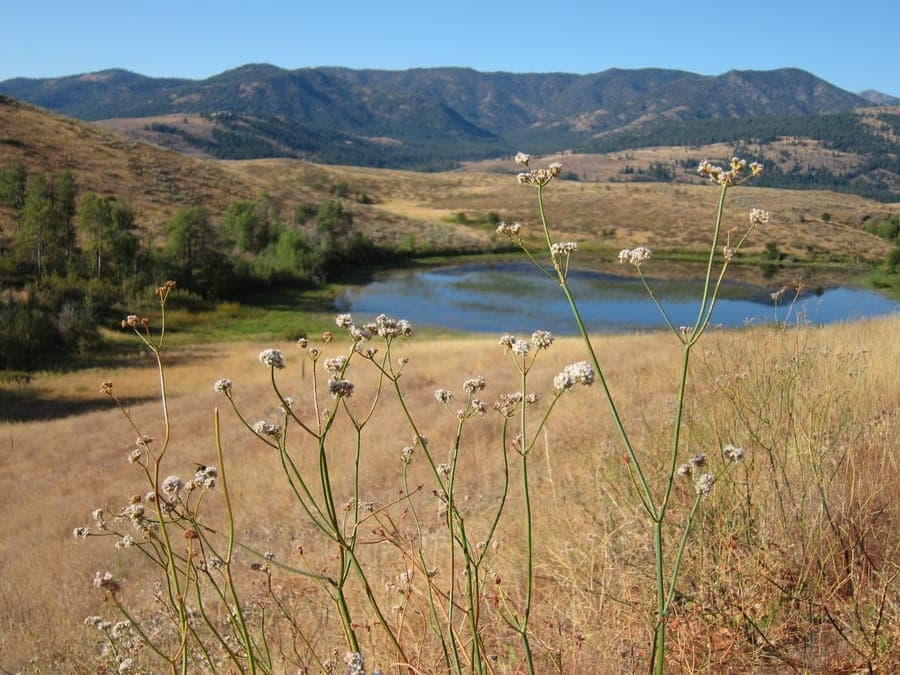
The species epithet 'elatum' comes from the Latin elatus, meaning 'tall' or 'elevated' - a direct description of the plant's most characteristic feature: its remarkably tall, slender flowering stems. These stems can reach 60 to 120 cm in height, rising well above the low, ground-hugging leaf rosette. That contrast - a compact mat of woolly grey-green leaves at ground level topped by airy, branching white flower clusters - is the defining visual trait of this species.
For gardens in northern Europe, Eriogonum elatum offers a compelling combination of drought tolerance, long bloom season, pollinator value, and elegant winter structure. Whether planted in a dry border, a gravel garden, or a rocky slope, it delivers seasonal interest from early summer through to the first hard frosts of winter and beyond. Visit gardenworld.app to explore how drought-tolerant natives like Eriogonum elatum can anchor a low-water garden planting, or to design a custom scheme before you plant.
The plant grows as both a subshrub and an herbaceous perennial depending on conditions. In its native range, it survives on exceptionally lean, dry soils and can thrive for years without irrigation. That resilience translates well to European gardens where summer dry spells have become increasingly common.
Appearance & bloom cycle
The foliage of tall woolly buckwheat consists of a compact, low-growing basal rosette of oblong to elliptical leaves. The upper surface of each leaf is green to grey-green, while the underside is densely covered in soft, white to grey woolly hairs - a characteristic that gives the species its common name and helps the plant manage heat and moisture loss in exposed positions. The hairy leaf surface reflects sunlight and reduces transpiration, allowing the plant to remain in good condition even during extended dry periods.
From June onwards, long, branching flowering stems emerge from the rosette. These stems are slightly hairy themselves and carry dense, flat-topped clusters of small white to cream flowers at their tips and branch ends. Individual flowers are only a few millimetres wide, but each stem carries dozens of flowers grouped into rounded heads, making the overall floral display generous and visible from a distance. The bloom season runs from June to September, with the peak in July and August.
After the flowers fade, the seed heads dry in place and transition from white through cream and ochre to a warm reddish-brown or copper tone. In this dried state the flower stems remain attractive throughout autumn and winter as a structural element in the garden. The dried stems also make excellent material for dried arrangements or naturalistic winter displays. Birds, particularly seed-eating finches and sparrows, visit the seed heads during autumn and winter.
In its native range, Eriogonum elatum is an important nectar plant for native bees, solitary bees, bumblebees, and butterflies. In European gardens, the white flower clusters attract honeybees, bumblebees, and numerous species of hoverfly throughout the long bloom season.
Ideal location
Tall woolly buckwheat demands a fully sunny position with at least six hours of direct sunlight daily. The plant does best in open, unshaded positions without overhanging trees or dense shrubs nearby. A south- or south-west-facing border, an open rock garden, a steppe border, or a dry gravel bed are all excellent choices.
The tall flowering stems make this plant particularly useful as a mid-border or background plant in dry schemes, where the low rosette covers the foreground and the stems add a light, naturalistic vertical accent to the mid-border or back. Plant in clusters of three to five for the strongest visual effect, as grouped stems form a more cohesive floral mass than single specimens.
Avoid positions with persistently wet conditions, heavy clay soil, or shade cast by buildings or dense planting. In urban settings, the plant is suitable for courtyard or paved gardens with gravel beds, provided the position receives adequate sun. Spacing in group plantings: 45 to 60 cm between plants.
The vertical stem habit pairs particularly well with low, cushion-forming or horizontal neighbours such as Festuca, Delosperma, or mat-forming Phlox species. That contrast in growth form makes a border more dynamic and visually interesting throughout the season.
Soil requirements
Eriogonum elatum is undemanding regarding soil fertility but requires good drainage without exception. In its native range it grows on rocky, lean or sandy soils with a pH of 6 to 8.5. That wide pH tolerance makes the species adaptable to diverse soil conditions, from slightly acid soils to calcareous substrates.
In northern European gardens, most soils are richer and moister than what the plant experiences in the wild. It is therefore sensible to improve the planting hole before setting out plants. Mix the existing soil with 30 to 40 percent coarse grit, crushed stone, or perlite to increase permeability. Do not use heavy clay soil without amendment; clay retains water and this can be fatal to Eriogonum roots, especially combined with wet winters.
A mulch layer of quartz sand or broken granite around the plant base keeps the root crown dry and suppresses weeds effectively. Avoid organic mulches such as bark or leaf compost placed directly around the base, as these retain moisture and increase the risk of soil fungal issues. Do not add nitrogen-rich fertiliser: Eriogonum elatum thrives on lean ground and responds to over-feeding with lush but weak, short-lived growth.
Free design
Want to see Tall woolly buckwheat: complete guide in your garden? Make a free design now.
Watering
Eriogonum elatum is a drought specialist that survives in its natural habitat on limited rainfall, sometimes less than 300 mm per year. Once well established, the plant can get by on rainfall alone in northern European conditions and needs almost no supplemental irrigation.
During the first growing season after planting, regular watering is necessary to help the plant establish. Water once per week during dry, warm conditions. Always wait until the top 8 to 10 cm of soil feels completely dry before watering again. Drip irrigation delivering water directly to the roots without wetting the foliage gives the best results. Wet leaves are a risk factor for fungal disease.
From the second season onwards, supplemental watering is rarely needed. The plant handles dry spells of three to four weeks without difficulty. Only in exceptional heat combined with drought exceeding four to five weeks does an extra watering help. In that case, water deeply and then allow the soil to dry out fully before watering again.
Do not water in autumn or winter under any circumstances. Excess winter moisture combined with poor drainage is by far the most common cause of plant loss with Eriogonum in European gardens. The plant tolerates drought far better than waterlogging.
Pruning
Eriogonum elatum calls for a restrained approach. Leave the dried flower stems standing through autumn and winter - they provide structure in the border, food for seed-eating birds, and protection for the root crown. Only in early spring, once new green shoots appear at the base, is it time to cut back.
Trim the dried flower stems to about 8 to 10 cm above ground level. Always use clean, sharp secateurs to avoid damaging young shoots. Cutting back before new growth appears risks harming emerging buds. Never cut too deeply into the woody base: that basal framework is the lifeblood of the plant and recovers poorly from unnecessarily hard cutting.
A light tidying cut in April or May, trimming outward-spreading stems to maintain a tidy shape, encourages compactness and good flowering. Remove damaged or dead branches as soon as you notice them. A more thorough renovation is rarely needed; cutting back by one-third every four to five years is sufficient for most plants. To limit self-seeding, remove dry seed heads before seeds are fully ripe.
Maintenance calendar
January and February: Full dormancy. No intervention. Check that no water is pooling around the plant after heavy rainfall. Frozen ground is fine; persistent waterlogging is not.
March: Begin removing dried flower stems once new shoots are visible at the base. Cut back to 8 to 10 cm above ground level. Remove any dead or damaged stems.
April: Optionally add a fresh layer of gravel mulch around the plant. Water once weekly during prolonged dry spells. A small amount of potassium-rich fertiliser can support flowering.
May and June: Growing season underway. Water weekly in dry weather. Weed control in the gravel mulch. Flower buds appear; bloom starts in late June.
July and August: Peak of the bloom. White flower clusters at their most impressive. Minimal watering. Remove only clearly dead stems.
September: Flowering winds down. Stems begin to dry and discolour. Leave everything standing for structure and bird food. Stop watering.
October and November: Autumn. No additional action. Check drainage.
December: Full dormancy. No interventions.
Winter hardiness
Eriogonum elatum is reliably hardy and tolerates frost well, provided the soil drains freely. Based on its distribution - from the coastal regions of Oregon and Washington to the mountain slopes of Nevada - the species is generally placed in USDA hardiness zones 5 to 8, corresponding to minimum temperatures of approximately -28 to -12 degrees Celsius. Most parts of the Netherlands and Belgium fall into zone 7 to 8, meaning the plant survives winter without special protection in typical conditions.
The greatest risk factor is not cold but a combination of moisture and cold: wet roots during frost periods lead to cell damage and root rot. Free-draining soil, possibly supplemented with a drainage layer of coarse grit beneath the planting pocket, is the most effective protection. In exceptionally wet-winter regions, a simple glass or tile shelter placed above the plant base can help deflect excess moisture.
Snow cover is not a problem for the plant - on the contrary, a layer of snow insulates the roots and moderates temperature fluctuations. Dead flower stems from winter are removed only in early spring once new shoots are visible. For a tailored garden design featuring winter-hardy drought lovers such as Eriogonum elatum, explore the tools available at gardenworld.app.
Companion plants
Eriogonum elatum fits naturally into dry borders, rock gardens, and steppe-style plantings. The white flower clusters and tall stems contrast well with blue, purple, and yellow-flowering species. Good planting combinations include:
- Lavandula angustifolia 'Munstead': Lavender-blue spikes 30 to 40 cm, flowering simultaneously in July and August. The classic white-blue combination is always effective.
- Penstemon digitalis 'Husker Red': White flowers and dark red foliage, 60 to 80 cm, blooms May to July. The vertical flower stems echo the growth habit of Eriogonum elatum.
- Salvia nemorosa 'Caradonna': Deep purple, 50 to 60 cm, blooms May to June and overlaps with early Eriogonum flowering.
- Stipa tenuissima: Fine-leaved feather grass, 40 to 60 cm. The airy, movement-filled texture contrasts well with the firm white flower clusters.
- Echinacea pallida: Pale pink to white coneflowers, 60 to 90 cm, blooms July to September.
- Achillea 'Moonshine': Sulphur yellow, 50 to 60 cm. Yellow against white creates a fresh, long-lasting border partnership.
- Eriogonum umbellatum: Sulphur-yellow wild buckwheat as a contrasting colour partner sharing the same soil conditions.
Avoid plants with high moisture requirements such as Astilbe, Hosta, or Rodgersia. These plants cannot tolerate the dry siting requirements of Eriogonum elatum and will struggle alongside it. Choose partners from prairie, steppe, or Mediterranean planting traditions for the best results.
Closing
Tall woolly buckwheat is an elegant, versatile perennial that brings distinctive vertical structure to dry, sunny gardens. Its long, white-topped flower stems, its decorative winter silhouette, its generous pollinator value, and its extremely low maintenance demands make it a compelling choice for gardeners who want beauty without the burden of irrigation.
At gardenworld.app you can explore planting combinations featuring wild buckwheat species like Eriogonum elatum alongside other drought-tolerant natives and ornamentals. Design a custom garden layout to see how these plants would look in your own outdoor space before you lift a trowel.
Want to see Tall woolly buckwheat: complete guide in your garden? Make a free design now.
Upload a photo, pick a style, and get a photorealistic design with plant list in under a minute.
10,000+ gardens designed already
No credit card required


Similar plants
Sulfur buckwheat: complete guide
Eriogonum umbellatum
Full guide to sulfur buckwheat: siting, soil, watering, pruning and companion planting for this showstopping yellow-flowered perennial from the American West.
California buckwheat: complete guide
Eriogonum fasciculatum
Full guide to Eriogonum fasciculatum: siting, soil, watering, pruning and companion plants for this popular California native shrub beloved by pollinators.
Inyo buckwheat: complete guide
Eriogonum latens
Full guide to Eriogonum latens: siting, soil, watering, pruning and companion planting for this rare California native wild buckwheat from the dry Inyo Mountains region.