
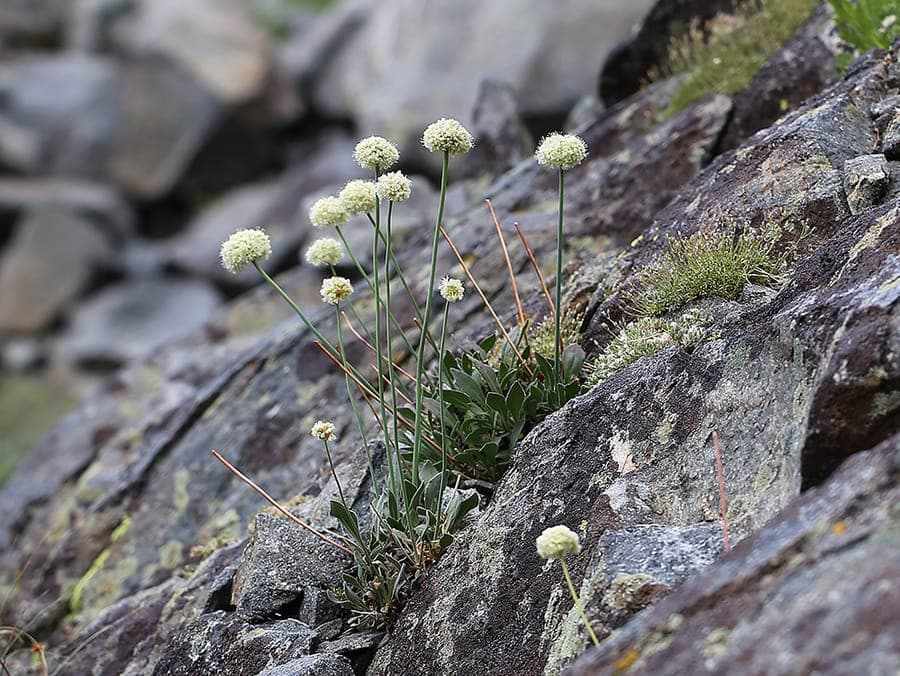
(c) Steve Matson, some rights reserved (CC BY) / CC BY 4.0, via Wikimedia Commons
Inyo buckwheat: complete guide
Eriogonum latens
Want to see Inyo buckwheat: complete guide in your garden?
1 minute, no credit card
Overview
Eriogonum latens, commonly known as Inyo buckwheat or Onionflower buckwheat, is a little-known but botanically distinctive wild buckwheat species in the family Polygonaceae. The species has a restricted natural distribution, limited to California and adjacent western Nevada, with the core of its occurrence in and around the Inyo Mountains and the White-Inyo Range in eastern California. Its name speaks directly to this remarkable homeland: Inyo County, one of the most extreme and simultaneously most fascinating arid regions of the western United States.
The species name latens comes from the Latin latere, meaning 'to be hidden' or 'to remain concealed' - a reference to the plant's inconspicuous presence in the dry, rocky landscape. The common name Onionflower buckwheat refers to the flower arrangement, with small blooms gathered into rounded, slightly onion-shaped heads. Botanical synonyms Eriogonum elatum subsp. glabrescens and Eriogonum monticola, used in older literature, indicate that the plant is closely related to Eriogonum elatum but is recognised as a distinct species.
Eriogonum latens grows as a subshrub or herbaceous perennial with a compact, cushion-forming to somewhat loosely branched structure. In its California homeland it inhabits exceptionally dry, rocky slopes, desert scrub, and open shrub-steppe at elevations of 1,000 to 2,500 metres. For gardeners seeking an unusual, less common plant with genuine character for a dry garden, Eriogonum latens offers an interesting option. Explore how rare drought-tolerant natives like this can serve as distinctive accents in a naturalistic planting scheme at gardenworld.app.
The plant is less commercially available than its more famous relatives, but can sometimes be found at specialist nurseries focusing on California native and drought-adapted plants.
Appearance & bloom cycle
Eriogonum latens has a characteristic compact to moderately branched growth habit. The leaves are green, elliptical to egg-shaped, with a medium texture comparable to other members of the genus. The underside of the leaf shows light hairiness, though less conspicuously woolly than the closely related Eriogonum elatum. The basal rosette forms the foundation of the plant and remains attractively green throughout the growing season.
The flowering of Eriogonum latens is characteristic of the genus: small flowers in dense, rounded to hemispherical flower heads, carried on upright stems above the leaf rosette. Flower colour is typically white to cream, occasionally with a faint pink or yellow blush. The bloom period falls in summer, generally from June to September, depending on elevation and local climate conditions. At higher elevations the plant blooms later in the season than on lower, warmer sites.
After flowering, the flower heads dry slowly into brownish, compact structures that remain on the plant for an extended period, providing an attractive winter silhouette. The flowers attract native bees, bumblebees, and hoverflies, and the ripe seeds serve as a food source for small seed-eating birds. Compared to its more prominent relatives, Eriogonum latens is more modest in stature, but no less decorative in the right setting.
Ideal location
Eriogonum latens requires a fully sunny position with at least six hours of direct sun per day. As a plant of dry mountain slopes and desert margins, it does best on open, exposed sites without shade from buildings, trees, or large shrubs. In its native habitat it faces intense summer sun, wide temperature swings, and strong winds - conditions that make it robust rather than sensitive.
For gardens in northern Europe, suitable positions include: open rock gardens with a south-facing aspect, stony borders on higher and drier parts of the garden, gravel areas alongside paving or low walls, and xerophytic plantings combining low-growing subshrubs. Its compact growth habit makes it suitable as an infill plant between larger boulders or as an accent in a naturalistic steppe bed.
Spacing in group use: 40 to 60 cm between plants. Eriogonum latens also works well in broader flat gravel areas alongside other small drought-lovers, where its compact silhouette shows to advantage. Avoid damp hollows, shaded positions, and sites with persistently wet ground.
Soil requirements
Eriogonum latens makes the same strict demands on soil as its relatives: the ground must be lean, freely draining, and dry. The preferred pH is 6 to 8.5, a relatively wide range showing the plant adapts to both slightly acid and alkaline conditions. In its native range it grows on limestone slopes, granitic outcrops, and rocky clefts with minimal fine substrate.
In northern European gardens, where soil is typically richer and more moisture-retentive than the plant encounters in the wild, soil improvement in the planting area is important. Add 30 to 40 percent coarse grit, crushed shell, or perlite to the planting pocket to improve drainage. Keep organic matter content deliberately low - organic material retains moisture and over-enriches the soil. Eriogonum latens flourishes on lean, mineral-rich substrates that mirror its extreme natural habitat.
A mulch layer of quartz grit or crushed granite, 4 to 6 cm deep, around the plant base (not touching the stem) is recommended. This mulch keeps the root zone cool, reduces soil moisture evaporation, and protects the plant base from direct rain splash. Avoid bark chips and leaf compost in the immediate vicinity of the plant.
Free design
Want to see Inyo buckwheat: complete guide in your garden? Make a free design now.
Watering
Eriogonum latens is naturally a resident of one of California's driest mountain regions, the White-Inyo Range - an area renowned for its extreme aridity and minimal annual rainfall. It is among the most drought-tolerant representatives of the genus Eriogonum.
In the first growing season after planting, some supplemental watering is needed to help roots establish in the new soil. Water once per week during dry, warm conditions and allow the soil to dry out completely before the next watering. Use drip irrigation at the plant base and avoid wetting the leaves. Wet foliage raises the risk of fungal disease, particularly for plants in the relatively more humid European climate.
From the second growing season onwards, supplemental watering is rarely necessary. Eriogonum latens handles dry spells of several weeks without harm, provided the soil drains well. Never water in autumn or winter; winter moisture combined with wet soil is the most common cause of loss with drought-adapted plants in European gardens. When unsure whether to water: always wait longer than instinct suggests. The plant handles drought far better than excess moisture.
Pruning
Eriogonum latens requires a restrained approach to pruning, comparable to other Eriogonum species. Leave the dried flower stems and heads through autumn and winter - they provide structure in the dry bed, food for seed-eating birds, and protection for the plant's root crown. Only in early spring, once new green shoots appear at the base of the plant, is the right moment to intervene.
Cut back dead stems to 5 to 8 cm above the ground using clean, sharp secateurs. Pruning before new shoots are visible risks damaging emerging growth. Never cut deeply into the woody base: Eriogonum latens recovers slowly from hard cutting, like its relatives.
A light tidy in April or May, trimming outward-reaching shoots, encourages compact growth and good flowering. Remove dead or damaged stems as soon as you notice them. Hard renovation pruning is rarely needed; once every four to five years is well sufficient. To limit self-seeding, remove the flower heads after seeds have scattered but before full ripening.
Maintenance calendar
January and February: Full dormancy. No intervention. Check drainage during persistent rainfall. Leave dried flower stems for birds and winter structure.
March: Begin removing dead stems once new shoots appear at the base. Cut back to 5 to 8 cm above ground level. Remove any damaged material.
April: Optionally refresh the mulch layer with clean quartz grit. Water once per week during dry spring conditions. First green shoots become visible.
May and June: Growing season underway. Water weekly during dry periods. Flower buds appear. Bloom typically begins in late June.
July and August: Flowering season. Flower heads fully developed. Minimal watering. Pollinators present. Remove only clearly dead stems.
September: Flowering winds down. Flower heads dry out. Leave everything standing. Stop watering.
October and November: Autumn. No additional action. Check drainage ahead of autumn rainfall.
December: Full dormancy. No intervention.
Winter hardiness
Eriogonum latens is reliably hardy across most of the Netherlands and Belgium, though precise USDA zone ratings for this rarely cultivated species are less documented than for its more popular relatives. Based on its native range - California and western Nevada, with occurrences at elevations above 2,000 metres - winter hardiness to USDA zone 6 or 7 can be expected, corresponding to minimum temperatures of approximately -23 to -17 degrees Celsius.
The Netherlands and Belgium generally fall into zones 7 to 8, so the plant should manage an average winter without additional protection. The key rule applies here as elsewhere: dry roots in winter are essential. Wet soil combined with frost is by far the greatest risk factor. Always prioritise excellent drainage when selecting the site and preparing the soil.
In exceptionally cold winters - at -15 degrees or colder with little or no snow cover - a thin protective layer of quartz grit around the plant base can serve as insulation and a moisture buffer. Avoid thick organic covers, which retain unwanted moisture. Visit gardenworld.app for garden designs where rare, winter-hardy drought lovers like Eriogonum latens and its relatives are used thoughtfully within a coherent dry planting scheme.
Companion plants
Eriogonum latens fits well in rock gardens, dry borders, and naturalistically designed steppe and gravel gardens. Its modest, compact habit makes it suitable as a foreground or infill plant among larger drought-lovers. Good garden partners include:
- Eriogonum umbellatum: Sulphur-yellow flower clusters, matching soil requirements. Colour contrast between yellow and the white-cream flowers of Eriogonum latens.
- Eriogonum elatum: Tall white flower stems providing a vertical accent beside the compact Eriogonum latens.
- Delosperma cooperi: Bright pink ice plant, 5 to 10 cm tall, extremely drought-resistant ground cover.
- Phlox subulata 'Emerald Cushion Blue': Lavender-blue cushion phlox, 10 to 15 cm, blooms April to May.
- Allium senescens 'Glaucum': Blue-grey coiling ornamental allium, 20 to 30 cm, blooms August to September.
- Festuca cinerea 'Silbersee': Compact blue-grey fescue, 20 to 25 cm as a textural accent.
- Sempervivum species: Houseleeks in various forms as a low-growing carpet around the base of Eriogonum latens.
Avoid moisture-loving neighbours such as Hosta, Astilbe, or Rodgersia, which require a completely different watering regime.
Closing
Eriogonum latens is a distinctive, little-known wild buckwheat with its own character and origins in one of California's most extremely arid mountain regions. Its compact habit, summer flowering, ecological value for pollinators, and extremely low maintenance demands make it a worthwhile addition to any dry, sunny garden that deserves an authentic, naturalistic accent.
At gardenworld.app you can discover how rare drought-lovers like Eriogonum latens can be combined in a coherent garden design with better-known members of the same genus and other natives from dry mountain regions. Browse the inspiration gallery for ideas on enriching your own dry border or rock garden with plants that are unusual, ecologically valuable, and naturally water-efficient.
Want to see Inyo buckwheat: complete guide in your garden? Make a free design now.
Upload a photo, pick a style, and get a photorealistic design with plant list in under a minute.
10,000+ gardens designed already
No credit card required


Similar plants
Sulfur buckwheat: complete guide
Eriogonum umbellatum
Full guide to sulfur buckwheat: siting, soil, watering, pruning and companion planting for this showstopping yellow-flowered perennial from the American West.
Tall woolly buckwheat: complete guide
Eriogonum elatum
Full guide to Eriogonum elatum: siting, soil, watering, pruning and companion plants for this elegant white-flowered buckwheat from the western United States.
California buckwheat: complete guide
Eriogonum fasciculatum
Full guide to Eriogonum fasciculatum: siting, soil, watering, pruning and companion plants for this popular California native shrub beloved by pollinators.