
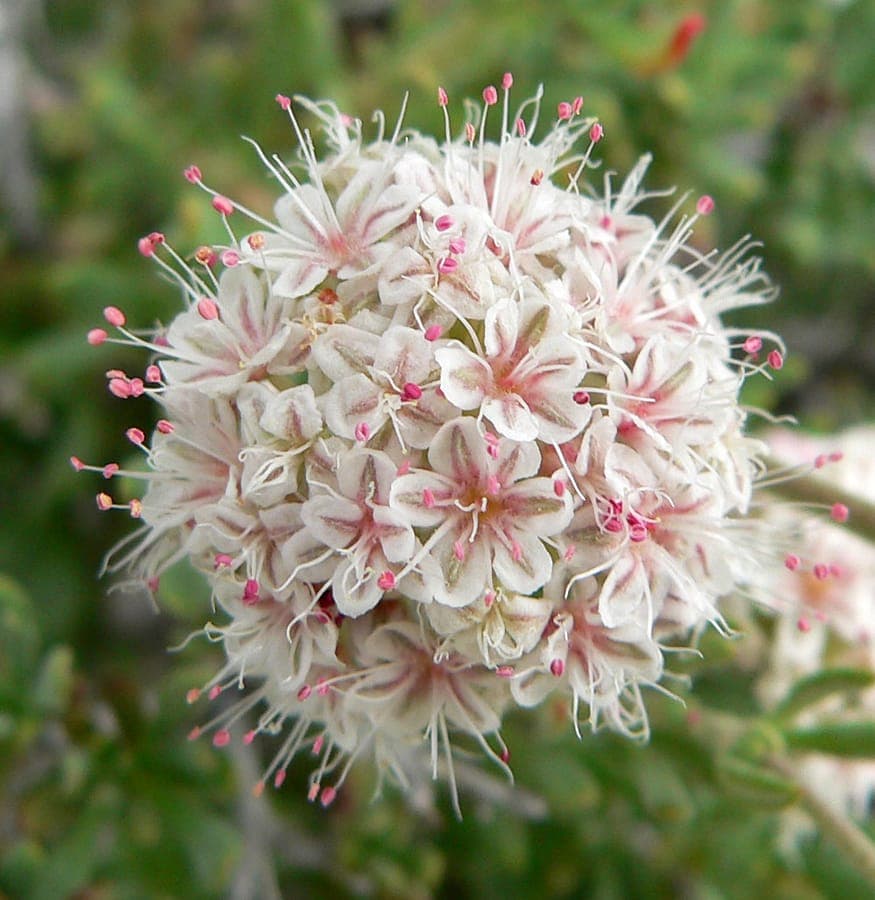
Stan Shebs / CC BY-SA 3.0, via Wikimedia Commons
California buckwheat: complete guide
Eriogonum fasciculatum
Want to see California buckwheat: complete guide in your garden?
1 minute, no credit card
Overview
Eriogonum fasciculatum, commonly known as California buckwheat or California wild buckwheat, is one of the most widespread and ecologically important native shrubs of western North America. It belongs to the family Polygonaceae and is naturally found in California, Arizona, Nevada, Utah, and northwestern Mexico, where it forms extensive populations in chaparral, coastal scrub, and open mountain slopes of the Transverse Ranges and the eastern Mojave Desert.
The species name fasciculatum derives from the Latin fasciculus, meaning 'bundle' or 'small bunch', referring to the characteristic way the small, needle-like leaves are clustered densely along the stems. This leaf arrangement, combined with the shrub's dense, multi-stemmed form, makes Eriogonum fasciculatum immediately recognisable in the field and in the garden.
The plant grows as a dense, wide-spreading shrub with multiple stems, typically 30 to 90 cm tall and 60 to 150 cm wide. In sheltered positions with slightly more moisture, specimens can grow somewhat larger. Its shrubby, spreading form makes it an outstanding ground-covering plant for dry slopes, roadsides, and naturalistic garden settings where a durable, low-water solution is needed.
In its native California and the American Southwest, Eriogonum fasciculatum is considered a keystone plant for dozens of native bee species, hoverflies, butterflies, and other pollinators. Garden designers working with the California native plant palette almost always include it as a backbone species. Explore how drought-tolerant native shrubs like this one can anchor your own low-water garden at gardenworld.app, where design tools help you visualise planting schemes before you plant.
Appearance & bloom cycle
The leaves of Eriogonum fasciculatum are small, narrow, and needle-like to strap-shaped, growing in tight clusters along the stems. The upper surface is dark green, while the underside is lightly woolly-hairy and slightly paler. In mild climates the foliage is evergreen throughout the year, providing reliable structure even outside the flowering season.
The bloom season is remarkably long: the first flowers typically appear in May or June, and in favourable conditions - especially in coastal regions - flowering can continue into October or November. The flower stems carry flat to slightly domed heads of small, cream-white to soft pink flowers. Colour varies between individuals and populations, from pure white through to a clear pink blush, and flowers transition from white to russet-brown or coppery-red after pollination. That colour change makes the shrub particularly decorative: on a mature plant, fresh white new flowers and rusty-red ageing heads may be present simultaneously, creating a two-toned effect throughout the season.
The dried, russet-brown flower heads persist on the plant for weeks and provide an attractive winter silhouette. They are also a valuable food source for songbirds and sparrows in autumn and winter. Pollinators visit in enormous numbers during flowering - the plant is well documented as one of the richest nectar and pollen sources in California chaparral, attracting native bees including specialist Eriogonum-visiting species found nowhere else.
Ideal location
Eriogonum fasciculatum demands a fully sunny position with at least six hours of direct sunlight per day. It thrives on open, warm sites without overhead shade. In its native range it occupies south-facing slopes and dry, open roadsides - positions exposed to full sun even in the hottest summers.
For gardens in the Netherlands and Belgium, suitable locations include: dry, sunny borders along walls or paving with good heat retention, well-drained slope gardens, gravel or xeriscaping projects where water use must be minimal. The wide, compact shrub form also works well as a ground cover on dry, sloping ground where erosion control is desirable.
Plant Eriogonum fasciculatum in groups of three to seven for the strongest landscape effect. Spacing: 80 to 120 cm, allowing each shrub to reach its full spread without competing with neighbours. Avoid positions with shade from buildings or tall hedges; flowering drops significantly below four hours of sun per day.
In urban settings, the plant handles heat-island conditions well and performs reliably in enclosed, south-facing courtyard gardens with gravelled surfaces. Pair it with larger boulders or low stone walls for an authentic chaparral-inspired planting scheme.
Soil requirements
Eriogonum fasciculatum is a plant for lean, freely draining ground. In its native range it grows on sandy, rocky, loamy, or granitic soils with a pH of 7.5 to 8.5 - slightly more alkaline than many other Eriogonum species. In the generally slightly acidic garden soils of northern Europe (pH 5.5 to 6.5), incorporating a small amount of ground limestone or crushed shell into the planting pocket can help adjust pH closer to the plant's preference.
Most importantly, the soil must drain quickly and completely. On well-draining sandy or sandy-loam soils, plants can be set out without amendment. On heavier or clay-containing soils, improving the planting pocket with 30 to 50 percent coarse grit, perlite, or crushed aggregate is essential. Permanently wet subsoil almost always leads to plant loss.
Never add organic fertilisers such as compost, manure, or peat to the planting pocket: these increase moisture retention and over-enrich the soil. Eriogonum fasciculatum responds to overly fertile conditions with excessive leafy growth at the expense of flowering. A thin mulch layer of stone grit or quartz grit around the plant (not touching the stem) helps stabilise soil temperature and reduce moisture evaporation without the downsides of organic mulch.
Free design
Want to see California buckwheat: complete guide in your garden? Make a free design now.
Watering
Eriogonum fasciculatum is one of the most drought-tolerant shrubs that can be planted in a European garden. Across its native range in California and the Mojave, the plant thrives in areas receiving 200 to 400 mm of annual rainfall without irrigation. Once established, it requires no summer watering in most parts of the Netherlands and Belgium.
During the first growing season after planting, supplemental watering is needed to help the plant establish. Water once per week during dry, warm conditions and allow the soil to dry out completely before the next watering. Drip irrigation at the plant base is best; wet foliage increases the risk of fungal disease.
From the second or third year onwards, supplemental irrigation is normally unnecessary. The plant handles dry spells of four or more weeks without visible stress. Never water in autumn or winter - winter moisture is the single greatest threat to this plant in European gardens. Never overwater in summer either: excess water and waterlogging lead quickly to root rot.
A reliable rule of thumb: allow the soil to dry to a depth of 15 to 20 cm before watering again. When in doubt, wait longer rather than watering too soon.
Pruning
Eriogonum fasciculatum benefits from a light annual tidy to stay compact and free-flowering. As a semi-woody shrub rather than an herbaceous perennial, it tolerates slightly more interventional pruning than softer plants.
In early spring - around March to early April - remove dead flower stems and any dead or damaged wood. At the same time, shape the shrub by trimming outward-reaching stems back to the desired outline and removing inward-growing or crossing branches. The maximum recommended cutback is one-third of the total height; harder pruning risks damaging the plant's recovery capacity.
In mild coastal climates or warm regions, a light autumn tidy in October can be beneficial, shortening spent flowering stems. Always use clean, sharp secateurs. Leave the dried flower heads of the previous season standing until new shoots are clearly visible in spring - they provide food for birds through winter and early spring.
Maintenance calendar
January and February: Dormancy. No intervention. Check drainage during persistent rain. Leave dried flower stems standing for winter structure and birds.
March: Annual tidy as soon as new growth appears. Remove dead and damaged stems. Reshape the shrub. Optionally refresh the stone grit mulch layer.
April: Growing season begins. First bud formation. Water during dry spells. Weed removal in the mulch bed.
May and June: Flowering starts. Cream-white flower heads at their freshest. Pollinators arrive in large numbers. Minimal watering.
July and August: Peak flowering. New white and ageing russet heads present simultaneously. No watering needed in normal summers.
September: Flowering tapers. Flower heads transition to brown. Leave in place for birds. No watering.
October: Optional light autumn tidy in mild areas. In northern regions: no more pruning until spring. Add a thin protective grit layer ahead of cold winters.
November and December: Full dormancy. No action. Dried flower heads serve as winter bird food.
Winter hardiness
Eriogonum fasciculatum is hardy in USDA zones 7 to 10, corresponding to minimum temperatures of approximately -17 to 1 degree Celsius. This places the plant within the winter-hardiness range of most of the Netherlands (zone 8) and Belgium (zones 8 to 9), though in severe winters with temperatures below -15 degrees Celsius, some frost damage is possible, particularly when the soil is simultaneously wet.
The key to reliable winter survival is soil condition: excellent drainage makes the plant substantially more cold-tolerant than when grown in wet or poorly draining ground. In dry winters, even with moderate frost, Eriogonum fasciculatum survives without difficulty. Combinations of frost and wet soil are the most dangerous scenario.
In colder regions or high-elevation gardens, a thin layer of broken quartz grit over the root zone provides insulation and helps buffer moisture. Keep deep organic mulch away from the stem base. If severe frost kills all above-ground growth, the plant may regenerate from the roots in spring - allow it the opportunity to recover before removing it. Visit gardenworld.app for a tailored garden design featuring cold-hardy drought-loving shrubs suited to your specific location.
Companion plants
Eriogonum fasciculatum is an excellent structural shrub for dry borders, gravel beds, chaparral-style plantings, and naturalistic slope gardens. Its cream-white to pink flowers pair well with cool blue-purple and warm yellow-ochre companions. Good planting combinations include:
- Artemisia californica or Artemisia 'Powis Castle': Silver-grey, 60 to 120 cm. Silver foliage contrasts beautifully with the cream-white flower heads.
- Salvia leucophylla or Salvia officinalis: Pink-purple or blue-purple, 60 to 150 cm. Sage family members share the same drought conditions.
- Ceanothus varieties: Deep blue, 120 to 200 cm. California lilac creates a stunning partnership with the cream Eriogonum flowers.
- Lavandula stoechas: Spanish lavender, 40 to 60 cm, blooms April to June.
- Achillea millefolium 'Paprika': Bright red, 50 to 60 cm. Vivid colour contrast against the white flower heads.
- Festuca californica or Festuca glauca: California fescue or blue fescue, 30 to 60 cm. Textural contrast against the dense shrub form.
- Penstemon heterophyllus: Blue-purple, 40 to 60 cm, blooms May to July.
Avoid plants requiring regular watering such as Hydrangea, Hosta, or Astilbe, which are incompatible with the dry conditions Eriogonum fasciculatum needs to thrive.
Closing
Eriogonum fasciculatum is one of the most valuable native shrubs for dry, sunny gardens. Its exceptionally long bloom season from May through to autumn, its outstanding ecological value as a pollinator plant, the attractive seasonal colour shift of its flower heads, and its minimal maintenance requirements make it a first-choice shrub for the thoughtful gardener.
At gardenworld.app you can explore how California buckwheat combines with other drought-tolerant shrubs and perennials to form a coherent, low-water garden design. Browse the inspiration gallery for ideas, or use the garden design tool to visualise a planting plan tailored to your own outdoor space.
Want to see California buckwheat: complete guide in your garden? Make a free design now.
Upload a photo, pick a style, and get a photorealistic design with plant list in under a minute.
10,000+ gardens designed already
No credit card required


Similar plants
Sulfur buckwheat: complete guide
Eriogonum umbellatum
Full guide to sulfur buckwheat: siting, soil, watering, pruning and companion planting for this showstopping yellow-flowered perennial from the American West.
Tall woolly buckwheat: complete guide
Eriogonum elatum
Full guide to Eriogonum elatum: siting, soil, watering, pruning and companion plants for this elegant white-flowered buckwheat from the western United States.
Inyo buckwheat: complete guide
Eriogonum latens
Full guide to Eriogonum latens: siting, soil, watering, pruning and companion planting for this rare California native wild buckwheat from the dry Inyo Mountains region.