
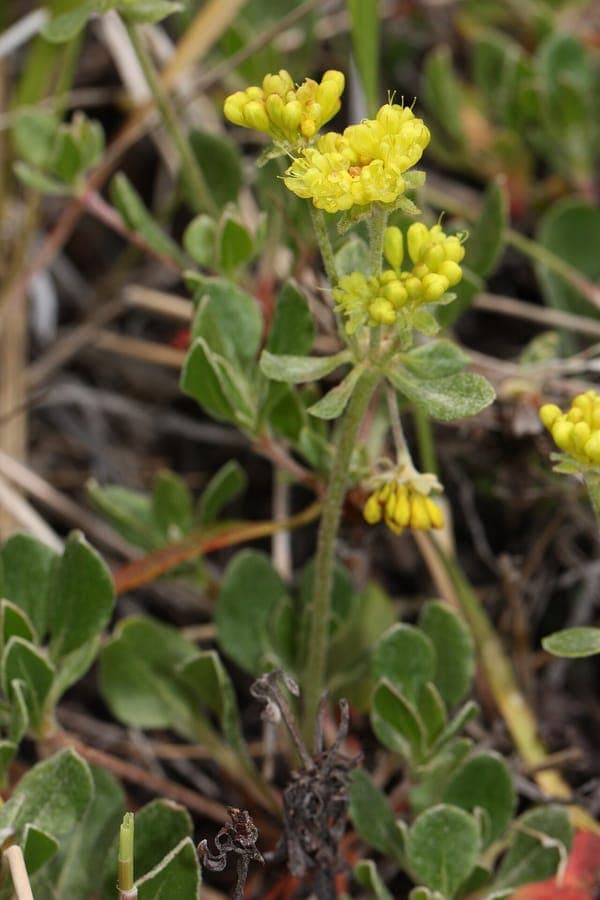
Walter Siegmund (talk) / CC BY-SA 3.0, via Wikimedia Commons
Sulfur buckwheat: complete guide
Eriogonum umbellatum
Want to see Sulfur buckwheat: complete guide in your garden?
1 minute, no credit card
Overview
Sulfur buckwheat (Eriogonum umbellatum) is a compact to medium-sized subshrub in the family Polygonaceae, native to the western United States and western Canada. Its remarkable natural range spans Alberta, Arizona, British Columbia, California, Colorado, Idaho, Montana, Nevada, New Mexico, Oregon, Utah, Washington, and Wyoming - making it one of the most widely distributed Eriogonum species on the continent. This broad distribution has allowed the species to adapt to an extraordinary range of conditions, from high mountain meadows and alpine scree at over 3,000 metres to dry lower-elevation steppe and chaparral.
The species epithet umbellatum refers to the characteristic flower arrangement: umbel-like clusters held on erect stems, resembling miniature parasols. The common names sulfur buckwheat and sulphur-flower buckwheat both refer to the striking sulphur-yellow to bright ochre colour of the blooms, which is one of the most distinctive features of the species.
Eriogonum umbellatum forms a slowly spreading subshrub 20 to 50 cm tall and 40 to 90 cm wide. Older plants develop a characteristic cushion or broad mat form. It is reliably perennial, flowering every summer from June through September, and is exceptionally long-lived where drainage suits it. Discover how drought-tolerant planting schemes look in real garden settings at gardenworld.app - an excellent starting point for planning a low-water garden.
Appearance & bloom cycle
The foliage of sulfur buckwheat consists of oval to elliptical leaves, 1 to 4 cm long, with a grey-green to dark green upper surface and a softly grey to white woolly-hairy underside. The texture is notably coarse compared to related species such as Eriogonum niveum or Eriogonum strictum, which contributes to the plant's rustic appeal. In autumn, the foliage often develops attractive colour change from green to orange-red or carmine red, extending the plant's decorative value well beyond the flowering season.
The flowering season runs from June to September, peaking in July and August. Flower stems rise 20 to 40 cm above the foliage and carry compact, parasol-like clusters of small sulphur-yellow to soft ochre-yellow flowers. Individual flowers are only 3 to 4 mm across, but they are so densely packed into the clusters that the overall flower head is impressive and highly visible from a distance. Eriogonum umbellatum ranks among the most pollinator-friendly plants in its genus: the abundant nectar production attracts honeybees, bumblebees, solitary bees, butterflies, skippers, and numerous hoverfly species in large numbers.
After flowering, the flower stems dry to russet-brown clusters that remain attractive throughout autumn and winter as a structural element. Well-known garden cultivars include 'Shasta Sulfur' (slightly larger, intensely yellow flowers), 'Kannah Creek' (compact, with amber-ochre flower tones), and 'Shasta Snow' (cream-yellow flowers with a pink blush).
Ideal location
Sulfur buckwheat requires a fully sunny position, receiving at least six hours of direct sun daily. In warm climates, light afternoon shade is tolerated, but in the cool, frequently overcast conditions of northern Europe, maximum sun exposure produces the richest flowering. South-facing or south-west-facing borders, open rock gardens, sunny slope plantings, and dry gravel gardens are excellent choices.
The plant excels in lean, inhospitable spots where most perennials struggle: dry verges beside paved paths, gravel beds, unirrigated sloping borders, and extensive green roofs. Its low, wide growth habit also works well as a ground cover in dry zones, especially when several plants are set together. Spacing in group plantings: 50 to 75 cm between plants. For complete ground coverage in a dry planting: four to five plants per square metre.
In urban settings, Eriogonum umbellatum proves remarkably heat-resistant and thrives even in enclosed, heat-trapping environments. Paired with gravel or lava aggregate mulch, its performance is outstanding. Avoid positions with standing water or heavy overhead shade.
Soil requirements
Sulfur buckwheat is undemanding regarding soil fertility but requires excellent drainage without exception. The preferred pH range is 6.5 to 8.0, though the plant is adaptable across a wide spectrum. Heavy, wet clay soils are unsuitable and almost invariably lead to root rot, especially in combination with wet winters.
For planting into moderately or poorly draining soil: incorporate 30 to 40 percent coarse grit, crushed stone, or perlite to improve drainage. Limit the addition of compost or other organic soil improvers to a minimum - overly fertile soil encourages lush leafy growth but weakens flowering and winter hardiness. Lean, mineral-rich soils produce the densest and most colourful flowering.
In rock gardens and stone features: plant Eriogonum umbellatum into pockets filled with a mixture of crushed stone and coarse sand in a 2:1 ratio. A mulch layer of 4 to 6 cm of broken granite or quartz grit around the plant protects roots from summer heat, suppresses weeds, and keeps the base dry. Avoid organic mulches such as bark or leaf compost placed directly around the base.
Watering
Sulfur buckwheat is one of the most drought-tolerant perennials that can be grown in a European garden. Across its vast natural range, it survives in areas receiving less than 300 mm of annual rainfall without supplemental irrigation. In the dry mountain areas of Nevada and Arizona, it grows on exceptionally lean terrain with only sporadic rainfall.
During the first growing season after planting, water once per week in dry, warm conditions to encourage strong root development. Always wait until the top 6 to 10 cm of soil has dried out completely before watering again. Drip irrigation delivering water directly to the roots without wetting the foliage gives the best results. Never irrigate in full midday sun; water early in the morning or in the early evening.
From the second season onwards, supplemental watering is normally unnecessary except during extreme dry spells exceeding four weeks. Do not water in autumn or winter under any circumstances. Excess moisture during winter is by far the most dangerous condition for Eriogonum umbellatum and the most frequent cause of plant loss in European gardens.
Free design
Want to see Sulfur buckwheat: complete guide in your garden? Make a free design now.
Pruning
Sulfur buckwheat needs minimal pruning. The ideal approach is restraint: allow the plant to determine its own form and intervene as little as possible. Leave the spent, dried flower clusters standing through autumn and winter - they provide seeds for birds, an attractive structural silhouette, and protection for the root crown.
In early spring, around mid-March to early April, cut back dead stems and dried flower stalks to approximately 5 to 8 cm above ground level. Always wait until new green shoots are visible at the base before cutting back. Never cut deeply into the woody basal tissue: Eriogonum umbellatum recovers slowly from hard pruning.
A light tidying cut in April or May - trimming outward-spreading shoots to the desired length - encourages compactness and good flowering. Remove dead or damaged wood promptly. A light renovation every three to four years is sufficient for a vital, free-flowering plant. To limit self-seeding, remove seed heads after dispersal but before full ripening.
Maintenance calendar
January and February: Full dormancy. No action. Check drainage after heavy rainfall and ensure no water pools around the plant base.
March: Begin removing dead stems and flower stalks once new shoots appear at the base. Cut back to 5 to 8 cm above ground level.
April: Optional: add a fresh layer of gravel mulch around the plant. Water weekly in dry weather to support growth resumption. A small amount of potassium-rich fertiliser can support flowering.
May and June: Growing season underway. Water once weekly during dry periods. Weed control in the gravel mulch. Watch for the start of flowering.
July and August: Peak flowering season. The sulphur-yellow flower clusters are at their most spectacular. Minimal watering. Remove only damaged or dead stems.
September: Flowering winds down. Leave stems and seed heads for wildlife and structural interest. Stop watering.
October and November: Autumn. No further intervention. Add a thin gravel layer around the base if wet winters are a concern.
December: No action. Full dormancy.
Winter hardiness
Sulfur buckwheat is rated hardy to USDA zone 4, corresponding to minimum temperatures of approximately -34 °C. This makes it harder than many other Eriogonum species and reliably suitable for gardens across the Netherlands, Belgium, northern Germany, and Great Britain, where average minimum temperatures range from -15 to -20 °C.
The plant survives even prolonged periods of hard frost, provided drainage is excellent. In its native range it endures frozen mountain winters at -25 °C under snow cover. That snow cover is protective: it insulates the roots and keeps the root crown dry beneath the snow layer. In dry, snowless European winters, risks are higher if the soil is simultaneously wet.
Always prioritise drainage as the first consideration when selecting or preparing the planting site. In severe winters without snow and with temperatures below -20 °C, a thin protective layer of quartz sand or coarse grit around the plant base is recommended. Thick organic insulating mulch is unsuitable and counterproductive because it retains moisture. Visit gardenworld.app to see how Eriogonum umbellatum can be combined with other winter-hardy drought lovers in a garden design tailored to your specific site.
Companion plants
Sulfur buckwheat makes an outstanding centrepiece or border edging in dry beds, rock gardens, and gravel gardens. Its sulphur-yellow flowers offer beautiful colour contrasts with blue, purple, and silver-toned species. Suitable garden partners include:
- Lavandula angustifolia 'Hidcote': Deep blue spikes 30 to 40 cm tall, blooming simultaneously in July and August. The blue of lavender contrasts magnificently against the yellow of Eriogonum.
- Penstemon pinifolius: Bright red tubular flowers 30 to 40 cm in June to August, particularly attractive to pollinators.
- Artemisia 'Powis Castle': Silver-grey fine-textured sub-shrub 60 to 80 cm, providing colour contrast and textural connection.
- Salvia nemorosa 'Caradonna': Dark purple flowers on 50 to 60 cm stems, blooming May to June and overlapping with early Eriogonum flowering.
- Festuca glauca 'Elijah Blue': Blue-grey ornamental grass 20 to 30 cm as a textural accent.
- Sedum 'Herbstfreude': Soft pink flowers 50 to 60 cm in September to October, extending the border's appeal into autumn.
- Eriogonum niveum and Eriogonum strictum: White and cream-white flowers that contrast beautifully with the yellow Eriogonum umbellatum.
Avoid pairing with moisture-loving plants such as Hosta, Rodgersia, or Astilbe, which require a completely different watering regime.
Closing
Sulfur buckwheat is an exceptionally versatile and robust perennial that enriches any dry, sunny garden. Its striking sulphur-yellow flower clusters, attractive grey-green foliage, beautiful autumn colour, and minimal maintenance demands make it one of the most rewarding choices for the thoughtful gardener pursuing a low-water planting approach.
Visit gardenworld.app to design a personalised garden with drought-tolerant plants such as Eriogonum umbellatum as the focal point. Or explore the inspiration gallery for ideas on how to combine this plant with other pollinator-friendly, water-efficient perennials in your own outdoor space.
Want to see Sulfur buckwheat: complete guide in your garden? Make a free design now.
Upload a photo, pick a style, and get a photorealistic design with plant list in under a minute.
10,000+ gardens designed already
No credit card required


Similar plants
Crosby's wild buckwheat: complete guide
Eriogonum crosbyae
Full guide to growing Eriogonum crosbyae: ideal site, soil, watering, winter hardiness and companion plants for this rare western wild buckwheat.
Spreading buckwheat: complete guide
Eriogonum effusum
Full guide to growing Eriogonum effusum: ideal site, soil, watering, winter hardiness and companion plants for this prairie subshrub from the American West.
Tall woolly buckwheat: complete guide
Eriogonum elatum
Full guide to Eriogonum elatum: siting, soil, watering, pruning and companion plants for this elegant white-flowered buckwheat from the western United States.