
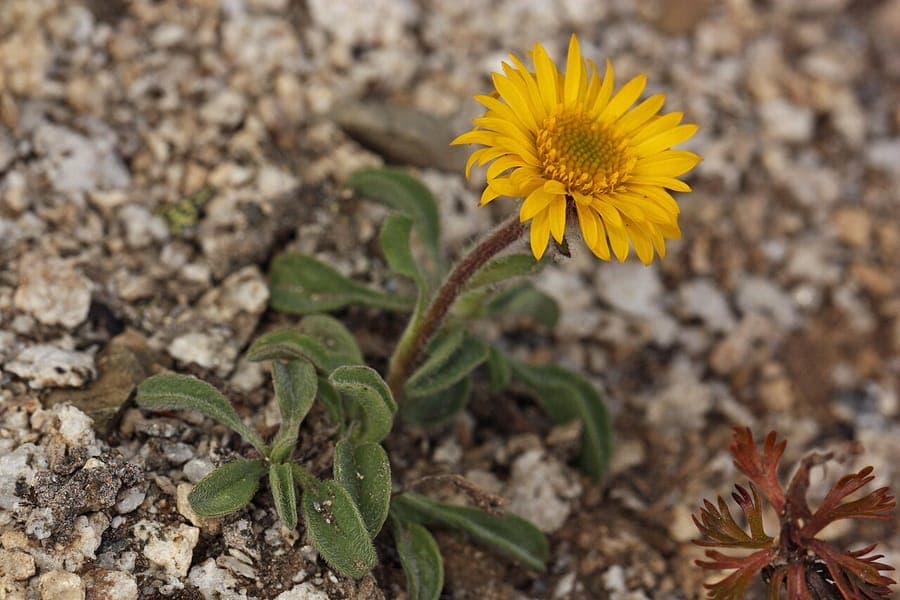
Walter Siegmund (talk) / CC BY-SA 3.0, via Wikimedia Commons
Golden fleabane: complete guide
Erigeron aureus
Want to see Golden fleabane: complete guide in your garden?
1 minute, no credit card
Overview
Erigeron aureus, commonly known as golden fleabane or golden daisy, is a delightful alpine perennial belonging to the Aster family (Asteraceae). Native to the mountain ranges of western North America, it grows wild in British Columbia, Alberta, Washington and Oregon, where it clings to rocky slopes, scree, and alpine meadows at considerable elevation. Its striking bright yellow flowers distinguish it from most other fleabanes, which typically bear white or lavender ray petals. For gardeners interested in rock gardens, alpine troughs, or drought-tolerant planting schemes, Erigeron aureus is one of the most rewarding small perennials available. At gardenworld.app you will find design inspiration for bringing this mountain gem into your own garden.
Appearance and bloom cycle
Golden fleabane is a low-growing, cushion-forming plant. Stems typically reach 8 to 20 cm in height, depending on soil fertility and exposure. The leaves are narrow, spatula-shaped and slightly hairy, with a soft grey-green tone. Each flower head features a bright golden-yellow disc centre surrounded by many narrow, equally yellow ray florets, creating a sunburst effect that is immediately recognisable. Unlike the majority of fleabane species, which have white or purple rays, Erigeron aureus is entirely golden, making it a rare treasure among alpine perennials. The main flowering season runs from June to August. Deadheading spent flowers regularly encourages repeat blooming throughout the summer months. Even when not in flower, the compact rosette of basal leaves provides neat, textural interest.
Ideal location
As a child of open mountain terrain, Erigeron aureus demands full sun. A minimum of six hours of direct sunlight per day is essential for good flowering. In the garden, a south-facing or south-west-facing position in a raised rock bed or alpine garden is ideal. The plant does not tolerate prolonged shade: insufficient light causes etiolated growth and sparse bloom. Avoid low-lying spots where water pools after rain. It thrives equally in gaps between paving stones, in wall crevices, or in alpine troughs where drainage is naturally excellent. In containers, choose a pot with generous drainage holes and a gritty compost mix. The plant looks particularly effective when positioned against warm stone, which reflects heat and keeps the root zone dry.
Soil
Poor, sharply drained soil is the key to success with golden fleabane. In its native habitat it grows in thin, stony or gravelly mountain soils with minimal organic content. In the garden, replicate these conditions by mixing standard potting or garden soil with a generous proportion of horticultural grit, coarse sand, or perlite (aim for roughly one-third to one-half grit by volume). A soil pH between 5.5 and 7.5 suits it well. Do not enrich the planting hole with compost or slow-release fertiliser: excess nitrogen drives leafy growth at the expense of flowers and makes the plant prone to soft rot. A mulch of fine gravel around the plant base helps keep the crown dry and discourages fungal disease at soil level.
Watering
Once established, golden fleabane is quite drought-tolerant and requires only moderate watering. During the growing season (spring through summer) water when the soil has dried out noticeably, then allow it to dry again before watering once more. As autumn approaches, reduce watering significantly. During winter the plant should be kept as dry as possible: wet, mild winters are far more damaging than cold, dry ones. Container-grown plants need particular attention, as pots can become waterlogged quickly in persistent rain. Signs of overwatering include yellowing or limp foliage and black patches at the leaf base. Always ensure that water can drain freely from the pot.
Free design
Want to see Golden fleabane: complete guide in your garden? Make a free design now.
Pruning
Pruning requirements are minimal. Remove spent flower heads promptly using clean, sharp scissors or secateurs, cutting the stem just above a leaf node. Regular deadheading extends the blooming period substantially. After flowering concludes in late summer, a light trim of old stems back to just above the basal rosette keeps the plant tidy heading into winter. Avoid cutting into live green growth unnecessarily, as Erigeron aureus recovers more slowly from hard pruning than many other perennials. In early spring, remove any dead leaves or dried stems to allow fresh growth to emerge unobstructed.
Maintenance calendar
March: inspect the plant after winter, remove dead foliage, resume light watering once the soil begins to drain. April: apply a light potassium-rich feed if the soil is very poor; avoid nitrogen-heavy products. May: watch for emerging flower buds, check drainage. June to August: peak bloom period; deadhead regularly to prolong flowering. September: reduce watering, stop feeding. October to November: light tidy-up, top up gravel mulch around the crown. December to February: rest period; keep the plant dry and protect from waterlogging during wet spells.
Winter hardiness
Erigeron aureus is exceptionally hardy for an alpine perennial. In its mountain homeland it endures frozen ground, heavy snowfall, and extreme cold with ease. It is reliably hardy to USDA zone 4, tolerating temperatures as low as -34 degrees Celsius. In northern Europe, including the Netherlands and Belgium, it generally has no difficulty with winter cold. The real threat is winter wetness: prolonged rain combined with mild temperatures promotes crown rot. Ensure excellent drainage at all times. In particularly wet winters, a pane of glass or a cloche placed over the plant offers adequate protection. Container plants are more vulnerable to frost penetration at the root zone and should be moved to a frost-free position or insulated with hessian during severe cold snaps.
Companion plants
Golden fleabane partners beautifully with other compact alpine perennials that share its preference for dry, well-drained, nutrient-poor conditions. Excellent companions include Sempervivum (houseleeks), Sedum (stonecrops), Arabis (rock cress), Aubrieta, Pulsatilla (pasque flower), and Dianthus alpinus (alpine pink). Low, fine-leaved ornamental grasses such as Festuca glauca work well as neighbours provided drainage is equally good. Avoid combining with moisture-loving perennials such as hostas or astilbes, which require the opposite conditions. Most garden centres in the UK and Ireland stock a selection of compatible alpine plants; ask specifically for species suited to well-drained rock gardens. At gardenworld.app you can plan your alpine garden layout before buying a single plant.
Closing thoughts
Erigeron aureus is a plant that earns its place in the garden many times over. Compact, long-flowering, drought-resistant, and reliably hardy, it asks for very little while delivering bright golden colour from June through August. Whether you tuck it into a wall crevice, plant it in a trough, or give it a spot at the front of a sunny border, the golden fleabane will reward you with cheerful flowers season after season. It is a plant that suits the modern trend toward low-maintenance, naturalistic planting without sacrificing visual impact.
Want to see Golden fleabane: complete guide in your garden? Make a free design now.
Upload a photo, pick a style, and get a photorealistic design with plant list in under a minute.
10,000+ gardens designed already
No credit card required


Similar plants
Cutleaf daisy: complete guide
Erigeron compositus
Full guide to growing Erigeron compositus: ideal site, soil, watering, pruning, and companion plants for this alpine daisy.
Threadleaf fleabane: complete guide
Erigeron filifolius
Full guide to growing Erigeron filifolius: sunny dry sites, lean soils, watering, pruning, and companion planting for this fine-leaved daisy.
Subalpine fleabane: complete guide
Erigeron peregrinus
Full guide to growing Erigeron peregrinus: purple blooms, moist soils, ideal site, winter hardiness, and companion plants for this alpine daisy.