
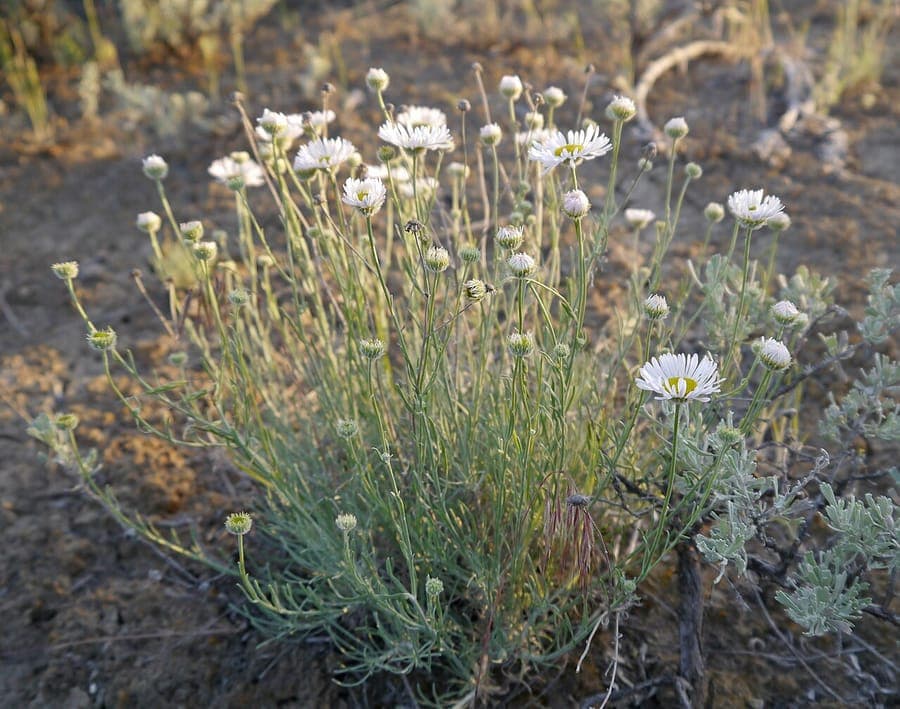
Thayne Tuason / CC BY 4.0, via Wikimedia Commons
Threadleaf fleabane: complete guide
Erigeron filifolius
Want to see Threadleaf fleabane: complete guide in your garden?
1 minute, no credit card
Overview
Erigeron filifolius, commonly known as threadleaf fleabane or thread-leaved daisy, is a slender, clump-forming perennial belonging to the Asteraceae family. The species was described in 1840 by Nuttall, based on earlier specimens collected by Hooker, and is native to the dry, open habitats of western North America: British Columbia, California, Idaho, Montana, Nevada, Oregon, Utah, and Washington. Its natural environment consists of dry, gravelly hillsides, sagebrush flats, and open grassland slopes where summer heat is intense and rainfall is low.
The species name filifolius comes from the Latin filum (thread) and folium (leaf), an accurate description of the plant's most distinctive feature: its extraordinarily fine, needle-like foliage. The leaves are so narrow - often less than 1 mm wide - that the plant resembles a fine ornamental grass from a distance, producing a cloud of white daisy flowers atop airy, thread-like stems in early to midsummer.
In garden culture, Erigeron filifolius is less widely grown than some of its relatives, such as Erigeron karvinskianus, but it deserves broader recognition. Its ability to thrive in lean, dry conditions with minimal care makes it exceptionally useful for low-water gardens, gravel plantings, and naturalistic dry borders. Start planning your drought-tolerant garden design at gardenworld.app.
The growth form is described botanically as multiple-stemmed, meaning the plant forms a dense basal clump from which numerous upright stems emerge and fan outward during the season. Growth rate is rapid, allowing a new plant to establish and develop into an attractive specimen within a single growing season.
Appearance & bloom cycle
The defining visual feature of Erigeron filifolius is its exceptionally fine foliage. Leaves are thread- to needle-like, just 0.5-1.5 mm wide and 2-8 cm long, and densely arranged so that the stems appear almost grass-like. The foliage texture is classified as fine in botanical references - finer than nearly all other fleabane species. Leaf colour is bright to grey-green, with a light covering of fine hairs that gives the foliage a soft sheen in direct sunlight.
Flowers appear from May through August, with the main flush in garden conditions typically from early June to late July. Each flower head consists of a small yellow disc centre surrounded by 30-60 white to light pink ray florets in a classic daisy arrangement. Fully open flower heads measure 1-2.5 cm across, held on slender, upright stems 20-40 cm tall - considerably taller than the leafy basal clump, giving the plant a two-tier structure that looks attractive in dry borders and rock gardens.
After flowering, small seeds equipped with a white pappus are dispersed by wind. On open, well-drained ground, Erigeron filifolius may self-seed modestly, gradually expanding the colony in an informal, naturalistic way without becoming invasive. The variety robustior (E. filifolius var. robustior, described by M. Peck) has slightly broader leaves and larger flower heads, and tolerates marginally moister conditions than the typical form.
Removing spent flower stalks promptly after the first flush often triggers a lighter second flowering in August. This extends the season of interest and ensures the plant looks tidy throughout summer.
Ideal location
Erigeron filifolius performs best in a fully sunny position receiving at least six hours of direct sunlight daily. Originating from dry, open environments with high light intensity and free air circulation, it requires conditions where air moves freely around the foliage and soil dries out between rainfall events. A south- or southwest-facing position in a rock garden, at the top of a dry stone wall, or in the front row of a border on well-drained soil is ideal.
The plant also grows well in large containers (minimum 25 cm diameter) with excellent drainage, making it suitable for sunny patios and roof terraces. Partial shade is tolerated but results in noticeably fewer flowers and a looser, more lax growth habit. Dense shade is unsuitable. In positions with high humidity or poor air circulation - against a wall or under dense canopy - the plant becomes more susceptible to fungal infections.
In a xeriscape or dry garden design, Erigeron filifolius is an ideal companion for ornamental grasses such as Stipa or Festuca. The thread-like leaves complement the fine texture of these grasses visually, and the white flowers introduce lightness and contrast into colour schemes dominated by blue-grey and silver-white.
Soil requirements
Erigeron filifolius thrives in lean, fast-draining soil with a pH between 6.0 and 7.5 - neutral to slightly acidic. It also tolerates calcareous or lightly alkaline conditions as long as drainage is adequate. On heavy, nutrient-rich clay soils with poor drainage, the plant performs poorly and is susceptible to root problems.
For best results on standard garden soil, amend the planting area (top 25-30 cm) with 25-30% coarse river sand (particle size 2-4 mm) and 10% perlite before planting. On sandy or stony soils, little preparation is needed. Avoid adding fresh compost or nitrogen-heavy fertiliser at planting time: Erigeron filifolius actually performs better on lean soils. A small amount of well-aged compost (5-7 cm) worked into the surface layer is acceptable for improving soil structure without significantly increasing fertility.
Mulching around established plants with fine gravel or crushed stone (particle size 10-20 mm) gives the best results: it keeps the plant base dry, suppresses weeds, and gives the planting a neat appearance.
Free design
Want to see Threadleaf fleabane: complete guide in your garden? Make a free design now.
Watering
Once established - typically four to six weeks after planting - Erigeron filifolius needs very little water. It is a genuine drought lover that endures high summer temperatures and weeks without rainfall on well-drained, stony ground without complaint. This makes the species particularly valuable during periods of water restriction and in gardens where irrigation needs to be minimised.
During the first growing season, water once per week in dry spells at temperatures above 20 °C to help roots establish properly. Apply water at ground level with a gentle spray to keep foliage dry and reduce the risk of fungal disease. Ensure water penetrates to a depth of 15-20 cm so that roots are encouraged to grow deeper into the soil.
After the first summer, reduce watering to once every two to three weeks for established plants. In the Netherlands and Belgium, average rainfall is usually sufficient during the growing season with little to no supplemental irrigation needed. Always avoid watering when water pools around the plant base, especially in autumn and winter when the risk of crown rot is greatest.
Pruning
Erigeron filifolius requires minimal pruning. Remove spent flower stalks after the main flush in June-July by cutting them back to just above the basal leaf cushion. This can stimulate a lighter second flowering in August in favourable conditions. Use clean, sharp scissors or small pruning shears and disinfect the tools with alcohol between plants to prevent disease transmission.
In autumn, after the first hard frost, you can remove dead above-ground plant material. Leave the basal leaf rosette in place, however, as it protects the crown through winter. In early spring - once new growth appears, usually in March or early April - remove remaining old foliage. At the same time, check for any dead sections within the clump and remove them cleanly.
Dividing the clumps every three to four years in early spring extends plant lifespan and keeps the centre of the clump vigorous. Lift the entire clump, divide it into sections of five to seven stems each, and replant at 25-30 cm spacing in refreshed soil.
Maintenance calendar
January – February: Check for standing water around plants. During persistent wet periods, ensure drainage channels are clear.
March: Remove winter protection once hard frosts are over. Cut away old foliage and lightly fork over the planting zone. Plant out new specimens once the ground is no longer frozen. No feeding required.
April: Weed carefully around plants. Top up gravel mulch if the layer has thinned. New leaves will be emerging - this is also the right time to divide congested clumps.
May – June: Main flowering period begins. Remove spent flowers regularly to prolong the display. Water only when dry spells exceed five to seven days.
July – August: Possible second flowering. Keep the site weed-free. Drought periods of up to three weeks are well tolerated on free-draining soil.
September – October: Remove remaining spent stalks after flowering. Leave the leaf cushion for winter protection. Check drainage at the planting site.
November – December: Minimal care. Barely any watering needed. No feeding.
Winter hardiness
Erigeron filifolius is a robust, cold-hardy perennial that survives temperatures down to -15 °C and below. In USDA zones 4-7 - covering most of the Netherlands, Belgium, and northern Germany - the species typically overwinters without additional protection. The plant evolved in the continental climate of western North America, where cold winters with severe frosts alternate with hot, dry summers.
The main winter risk is excess moisture: standing water at the crown combined with freeze-thaw cycles causes direct cell damage and root rot. Ensuring well-drained soil is therefore essential. On stony or sandy ground, additional protective measures are almost never needed. On heavier soils, a 5-8 cm layer of gravel mulch around the plant base is beneficial both in winter and during wet autumn periods.
In particularly wet winters or in regions with frequent freeze-thaw cycles, check the planting site after heavy rainfall and clear temporary drainage channels if water is not dispersing quickly. Explore drought-hardy planting combinations for your garden at gardenworld.app.
Companion plants
Erigeron filifolius combines best with other plants that prefer dry, sunny sites and tolerate lean, free-draining soils. Recommended companions include:
- Stipa tenuissima (Mexican feather grass) – the silvery, ultra-fine blades of this ornamental grass complement the thread-like leaves of Erigeron filifolius perfectly. Plant at 30 cm spacing from Erigeron.
- Festuca glauca (Blue fescue) – metallic blue colouring contrasts beautifully with the white flowers. Plant 20-25 cm from Erigeron.
- Sedum acre (Stonecrop) – low-growing, yellow-flowering succulent for the foreground; shares preference for dry, stony ground.
- Penstemon pinifolius – also features needle-like leaves alongside bright red tubular flowers; an attractive pairing in dry gardens.
- Achillea tomentosa (Woolly yarrow) – low-growing, yellow-flowering perennial that prefers the same dry, sunny conditions and attracts bees.
- Zauschneria californica (California fuchsia) – blooms later in the season with orange-red flowers, providing colour continuity after Erigeron's main flush.
Space Erigeron filifolius plants 25-30 cm apart in the border. On lean soils, growth is slower than on standard garden soil, which is desirable: compact, measured growth produces the most floriferous and attractive specimens.
Conclusion
Erigeron filifolius is an overlooked gem among drought-tolerant perennials - barely known in European gardens yet exceptionally well suited to the modern, water-conscious garden. The thread-like foliage gives the plant a lightness and texture that is hard to match, and the clouds of small white flowers in June and July are genuinely beautiful above the fine, airy leaves. This species earns a permanent place in every dry garden, xeriscape planting, or rock garden scheme. Visit gardenworld.app to see how Erigeron filifolius can be incorporated into a stylish, low-maintenance front garden design.
Want to see Threadleaf fleabane: complete guide in your garden? Make a free design now.
Upload a photo, pick a style, and get a photorealistic design with plant list in under a minute.
10,000+ gardens designed already
No credit card required


Similar plants
Calendula stellata: complete guide
Calendula stellata
Complete guide to Calendula stellata, the star-flowered marigold from Sicily: location, soil, watering and companion planting tips.
Korean chrysanthemum: complete guide
Chrysanthemum x rubellum
Chrysanthemum x rubellum is a hardy autumn perennial with single pink to copper flowers from August to November. Care and combinations.
Helianthus divaricatus: complete guide
Helianthus divaricatus
Helianthus divaricatus is a North American woodland sunflower with yellow summer blooms, ideal for naturalistic borders and shady edges.