
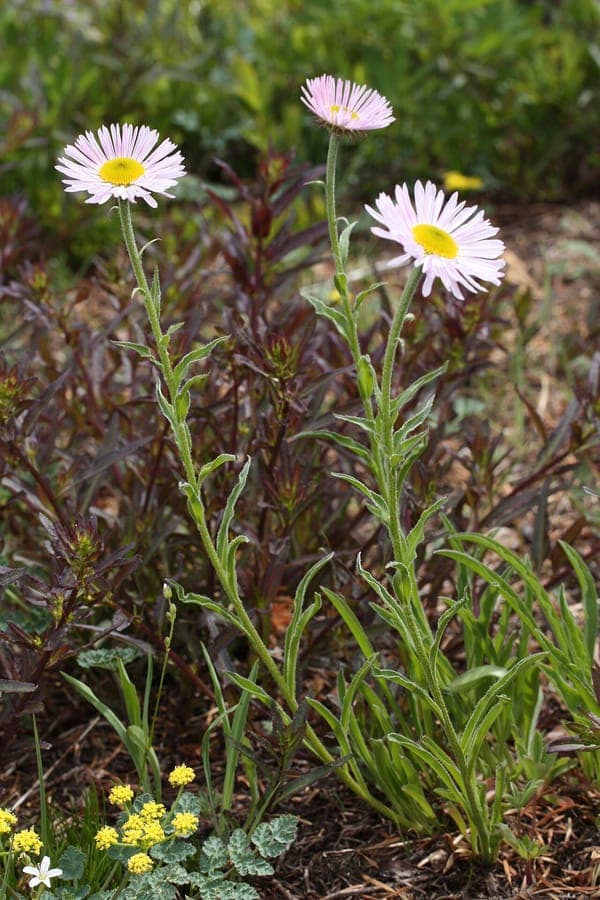
Walter Siegmund (talk) / CC BY-SA 3.0, via Wikimedia Commons
Subalpine fleabane: complete guide
Erigeron peregrinus
Want to see Subalpine fleabane: complete guide in your garden?
1 minute, no credit card
Overview
Erigeron peregrinus, commonly known as subalpine fleabane, wandering fleabane, or subalpine daisy, is a striking perennial of the Asteraceae family, distinguished above all by its large, deep purple to lavender flower heads. The species was described by Greene in 1897, and its name - from the Latin peregrinus, meaning wandering or foreign - alludes to its remarkably wide natural distribution: from Alaska and the Canadian Rockies through Oregon and Washington in the Pacific Northwest, and across the Pacific Ocean to Kamchatka and the Kuril Islands in Russia.
In its natural habitat, Erigeron peregrinus colonises subalpine meadows, mountain stream margins, forest edges at higher elevations, and open rocky slopes. It experiences cool, moist summers, heavy snowfall in winter, and a short but intense growing season. These origins make it both cold-hardy and comfortable with somewhat more moisture than its drought-tolerant relatives Erigeron compositus and Erigeron filifolius, widening its usefulness in European garden situations.
The plant's growth form is rhizomatous - it spreads slowly via horizontal underground stems, forming ever-widening clumps over time. This spreading habit makes it well suited as a loose ground cover over small areas and contributes to its excellent winter survival. Discover how this beautiful purple-flowered species fits into your garden design at gardenworld.app.
For gardeners looking to introduce genuine mountain character into a border or naturalistic planting, Erigeron peregrinus offers flower colour and ecological value - attracting bees, bumblebees, and butterflies - that few other alpine daisies can match at the scale it achieves in full summer bloom.
Appearance & bloom cycle
Erigeron peregrinus forms an open rosette of broad lance-shaped to obovate basal leaves, 3-10 cm long and 1-3 cm wide, with entire to slightly wavy margins. Leaf colour is fresh green; texture is medium-fine. Stem leaves are smaller, narrower, and partially clasp the stem. The entire above-ground portion carries a light covering of soft hairs.
The flowers are the plant's great attraction. Each flower head consists of a yellow disc surrounded by 40-100 ray florets in deep purple to pale lilac, occasionally nearly white in some natural populations. Fully open flower heads measure 2.5-4.5 cm across - considerably larger than most other fleabane species - making each bloom genuinely impressive. In garden cultivation at temperate latitudes, the flowering period runs from June to August, peaking in July. Each stem carries a single flower head, but mature plants produce dozens of stems simultaneously, creating an outstanding display.
After flowering, small brown achenes tipped with white pappus hairs develop and disperse by wind. The rhizomatous spread is gradual, advancing roughly 5-10 cm per year, so the clump expands steadily without becoming invasive. Selected garden forms with deeper, more intensely purple ray florets - sourced from high-mountain populations - are sometimes available from specialist alpine nurseries and reward the search.
Removing spent flower stalks promptly after the main flush often induces a lighter second blooming in September, extending the season of purple colour well into autumn.
Ideal location
Erigeron peregrinus is more adaptable in its site requirements than the other two fleabane species covered in these guides. It performs best in full sun but tolerates up to two to three hours of partial shade daily, making it suitable for a wider range of garden positions. Gentle afternoon shade is particularly useful on hot, south-facing sites where summer heat and dryness can shorten the bloom period and scorch the foliage.
The ideal position is an open, slightly moist spot with good air circulation: the edge of a moisture-retentive border, a meadow-style planting alongside a garden path, or a location near a pond or ornamental stream. The plant tolerates temporary wet conditions better than Erigeron compositus but dislikes standing water. A gently sloping site aids drainage and helps maintain the ideal balance of moisture without waterlogging.
In urban gardens with the heat island effect, choosing a position with some afternoon shade is advisable. In cooler, moister climates - Scotland, Scandinavian-influenced gardens, or higher ground in the Ardennes - the species blooms magnificently in full sun. The purple flowers are most vivid in locations with moderate summer temperatures (15-22 °C) and adequate rainfall, conditions that mirror its subalpine natural habitat. Visit gardenworld.app for guidance on matching perennials to their ideal garden conditions.
Soil requirements
Erigeron peregrinus prefers moist but well-drained, lightly humus-rich soil with a pH between 6.4 and 7.5 - slightly acidic to neutral. Unlike its drought-loving relatives, this species needs soil that retains some moisture, without becoming waterlogged. Loamy or light clay soils with good structure are excellent; heavy clay and extremely stony soils are less suitable.
For best results on standard garden soil, incorporate 15-20% well-ripened compost into the top 25 cm of the planting zone before planting. This improves moisture retention without significantly reducing drainage. On light sandy soils, adding 20-25% clay particles or bentonite helps improve water-holding capacity. Soil pH below 6.0 is corrected by working agricultural lime into the planting zone at the rate of 100-150 grams per square metre.
Feed lightly: apply a thin layer of well-rotted compost (3-5 cm) around the plants once per year in early spring. Too much nitrogen encourages excessive leafy growth at the expense of flowers and makes the plant more vulnerable to powdery mildew and aphid attack. Avoid fresh manure, high-analysis granular fertilisers, and lawn feeds, all of which deliver far more nitrogen than this plant needs.
Free design
Want to see Subalpine fleabane: complete guide in your garden? Make a free design now.
Watering
Erigeron peregrinus needs more regular watering than its drought-tolerant relatives in the genus. Keep the soil lightly moist but never saturated. During summer, at temperatures above 20 °C without rainfall, watering two to three times per week is advisable. Morning watering is preferable to evening watering, allowing the foliage to dry off before nightfall and reducing the risk of fungal infection.
In the Netherlands and Belgium, average summer rainfall is usually adequate during normal, moderate summers. During heat waves or prolonged drought exceeding ten days, supplemental watering is needed: apply three to four litres per plant per watering session and ensure water penetrates to 15-20 cm depth. In autumn and winter, supplemental watering is rarely necessary; rainfall and autumn moisture are sufficient in most situations.
Be alert to winter waterlogging. The rhizomatous growth base is more susceptible to prolonged wet conditions than the stable basal rosette of species such as Erigeron compositus. On heavy soils, work fine gravel into and around the planting zone to improve drainage and protect the rhizomes during wet winter periods.
Pruning
Erigeron peregrinus requires little pruning, but a few simple actions significantly improve the plant's appearance and longevity. Remove spent flower stalks promptly after the main flowering period in July-August, cutting back to just above the leaf base. This encourages a tidy recovery of the clump after flowering and, in favourable years, a lighter second flowering in September.
In late autumn, after the first hard frost, remove dead above-ground plant material. Leave the rhizomes and basal leaf remnants in place for winter protection. In early spring - once new shoots emerge in March or April - remove remaining winter debris and give the plant space to grow out. Divide congested rhizomatous clumps every three to five years in early spring: this rejuvenates the plant and gives fresh new stems the best chance to develop into floriferous specimens.
After division, replant sections at 25-35 cm spacing in enriched, lightly composted soil. Water well after replanting and keep moist until new growth is established, usually within three to four weeks.
Maintenance calendar
January – February: Check regularly for persistent standing water around the plant base. During hard frost without snow cover, loosely place dry branches or straw over the rhizome zone for extra insulation.
March – April: Remove winter protection and remaining dead leaves once night frosts end. Apply a thin layer of well-rotted compost (3-5 cm) around the plant. Plant out new specimens once the ground is no longer frozen. This is also the best time for dividing congested clumps.
May: New leaves grow quickly. Watch for slug damage, which can be significant on young shoots at this stage. Weed around the plants and maintain light soil moisture.
June – July: Main flowering period. Remove spent flower stalks regularly. Water during dry spells lasting more than five days. Enjoy the purple flowers and the pollinators they attract.
August – September: Possible second flowering. Keep soil lightly moist. Remove any powdery mildew-affected leaves and improve air circulation if needed.
October – November: Remove dead above-ground material after the first frost. Leave the rhizome zone intact. Check drainage.
December: Minimal care. Barely any watering needed. No feeding.
Winter hardiness
Erigeron peregrinus is exceptionally cold hardy, surviving temperatures down to -25 °C or lower. USDA zones 3-7 apply: the plant's natural range includes Alaska, the Kuril Islands, and Kamchatka, where it is accustomed to severe continental winters with deep frosts and a thick insulating snow cover. In the mild maritime climates of the Netherlands and Belgium, where winters rarely drop below -12 to -15 °C and snow melts quickly, the plant has an easy time.
The main winter risk is prolonged wetness at the rhizome zone rather than cold. Rhizomes are inherently less protected than deep tap roots. Ensure light drainage around the planting site and apply a thin layer of compost mulch (3-5 cm) before winter - not plastic or foil sheeting, as the plant prefers a soil environment that breathes. Very mild but persistently wet winters can also trigger powdery mildew issues in early spring; good air circulation around plants and timely removal of affected leaves are the most effective preventive measures.
In particularly exposed, windy positions, a light support of dry brushwood pressed into the clump can reduce mechanical winter damage to stems without trapping excessive moisture.
Companion plants
Erigeron peregrinus combines well with other perennials that share its preference for moderately moist soil, full sun to light shade, and a moderate fertility level. Excellent companions include:
- Geranium pratense (Meadow cranesbill) – blooms simultaneously in blue-purple, creating a harmonious two-tone display with the deep purple of Erigeron peregrinus. Plant 30-40 cm apart.
- Achillea millefolium (Common yarrow) – lower-growing, with flat-topped white or pink flower clusters that set off the purple of Erigeron beautifully. Plant 25 cm apart.
- Campanula persicifolia (Peach-leaved bellflower) – graceful blue bell-shaped flowers rising to 60-80 cm; a height contrast that works well alongside the lower-growing Erigeron.
- Trollius europaeus (European globeflower) – moisture-loving border companion with golden-yellow globular flowers that bloom earlier than Erigeron, providing continuity from May to August.
- Carex morrowii (Japanese sedge) – evergreen ground cover that fills the gaps between Erigeron clumps with layered, glossy foliage without overshadowing the flowers.
- Primula vulgaris (Common primrose) – for early spring interest at the same moist site; the pale yellow spring flowers alternate beautifully with Erigeron's summer purple.
Space Erigeron peregrinus plants 25-35 cm apart, depending on the desired density. The rhizomatous spread gradually fills gaps, producing a dense, naturalistic-looking planting without intensive maintenance.
Conclusion
Erigeron peregrinus is among the most ornamentally rewarding fleabane species available for European gardens. Its deep purple flower colour, robust cold hardiness, and adaptable site requirements make this mountain plant a reliable choice for borders, moist meadow-style plantings, and naturalistic garden designs. The species returns year after year with undiminished flowering vigour, attracting bees, bumblebees, and butterflies with each visit through the summer months. Start planning your planting scheme today at gardenworld.app and see how this distinctive alpine daisy can add vibrant purple colour and ecological value to your garden design.
Want to see Subalpine fleabane: complete guide in your garden? Make a free design now.
Upload a photo, pick a style, and get a photorealistic design with plant list in under a minute.
10,000+ gardens designed already
No credit card required


Similar plants
Calendula stellata: complete guide
Calendula stellata
Complete guide to Calendula stellata, the star-flowered marigold from Sicily: location, soil, watering and companion planting tips.
Korean chrysanthemum: complete guide
Chrysanthemum x rubellum
Chrysanthemum x rubellum is a hardy autumn perennial with single pink to copper flowers from August to November. Care and combinations.
Helianthus divaricatus: complete guide
Helianthus divaricatus
Helianthus divaricatus is a North American woodland sunflower with yellow summer blooms, ideal for naturalistic borders and shady edges.