
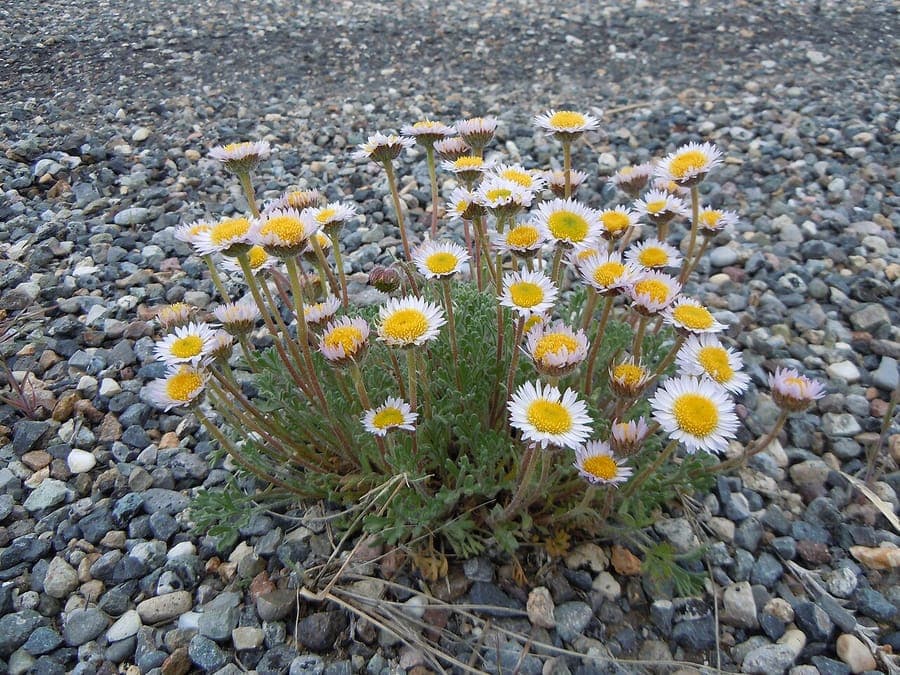
Matt Lavin from Bozeman, Montana, USA / CC BY-SA 2.0, via Wikimedia Commons
Cutleaf daisy: complete guide
Erigeron compositus
Want to see Cutleaf daisy: complete guide in your garden?
1 minute, no credit card
Overview
Erigeron compositus, commonly known as cutleaf daisy or dwarf mountain fleabane, is a compact, low-growing perennial belonging to the Asteraceae family. The species was described in 1813 by the botanist Pursh from specimens collected in subarctic North America. Its native range extends from Alaska and Greenland southward through the Canadian Rockies and into the western United States, including California, Montana, Wyoming, Colorado, and Utah. It grows naturally on rocky ridges, gravelly slopes, and subalpine meadows at elevations up to 3,500 metres.
The species name compositus refers to the distinctively divided, compound-looking leaves that set this plant apart from other fleabane species. The foliage is finely cut in a fern-like pattern, creating a delicate, almost lacy texture. Plants rarely exceed 15-20 cm in height and form neat, cushion-like mounds that look at home in rock gardens, alpine troughs, raised beds, and the front rows of herbaceous borders.
For gardeners seeking a reliably hardy, low-maintenance perennial with attractive white to pale-purple daisy flowers, Erigeron compositus is an excellent choice. It tolerates drought once established, attracts pollinators including bees and hoverflies, and fits well into naturalistic or wildflower-style garden designs.
Appearance & bloom cycle
The foliage of Erigeron compositus is the plant's most distinctive feature outside the flowering season. Leaves are two to three times pinnately divided, producing a finely textured, almost filigree pattern quite different from the simple leaves of many daisies. Basal leaves are lance-shaped to spoon-shaped, typically 2-6 cm long, and covered with fine, soft hairs that give them a grayish-green to blue-green cast. Stem leaves are smaller and similarly cut.
Flower heads appear from May through August in garden cultivation at lowland elevations. Each head consists of a yellow disc surrounded by 20-60 ray florets that range from white through light pink to pale lilac. Fully open flower heads measure 1.5-3 cm across, held on erect stems 8-20 cm tall. The var. grandiflorus form has slightly larger flower heads and is sought by collectors of alpine plants.
The var. discoideus form lacks ray florets entirely, producing only the central yellow disc - a curious but rather attractive look for those who prefer a less flamboyant planting. After flowering, small achenes develop equipped with a fine pappus that allows wind dispersal. Self-seeding can occur on well-drained, open ground, gently spreading the colony over several years.
The bloom period, typically mid-May through July at lowland sites, can often be extended into September by removing spent flower stalks promptly after the first flush. This technique encourages a second, somewhat lighter flowering that provides welcome late-season colour in rock gardens.
Ideal location
Erigeron compositus performs best in a fully open, sunny position receiving at least five to six hours of direct sun per day. In its natural habitat of mountain ridges and rocky plateaus, it experiences high light intensity, free air circulation, and well-drained soils that dry quickly after rain. Replicating these conditions in the garden is the key to success.
A south- or southwest-facing position in a rock garden, a dry stone wall, or the edge of a raised bed is ideal. The plant also does well in large containers (minimum 20 cm diameter) with excellent drainage holes, making it suitable for patios and balconies. Partial shade is tolerated but results in less prolific flowering and a looser rosette habit. Deep shade should be avoided entirely.
In urban gardens with the heat island effect, plants may bloom earlier than in rural settings, which is advantageous if you want early-season pollinator support. The compact growth habit also makes this species useful for planting along path edges or between stepping stones, where the low-growing mounds soften the hard lines of stone without obstructing foot traffic.
Soil requirements
The ideal soil for Erigeron compositus is lean, fast-draining, and mildly alkaline to neutral. In nature, the plant thrives on gravelly scree and rocky substrates with little organic matter and a soil pH between 6.1 and 8.1. Heavy clay soils need significant amendment: work in 20-30% coarse sand (particle size 2-4 mm) and 10-15% perlite into the top 25-30 cm of the planting zone before setting out plants.
Avoid overly rich, nitrogen-heavy soils or fresh compost, as too much fertility produces lush but floppy growth that suppresses flowering and increases susceptibility to fungal issues. A lean to moderately fertile soil is the best choice. When mulching around established plants, use fine gravel or crushed stone rather than bark chips: gravel mulch dries quickly, prevents moisture sitting against the crown, and improves air circulation at the base of the plant.
Container-grown plants do best in a gritty, free-draining mix: use one part standard potting compost, one part coarse sand, and one part perlite or fine gravel. Repot every two to three years when the crown becomes congested, dividing at the same time to rejuvenate growth.
Watering
Once established - typically six to eight weeks after planting - Erigeron compositus is notably drought tolerant. During the first growing season, water once or twice per week in dry spells to help the roots establish in the new soil. Water at ground level with a gentle spray to keep the leaf rosette dry and minimise the risk of fungal problems.
After establishment, the plant can tolerate dry periods of two to three weeks without permanent damage, particularly on well-drained, gravelly soil. During prolonged summer drought, a thorough weekly watering is sufficient. In wet periods or on heavier soils, excess moisture is more dangerous than drought: waterlogged roots during winter are the most common cause of plant loss. Ensure the site drains freely and that no water sits against the crown during the dormant season.
In winter, rainfall in the Netherlands and Belgium is generally sufficient; additional watering is rarely needed. A gravel mulch around the base of the plant helps keep excess moisture away from the crown and maintains the dry conditions the roots prefer.
Free design
Want to see Cutleaf daisy: complete guide in your garden? Make a free design now.
Pruning
Erigeron compositus requires very little pruning. After the main flush of flowers - usually in June or July - cut the spent flower stalks back to just above the leaf rosette using clean, sharp scissors or small hedge shears. This simple step often triggers a second, lighter flowering period in August and September.
In late autumn, after the first hard frost, you can remove dead leaf debris. However, leave the leaf rosette itself in place: the tight bundle of foliage provides insulation for the crown during hard frosts. Only in early spring - once new growth becomes visible, usually in March - should you clear away the old leaves entirely. Avoid hard pruning in autumn on frost-prone sites, as removing the rosette increases the risk of winter damage to the growing crown.
Division every three to four years in early spring helps maintain vigour and prevents the centre of old clumps from dying out. Lift the clump, split it into sections of three to five rosettes each, and replant at the same depth in refreshed soil.
Maintenance calendar
January – February: Check that the plant is not sitting in standing water. During hard frosts with little snow cover, a loose layer of pine branches over the rosette provides extra insulation.
March: Remove winter protection once hard frosts end. Cut away dead leaves and add a small handful of lean compost around the base. Plant out new specimens once the ground is no longer frozen.
April: Weed carefully around plants. Refresh the gravel mulch if needed. No feeding required; excess nitrogen encourages weak, floppy growth.
May – June: Main flowering period begins. Remove spent flower stalks regularly to encourage a second flush. Water only during dry spells lasting more than one week.
July – August: Possible second flowering. Keep the site weed-free. Drought periods of up to three weeks are well tolerated on free-draining soils.
September – October: Remove remaining spent stalks after flowering ends. Leave the leaf rosette intact for winter hardiness. Check drainage around the planting site.
November – December: Minimal care. No feeding and barely any watering needed.
Winter hardiness
Erigeron compositus is exceptionally cold hardy. Its natural habitat includes Alaska, Greenland, and subarctic mountain ranges where temperatures regularly fall to -30 °C or below. In garden cultivation across the Netherlands, Belgium, and northern Germany (USDA zones 4-7), the plant reliably survives even severe winters with temperatures down to -20 °C, provided the site drains well.
The principal winter risk is not cold but moisture: standing water around the crown during mild, wet winters - increasingly common in the Benelux region - causes root rot. Using a gravel mulch and planting on a slightly raised site (10-15 cm above surrounding soil level) significantly reduces this risk. On well-drained soils, no additional winter protection is needed. The variety discoideus shares the same cold hardiness; var. grandiflorus is marginally more susceptible to frost cracking during rapid spring temperature fluctuations but survives Benelux winters without difficulty.
Companion plants
Erigeron compositus combines beautifully with other rock garden and alpine plants that prefer similar growing conditions. Recommended companions include:
- Sedum (Hylotelephium) 'Matrona' and 'Herbstfreude' – the thick, succulent leaves create a bold textural contrast with the fine foliage of Erigeron while sharing its preference for dry conditions.
- Dianthus gratianopolitanus (Cheddar pink) – thrives on dry, calcareous soils and blooms in pink or red at the same time as Erigeron's white flowers, creating a striking two-tone display.
- Armeria maritima (Thrift) – a cushion-forming plant with spherical pink flower heads that complements the height and texture of Erigeron perfectly.
- Aubrieta x cultorum – an early-flowering, creeping plant that fills gaps between stones with a purple carpet before Erigeron begins to bloom, ensuring continuous colour from March onwards.
- Festuca glauca (Blue fescue) – the metallic blue needle-leaves provide a beautiful foil to Erigeron's white flowers. Plant Festuca 25-30 cm from Erigeron clumps to avoid root competition.
- Pulsatilla vulgaris (Pasque flower) – shares similar site requirements, blooms in April-May with purple flowers, and produces ornamental feathery seed heads that extend the season of interest.
In a rock garden bed, plant Erigeron compositus at 20-25 cm spacing. The plants will gradually fill in without overwhelming neighbours. Explore more planting design ideas for alpine and rock garden combinations at gardenworld.app.
Conclusion
Erigeron compositus is an underused gem in European gardens. This compact, exceptionally hardy perennial asks very little - a sunny spot, well-drained lean soil, and minimal watering - while delivering consistent floral display from May to September and genuine ecological value for pollinators. Whether you are designing a rock garden, a drought-tolerant front garden border, or an alpine trough arrangement, this mountain daisy is a reliable, elegant choice that returns faithfully year after year. Start planning your garden at gardenworld.app and see how this versatile plant fits into a beautiful, low-maintenance design.
Want to see Cutleaf daisy: complete guide in your garden? Make a free design now.
Upload a photo, pick a style, and get a photorealistic design with plant list in under a minute.
10,000+ gardens designed already
No credit card required


Similar plants
Calendula stellata: complete guide
Calendula stellata
Complete guide to Calendula stellata, the star-flowered marigold from Sicily: location, soil, watering and companion planting tips.
Korean chrysanthemum: complete guide
Chrysanthemum x rubellum
Chrysanthemum x rubellum is a hardy autumn perennial with single pink to copper flowers from August to November. Care and combinations.
Helianthus divaricatus: complete guide
Helianthus divaricatus
Helianthus divaricatus is a North American woodland sunflower with yellow summer blooms, ideal for naturalistic borders and shady edges.