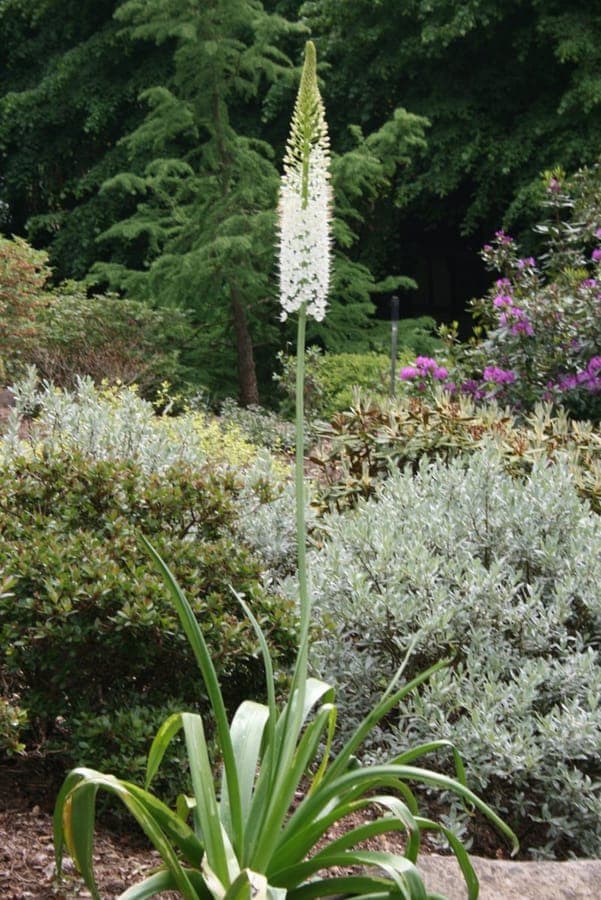
Sten Porse / CC BY-SA 3.0, via Wikimedia Commons
Himalayan foxtail lily (Eremurus himalaicus): growing guide
Eremurus himalaicus
Want to see Himalayan foxtail lily (Eremurus himalaicus): growing guide in your garden?
Full design in HD: €7.99
Look after your Himalayan foxtail lily with the GardenWorld app
Identify plants with your camera and get a care calendar with reminders for this plant.


Overview
Eremurus himalaicus is the white foxtail lily from the Himalaya, sold as the Himalayan foxtail lily or Himalayan desert candle. It stands out for its pure white flower spikes on stems that grow taller than most people, and for its broad, fresh green foliage. It is also the earliest of the genus to bloom: while other foxtail lilies are still in bud, this one is already in full flower.
The plant belongs to the Asphodelaceae family. In the wild it grows on rocky slopes in the drier parts of the western Himalaya, from Afghanistan and Pakistan to northern India, at altitudes of roughly 2,100 to 3,300 metres. Snow lies there in winter, meltwater soaks the ground in spring and summer is dry and sunny. That pattern of a cold, moist spring followed by a dry summer is the key to growing it well.
In a border the flower stem usually reaches 120 to 180 cm, and in a warm, fertile spot the RHS gives up to 2 metres or more. The leaf rosette itself is 50 to 60 cm across. A plant of that stature deserves a well-chosen spot, and on gardenworld.app you can have a garden design made that takes height, flowering time and the summer gap it leaves into account.
Appearance and flowering season
The leaves appear as early as February or March. They are strap-shaped, 3 to 5 cm wide and 30 to 60 cm long, glossy bright green and channelled along the midrib. They arch gracefully outwards into an open rosette, clearly visible in the photo. Compared with other foxtail lilies the foliage is broad and lush, closer to a large lily than to a grass.
In May the flower stem shoots up quickly. The upper section, 60 to 90 cm long, carries hundreds of small, open, starry flowers about 2 cm across, each with long protruding stamens. The buds at the tip are greenish and the open flowers pure white. Flowering starts at the base and works its way upwards over two to three weeks, from mid-May to mid-June.
On a sunny border, white catches the light and calms everything around it. Just before early summer very little else flowers at this height, so the plant becomes a genuine exclamation mark. Bees and bumblebees work the spikes all day. After flowering, rounded seed capsules ripen; leave them for seed or cut them off.
Ideal position
Give it a sunny, sheltered spot with at least six hours of direct sun a day; a warm south-facing aspect is ideal. Shelter matters more for this species than for the shorter foxtail lilies, because a stem nearly two metres tall with a heavy white spike catches a lot of wind. In an open site, tie the stem to a sturdy cane or plant it in the lee of shrubs.
Because it comes into growth so early, a spot that warms up quickly in March and April helps. Avoid frost pockets where cold air lingers. Do not plant it under trees either: apart from the shade, their roots dry the soil too fast in spring and make it too variable in summer.
Soil requirements
Deep, well-drained soil is the foundation. The fleshy roots of an older plant can spread 40 cm across and need room. Sandy loam or a well-worked loam lightened with grit is ideal. On wet clay the roots rot over winter, so build a raised bed at least 30 cm high.
This species is a little hungrier than its yellow steppe relatives. Work a bucket of well-rotted compost into the soil at planting time and give an organic fertiliser in spring. Neutral to slightly alkaline soil is fine.
Planting the crowns
You buy the plant as a dry crown with a central bud and long, spreading roots. Plant in September or October, as soon as possible after buying, because crowns that have dried out establish poorly.
Dig a hole about 50 cm wide and 20 cm deep. Make a cone of coarse sand in the middle, set the crown on top and spread the roots out like spokes. Cover until the bud is 10 to 15 cm below ground. Allow 60 to 90 cm between plants. A single plant already makes an impact; three in a row or a triangle look magnificent in a large border.
Put a cane in straight away. In summer there is nothing to see above ground, and one careless spade can undo years of growth.
Free preview
Want to see Himalayan foxtail lily (Eremurus himalaicus): growing guide in your garden? Make a free preview of your design.
Watering
Water once thoroughly after planting. In winter it needs nothing. From March to the end of May, while the leaves and flower stem grow, it does need more moisture than you might expect of a mountain plant, as meltwater is plentiful in its natural habitat at that time. In a dry spring, give a full watering can around the plant once a week.
After flowering, taper off. From July the soil is best kept dry, so a packed border watered every evening is not the right home.
After flowering
Simply let the foliage die back. From late June it yellows and then browns, and the plant needs those weeks to store reserves for the following year. Only remove it once it is completely dry. The flower stem can be cut off as soon as the last flowers have faded, unless you want to collect seed.
Raising it from seed is possible but takes patience: sow fresh seed in autumn in a pot left outdoors and expect about five years before the first flowers.
Dormancy
From July to February Eremurus himalaicus is dormant and withdraws completely into its crown. During this period it forms the flower bud for the next spring, and for that it needs warm, rather dry soil. Do not move plants while they are in growth; if you want to relocate or divide, do it from late August to September, when the plant is fully dormant.
Division is rarely necessary. After five to eight years a clump may have several buds; you can then lift it gently and split it, keeping at least one bud and a strong ring of roots on each piece.
Maintenance calendar
January to February: dormant. Clear wet leaves from the planting spot.
February to March: the leaves emerge. Protect the young rosette from night frost with fleece or a bucket and scatter ferric phosphate slug pellets.
April: give an organic fertiliser and water in dry spells. Have a cane ready in windy spots.
May to June: flowering. Tie the stem loosely if needed.
July to August: the foliage dies back. Stop watering and clear it away once dry.
September to October: plant new crowns or divide old clumps. Note the planting date and the next steps in your plant calendar on gardenworld.app, so you remember where that cane went too.
November to December: dormant. A layer of dry leaves or conifer branches gives extra security in cold spots.
Winter hardiness
The RHS rates Eremurus himalaicus H6: fully hardy, even in severe frost down to about -20 °C. The dormant crown deep in the soil has nothing to fear in a British or Belgian winter. Its weak point is the foliage that appears early in spring. A night frost of -5 °C on the young rosette can damage the developing flower stem, so keep fleece to hand between February and April and cover the plant when frost is forecast.
Companion plants
The white spike looks its best against a dark backdrop of shrubs or hedging, as in the photo, where it rises among silver-grey and dark green shrubs. In a border, pair it with peonies (Paeonia lactiflora) and oriental poppies (Papaver orientale), which flower around the same time and, like the foxtail lily, look less tidy after June.
Allium giganteum repeats the vertical line with purple globes on long stems. Greater sea kale (Crambe cordifolia) sets a white cloud beside it. A spurge such as Euphorbia characias keeps green leaves all year and fills the gap later on. Avoid fast-spreading ground cover that creeps over the crown.
Final thoughts
Eremurus himalaicus is the plant for anyone who wants something big to happen in late spring. A sunny, sheltered spot, deep and open soil and some moisture in spring are all it asks. Protect the young leaves from frost, let them die down quietly in summer and mark the spot with a cane. Then every May a white candle almost two metres tall will rise in your garden.
Frequently asked questions about Himalayan foxtail lily
Is Himalayan foxtail lily winter hardy?
The RHS rates Eremurus himalaicus H6: fully hardy, even in severe frost down to about -20 °C. The dormant crown deep in the soil has nothing to fear in a British or Belgian winter.
How much water does Himalayan foxtail lily need?
Water once thoroughly after planting. In winter it needs nothing.
What soil does Himalayan foxtail lily need?
Deep, well-drained soil is the foundation. The fleshy roots of an older plant can spread 40 cm across and need room.

See it in your garden
See Himalayan foxtail lily in your garden
One photo of your garden and a few questions. You see the result in about a minute.
Try it with a photoIdentify this plant in your own garden. Identify a plant
Similar plants
Giant onion: complete guide
Allium giganteum
Everything you need to grow Allium giganteum: planting, care, companions, and seasonal tips. Thrives in full sun from USDA zone 5.
Garden peony: complete guide
Paeonia lactiflora
Everything about the garden peony (Paeonia lactiflora): planting depth, fragrant blooms, cultivars and long-term care. Expert tips for flowers that last a lifetime.
Papaver orientale: complete guide to Oriental poppy
Papaver orientale L.
Comprehensive guide to Oriental poppy (Papaver orientale): growing, blooming periods, care requirements, and hardiness. A stunning perennial with enormous dramatic flowers.
