
Wadester16 / CC BY-SA 3.0, via Wikimedia Commons
Giant onion: complete guide
Allium giganteum
Want to see Giant onion: complete guide in your garden?
1 minute, no credit card
Overview
Allium giganteum, commonly known as giant onion, is a showstopper in any garden. Native to the mountainous regions of Afghanistan, Iran, and Central Asia, this member of the Amaryllidaceae family brings bold structure and architectural flair to borders. Reaching heights of up to 150 cm, it commands attention in early summer when few other perennials are at their peak. The plant grows from a large bulb and returns reliably each year with minimal care.
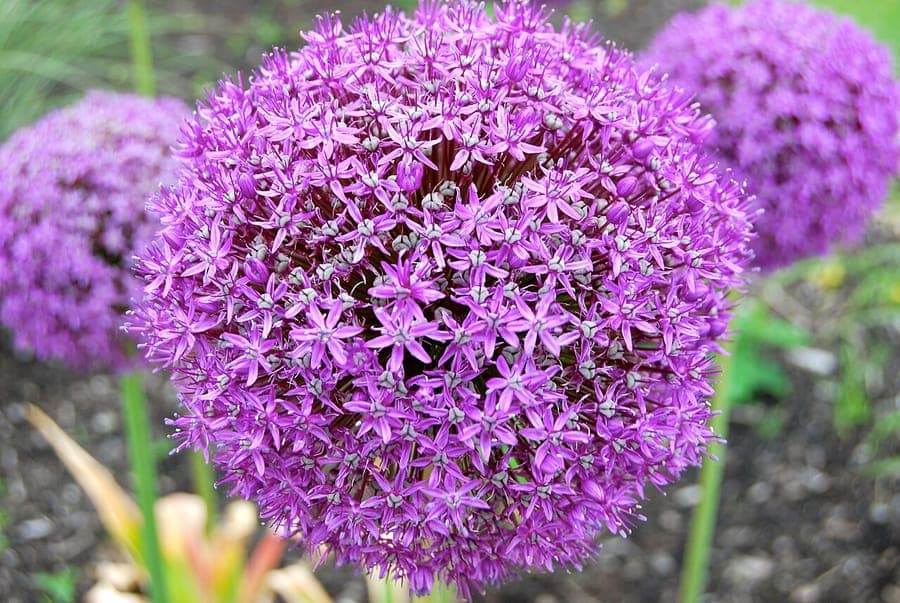
Despite its name, it's not grown for the kitchen. The leaves and bulbs are technically edible, but they're intensely pungent and rarely used. Its real value lies in its ornamental impact. The spherical flower heads, made up of hundreds of tiny star-shaped blooms, are perfect for cutting and also attract bees and hoverflies.
If you're designing a new border, gardenworld.app lets you map out plant heights and bloom times so Allium giganteum lands in the right spot-neither lost in the front nor overcrowding smaller plants.
Appearance & bloom cycle
Allium giganteum starts growth in April with strap-like, grey-green leaves emerging from the bulb. These leaves stay relatively short, rarely exceeding 30 cm, and begin to yellow by late June. The real star is the flower stem, which shoots up rapidly in May, reaching 120–150 cm by early June.
The flower head is a perfect sphere, 15–20 cm across, composed of deep purple to rosy-lavender florets. Blooming occurs from early to mid-June, depending on your zone and spring temperatures. In sheltered, sunny spots, flowering can start as early as late May. The blooms last for 2–3 weeks and remain attractive even as they dry, adding interest into autumn.
Seed formation is rare in cooler climates, so self-seeding isn't a concern. However, the dried seed heads can be left standing for winter texture or cut for dried arrangements.
Ideal location
Full sun is non-negotiable. This plant needs at least 6–8 hours of direct sunlight daily to develop strong, upright stems. In shade, the stems bend and flop, ruining the plant's clean lines. Position Allium giganteum in the middle or back of a sunny border where its height can shine.
In smaller gardens, grow it in a container at least 40 cm wide. Use a mix of potting soil and grit for drainage. Place the pot in a sunny spot on your patio. With gardenworld.app, you can preview how a cluster of giant onions will look in your space before you plant them-saving time and trial-and-error.
Soil requirements
Well-drained soil is essential. Heavy clay can be improved with horticultural sand or compost. The ideal pH is between 6.5 and 7.5-slightly neutral to slightly alkaline. Avoid waterlogged areas, as bulbs will rot in standing moisture.
Plant bulbs in autumn (September to November) at a depth of 15–20 cm, pointed end up. Space them 25 cm apart to prevent overcrowding and promote airflow. This spacing reduces the risk of fungal diseases like botrytis.
Free design
Want to see Giant onion: complete guide in your garden? Make a free design now.
Watering
Once planted, bulbs need little water unless the autumn is unusually dry. In spring, when growth resumes, regular watering helps establish strong stems. Water at the base to keep foliage dry and prevent mildew.
During dry spells in May and June, give a deep soak once a week. After flowering, reduce watering gradually. By late summer, stop watering altogether-this mimics the plant's native dry summer habitat and encourages dormancy.
Pruning
No pruning is needed. Do not cut back the foliage until it has fully yellowed-usually by late July or August. The leaves are feeding the bulb for next year's bloom. Cutting them early leads to weaker flowers in subsequent seasons.
The flower stem can be left intact for winter interest or cut once it turns brown. If using cut stems for arrangements, allow them to dry upside down in a dark, airy space for 2–3 weeks.
Maintenance calendar
- September: Prepare beds, clear old debris
- October–November: Plant bulbs 15–20 cm deep, 25 cm apart
- December–February: Dormant-no action required
- March: Watch for new shoots; check for aphids
- April: Leaves emerge-water lightly if dry
- May: Stems elongate-support if needed in exposed areas
- June: Peak bloom-water during dry spells
- July: Foliage yellows-stop watering
- August–September: Dormancy-leave undisturbed
Winter hardiness
Allium giganteum is hardy in USDA zones 5–8. It tolerates winter lows down to -20°C. In colder zones, a light mulch can help, but avoid covering the crown, which may trap moisture. In containers, move pots to a sheltered spot or wrap them to prevent freeze-thaw cycles that damage bulbs.
Companion plants
Pair with perennials that share its sun and soil needs. Try Salvia nemorosa, Echinacea purpurea, or Nepeta for long bloom seasons and complementary colors. Lavender works well for scent and structure. Lower-growing options like Thymus or Sedum 'Matrona' add ground-level texture without competing for light.
Avoid moisture-loving plants like Astilbe or ferns-they'll struggle in the same well-drained conditions this allium demands.
Closing
Allium giganteum isn't subtle, and that's the point. It's a structural anchor, a punctuation mark in the garden. When planted in groups of 5 or more, it creates a dramatic effect that few other bulbs can match. Buy quality bulbs in autumn from local garden centres-look for firm, plump bulbs without mould or soft spots. Large bulbs produce larger flower heads. With the right placement and patience, this giant delivers year after year.
Want to see Giant onion: complete guide in your garden? Make a free design now.
Upload a photo, pick a style, and get a photorealistic design with plant list in under a minute.
No credit card required


Similar plants
Douglas' Onion: complete guide
Allium douglasii
Douglas' onion is a compact ornamental allium with purple flowers, perfect for rock gardens and sunny borders. Learn care, siting and hardiness.
Oblique onion: complete guide
Allium obliquum
The oblique onion is a hardy ornamental allium with chartreuse flower heads and blue-green foliage. Location, soil and care explained.
False hooded garlic: complete guide
Allium pseudocalyptratum
Discover false hooded garlic (Allium pseudocalyptratum): a rare ornamental onion from Lebanon for rock gardens and alpine troughs.