
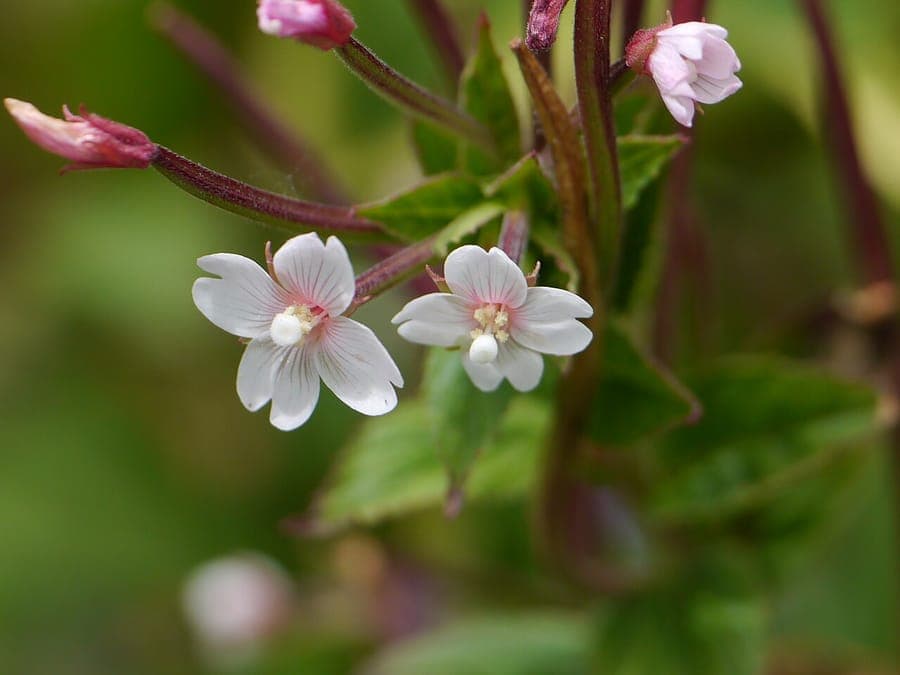
Dinesh Valke from Thane, India / CC BY-SA 2.0, via Wikimedia Commons
Purpleleaf willowherb: complete guide
Epilobium coloratum
Want to see Purpleleaf willowherb: complete guide in your garden?
1 minute, no credit card
Overview
Epilobium coloratum, commonly known as purpleleaf willowherb, cinnamon willowherb, or eastern willowherb, is an annual to short-lived perennial herb in the family Onagraceae. Native to eastern North America from Canada (New Brunswick, Ontario, Québec) south to the Gulf Coast states and even into Hispaniola, this graceful plant colonises wet, disturbed habitats: stream banks, marsh edges, wet meadows, and moist forest clearings.
The species name 'coloratum' aptly describes one of its most distinctive features: the purple-red to cinnamon-brown colouring of stems, leaf veins, and petioles. This warm colouration is most vivid in sunny positions and gives the plant ornamental value even outside its bloom period. The small pink to pinkish-purple flowers, though individually modest, are borne in such profusion from July through September that the whole plant shimmers with movement and subtle colour.
In garden settings, purpleleaf willowherb is well suited to pond margins, rain gardens, bog gardens, and any reliably moist corner of the landscape. It is self-seeding and can spread assertively in favourable conditions, but this quality also makes it a generous coloniser of awkward wet spots where other plants struggle to establish. It tolerates a wide pH range of 4.5 to 7.5 and adapts to most soil types provided moisture is consistently available.
Ecologically, the plant offers genuine value. The small flowers provide nectar and pollen for a broad range of small bees, hoverflies, and butterflies. The wind-dispersed seeds feed small birds in autumn. As part of a naturalised wet garden, it integrates seamlessly with native sedges, rushes, and moisture-loving wildflowers.
Appearance & bloom cycle
Purpleleaf willowherb grows as an erect, slender herb reaching 40 to 90 cm in height. The stems are green when young, but as the season progresses they develop characteristic purple-red to cinnamon-brown pigmentation - particularly striking on the upper half of the plant and on leaf veins. This colouring intensifies in full sun and on nutrient-moderate soils. Leaves are lance-shaped, 5 to 10 cm long and 1 to 3 cm wide, with finely toothed margins. Upper leaves are alternate; lower leaves are sometimes opposite.
The bloom period runs from July through August with straggling flowers persisting into September. Individual flowers are small (5–10 mm across), four-petalled, and pale pink to light pink-purple. They are produced in the axils of upper leaves, with dozens to hundreds of open flowers on a well-developed plant. After flowering, elongated cylindrical seed capsules 3 to 6 cm long develop; when ripe these split open to release tiny seeds, each equipped with a white plume for wind dispersal.
The overall texture of the plant is airy and light: slender stems with delicate flowers create a visual softness that contrasts well with bold-leaved marginal plants such as Typha or Lysimachia. Named cultivars or selections are not widely available; gardeners typically work with the straight species.
The synonym Epilobium divaricatum (Raf.) occasionally appears in older literature, as does Epilobium domingense for Caribbean populations. These refer to the same botanical entity.
Ideal location
Purpleleaf willowherb thrives in moist to wet, sunny to lightly shaded positions. In nature it is a pioneer of disturbed, wet ground: stream banks, drainage ditches, wet roadsides, and seasonally flooded meadows. In the garden, ideal locations include pond margins, the edge of a rain garden, low-lying boggy corners, or reliably moist areas along fences and walls where runoff collects.
Full sun produces the best stem colouring and most prolific flowering. In partial shade - beneath open tree canopy or along a lightly shaded path - the plant grows well but stem pigmentation is less intense. Deep shade is unsuitable: growth becomes spindly and flowering sparse.
Be aware of the plant's self-seeding tendency: in favourable conditions it can establish quite freely. In large, naturalised wet gardens this is advantageous; in small, tightly managed spaces, deadheading spent flower stems before seed capsules mature gives reasonable control. Unwanted seedlings are easy to remove while small.
Soil requirements
Purpleleaf willowherb is tolerant of a wide range of soil types provided consistent moisture is available. It grows in heavy clay, loamy sand, sandy peat, and marl, performing well across a pH range of 4.5 to 7.5 - from mildly acidic to slightly alkaline. On dry, chalky soils it performs poorly and is unlikely to persist.
In moist border or pond-margin situations, no soil amendment is typically needed. Where the plant is being established in a naturally drier site with supplemental irrigation, incorporating organic matter - a generous addition of garden compost or leaf mould - at planting improves water retention considerably. A 5 to 8 cm mulch layer of bark chips or leaf mould around the base retains moisture and suppresses competing weeds.
Avoid heavy nitrogen fertilisation: it promotes lush but floppy growth and can reduce the attractive reddish stem pigmentation. Moderate soil fertility with good organic matter content is ideal.
Watering
Consistent soil moisture is the primary cultural requirement of purpleleaf willowherb. In its natural habitat it grows in perpetually wet or very moist ground; in the garden this means the roots must have reliable access to moisture throughout the growing season. On naturally wet pond margins or stream banks, supplemental watering is generally unnecessary.
In moist borders or rain gardens that may dry partially between rain events, regular watering is important, particularly during warm, dry spells. In dry summer weather, water every two to three days to keep the top 10 to 15 cm of soil moist. Drip irrigation or a soaker hose delivers water efficiently to the root zone without wetting the delicate flowers. Overhead watering can cause the fine stems to lodge if water pressure is high.
During rainy periods or naturally wet summers, supplemental watering is not required. While the plant tolerates standing water temporarily, gently flowing or slowly draining marginal water is more beneficial than stagnant, oxygen-depleted conditions at the root zone. Mild movement of water around the roots actually promotes vigorous growth.
Free design
Want to see Purpleleaf willowherb: complete guide in your garden? Make a free design now.
Pruning
As an annual to short-lived perennial, purpleleaf willowherb requires minimal intervention. The main maintenance task is removal of spent flowering stems before seed capsules open, which limits self-seeding to manageable levels. Clip the upper flowering portion once capsules are visible but still green and closed; this prevents the characteristic wind-dispersed seeds from colonising adjacent garden areas you want to keep clear.
At the end of the growing season in October or November, cut back the aboveground portion to just above soil level. The cut material can be composted. If you want to encourage natural spread or provide winter food for small seed-eating birds, leave some seeded stems standing until late winter.
For multi-year plants, clump division in spring is the most reliable propagation method. Lift the root crown gently, divide it into two to four equal sections, and replant at the same depth with 30 to 40 cm spacing. Division also reinvigorates older clumps that may flower less prolifically.
Maintenance calendar
January–February: Dormancy. Ensure the planting site does not sit under frozen standing water for extended periods, which can damage root crowns at very low temperatures.
March: Growth resumes. Remove winter debris. Seeds on the soil surface from the previous autumn begin germinating; select desired seedlings and remove extras while still small.
April: Transplant young seedlings or divided clumps if desired. Maintain consistent moisture. Apply a 5 to 8 cm organic mulch around the base to retain moisture through the growing season.
May–June: Active growth phase. Water every two to three days in dry weather. Keep the area weed-free; Epilobium seedlings are identifiable at this stage and easily removed.
July–August: Bloom period. Enjoy the delicate flowers and the steady visits of small bees, hoverflies, and butterflies. Continue watering. Remove the first maturing seed capsules if you want to limit spread.
September: Late bloom and seed dispersal. Clip flowering tops to prevent spread if desired. Harvest ripe seed for deliberate sowing elsewhere in the garden.
October–November: Cut back aboveground stems to soil level. Compost or leave as winter ground cover.
December: Dormancy. Periodically check that the root crown has not been damaged by severe frost.
Winter hardiness
Epilobium coloratum is outstandingly cold-hardy, reflecting its native range across eastern Canada and the northeastern United States where winter temperatures can fall to -30 °C or colder. As a perennial, the root crown survives even very harsh winters; the aboveground stems die back and regrow from the base in spring. In European garden terms, it is reliably hardy in USDA zones 3 to 8, covering virtually all of western, central, and northern Europe.
The root crown is the surviving structure; the aboveground stems die back seasonally. In extreme cold accompanied by dry frost without snow cover, a light covering of fallen leaves or straw can provide insurance, but in practice this is rarely necessary for a plant that thrives across the Canadian winter. In mild coastal areas such as the Dutch and Belgian coast, regrowth from the base begins as early as March.
Ensuring the root zone does not completely dry out during autumn - maintaining moisture reserves in the soil going into winter - is the most useful preparation for reliable overwintering.
Companion plants
Purpleleaf willowherb combines best with other moisture-loving and pond-margin plants:
- Lysimachia punctata (garden loosestrife): yellow flower clusters provide vivid colour contrast with the pink blooms of Epilobium. Both thrive in wet to moist marginal soil. Space 40 cm apart.
- Iris pseudacorus (yellow flag iris): the sword-like leaf structure of the iris provides vertical textural contrast alongside the slender Epilobium stems. The two bloom in overlapping periods from May through July.
- Filipendula ulmaria (meadowsweet): low, creamy-white flower clusters complement the fine pink Epilobium flowers in the summer marginal zone. Together they create a classic wetland plant association.
- Lythrum salicaria (purple loosestrife): purple flower spikes complement the pink Epilobium tones beautifully in wet, sunny border sections. Space 50 to 60 cm apart.
- Carex riparia (greater pond sedge): broad, dark green sedge blades provide a calm backdrop behind the lighter, more delicate Epilobium stems.
Avoid combining with xerophytes and drought-tolerant plants such as Sedum, lavender, or Stipa - the soil moisture requirements are diametrically opposed.
See how purpleleaf willowherb works in a pond or water-edge design for your own garden at gardenworld.app, where you can upload your garden photo and try plant combinations. More on moisture-loving and marginal plants is available at gardenworld.app.
Closing
Purpleleaf willowherb is a modest but genuinely charming plant for wet and moist garden positions. Its ornamental purple-brown stem colouring, the delicate pink flowers, and the strong value for pollinators make it a worthwhile addition to pond margins, rain gardens, and naturalised wet corners. With minimal care it returns year after year, gradually expanding into a light, airy colony that enriches wet landscape areas in an entirely natural way.
Want to see Purpleleaf willowherb: complete guide in your garden? Make a free design now.
Upload a photo, pick a style, and get a photorealistic design with plant list in under a minute.
10,000+ gardens designed already
No credit card required


Similar plants
Shortfruit evening primrose: complete guide
Oenothera brachycarpa
Everything about Oenothera brachycarpa - the shortfruit evening primrose from the American Southwest. Growing tips, placement and care for your garden.
Sundrops (Oenothera tetragona): complete guide
Oenothera tetragona
Everything about Oenothera tetragona - the cheerful daytime-blooming sundrops perennial. Growing tips, placement, pruning and care for a long summer display.
Seabeach evening primrose: complete guide
Oenothera humifusa
Full guide to Oenothera humifusa, the seabeach evening primrose native to the US Atlantic coast. Yellow blooms, silvery foliage, drought-tolerant.