
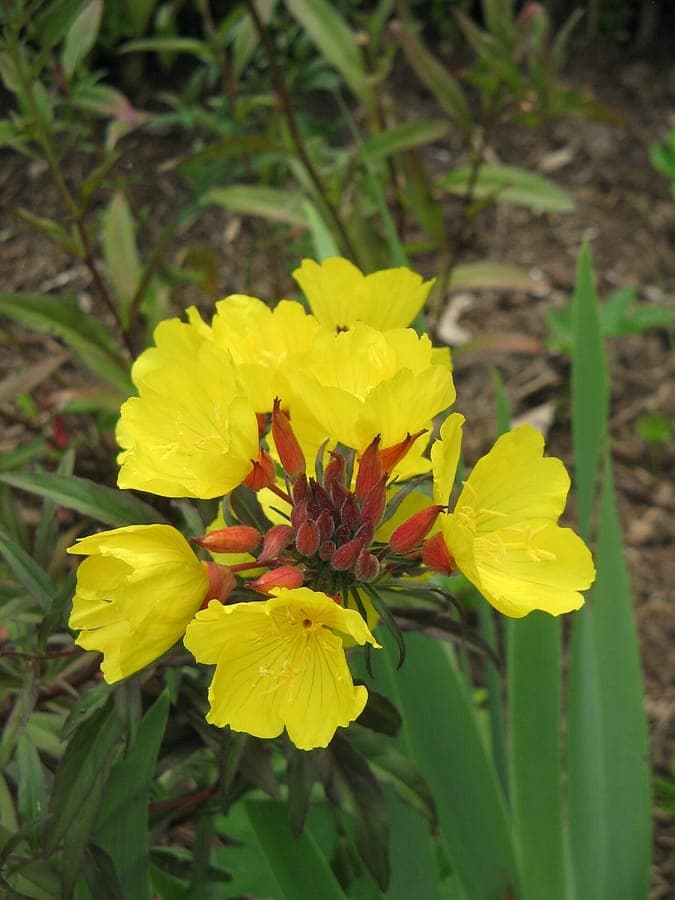
Meneerke bloem / CC BY-SA 3.0, via Wikimedia Commons
Sundrops (Oenothera tetragona): complete guide
Oenothera tetragona
Want to see Sundrops (Oenothera tetragona): complete guide in your garden?
1 minute, no credit card
Overview
Oenothera tetragona, commonly known as sundrops or narrowleaf evening primrose, is a popular and reliable perennial from the Onagraceae family. What sets it apart from many of its relatives is that its flowers open during the day rather than at dusk, making it a highly visible and cheerful presence throughout the summer garden. Native to eastern North America - from Nova Scotia and Quebec southward through the Appalachians to Alabama and Georgia - it has naturalised widely in European gardens and is known in some parts as an introduced species in Germany and beyond.
The species carries several synonyms, including Oenothera fruticosa subsp. tetragona and Oenothera glauca. The name tetragona refers to the four distinct ridges visible on the young stems, a useful identification feature. Numerous cultivars have been selected for garden use, among them the well-known 'Fireworks' (syn. 'Fyrverkeri'), which produces reddish stems and buds that contrast beautifully with the golden-yellow flowers.
Gardeners who visit gardenworld.app regularly will know how well sundrops sit alongside other long-blooming perennials in mixed borders and naturalistic plantings. This plant's combination of generous flowering, bee and butterfly appeal, and low maintenance has secured it a permanent place in the perennial gardener's repertoire.
Appearance and bloom cycle
Oenothera tetragona is a clump-forming perennial that returns reliably each year from a woody rootstock. The stems grow 40 to 70 cm tall and are often flushed reddish, particularly in cultivars selected for ornamental effect. This reddish colouring extends to the buds, creating a decorative contrast before the flowers even open. The leaves are oblong to lance-shaped with a glossy deep-green surface.
The flowers are among the most cheerful in the summer garden: bright golden yellow, four-petalled and 3 to 5 cm across. Unlike the classic night-blooming evening primroses, these open fully in daytime and remain open into the evening, making them accessible to a wide range of pollinators. Each flower lasts one day, but the plant produces buds in such quantity that the display continues for weeks.
Flowering begins in June and continues through July into August. In a good season with adequate moisture it can extend further into late summer. The spent flowers are replaced by characteristic four-angled seed capsules - the feature reflected in the species name. In autumn the foliage often takes on attractive reddish-bronze tones before dying back to the rootstock for winter.
Ideal location
Sundrops performs best in a full sun to lightly shaded position. Full sun delivers the richest flowering; some afternoon shade is tolerated in hotter climates, but heavy shade leads to weak, floppy stems and sparse bloom. Choose a reasonably sheltered spot where the stems will not be battered by strong wind.
The plant is at home in a wide range of garden settings - traditional borders, prairie-style plantings, wildflower meadows and informal cottage gardens all suit it well. Its upright, branching growth provides good mid-border height and structure. It also tolerates moister ground than many of the more drought-adapted Oenothera species, making it a candidate for planting near water features or in areas that remain damp in spring.
This adaptability reflects its wide natural range across the eastern United States, where it experiences everything from humid coastal summers to cold continental winters. It is considerably more flexible in its requirements than the desert-adapted species from the Southwest.
Soil
Oenothera tetragona is not fussy about soil type. It grows well in a broad range of substrates, from lightly sandy soils to fairly heavy loam, provided drainage is adequate. Its preferred pH range is 4.5 to 7.0, meaning it handles both mildly acidic and neutral soils without difficulty.
In practice, it performs best in a reasonably fertile, humus-rich garden soil that retains some moisture without becoming waterlogged. In very poor sandy ground it may bloom less freely; an annual top dressing of garden compost or a balanced slow-release fertiliser will help. In heavy clay, incorporate compost and coarse grit before planting, or place the plant in a raised bed.
A 5 cm layer of organic mulch - leaf mould, wood chips or garden compost - applied around the plant in spring conserves moisture, suppresses weeds and gradually improves soil structure. Keep the mulch clear of the stems to avoid rotting the base.
Watering
Oenothera tetragona has moderate water requirements and is not particularly demanding. In its first growing season, water regularly - once or twice a week depending on rainfall - to help the plant establish a strong root system. After that first year it becomes appreciably more self-reliant.
In average British or Northern European gardens, where summer rainfall typically provides 600 to 800 mm per year, supplementary watering is rarely necessary except during extended dry spells. In a hot, dry summer, a thorough deep watering once a week is more beneficial than frequent shallow watering, as it encourages roots to penetrate deeper into the soil.
This species is noticeably more tolerant of moisture than the desert-adapted Oenothera species. It does not demand drought conditions and in fact performs better with consistent, moderate moisture than in extreme dryness. That said, waterlogged soil - particularly in winter - remains a risk for root rot, so drainage should always be adequate.
Container-grown plants will need more regular watering than border plants, especially in warm, dry weather.
Free design
Want to see Sundrops (Oenothera tetragona): complete guide in your garden? Make a free design now.
Pruning
Maintenance needs are modest. The spent flowers drop cleanly, so routine deadheading is not essential. However, cutting the flowered stems back by around a third as each flush of bloom fades can encourage further branching and a longer overall season.
In early spring, once the new shoots are clearly emerging from the rootstock, remove the dead stems and dried foliage left from the previous year. Cut them back to 5 to 10 cm above ground level using clean secateurs. This simple annual tidying is all the plant normally requires.
Every three to four years the clump becomes congested and flowering diminishes. Division is the straightforward solution: lift the rootstock in early spring or early autumn, divide it into sections each carrying several shoots and a good portion of healthy root, and replant promptly. This reinvigorates the plant and provides free divisions for spreading through the garden or sharing with other gardeners.
Maintenance calendar
January - February: Dormancy. No action needed. Check that winter wet is not pooling around the crown.
March: Clear dead stems once new shoots appear. Top dress with compost or a balanced fertiliser. This is also the best time to divide congested clumps.
April: Plant new specimens purchased from garden centres into well-prepared, sunny positions.
May: Growth accelerates. Stake taller cultivars if the site is exposed to wind.
June - August: Peak flowering. Water during prolonged dry spells. Cut back flowered stems to encourage further bloom.
September: Flowering concludes. Seed capsules provide decorative interest and winter food for birds. Apply a final light feed if the soil is very poor.
October - November: Foliage may colour attractively before dying back. Leave stems until fully dead.
December: Rest. Apply a light mulch of compost over the crown if severe frost is expected in exposed gardens.
Winter hardiness
Oenothera tetragona is very reliably winter-hardy. It is rated for USDA zones 4 to 9, withstanding temperatures down to approximately -35 degrees Celsius. In practice this means it overwinters without difficulty throughout the British Isles, the Netherlands, Belgium, northern France and Germany under normal winter conditions.
The plant retreats entirely to its rootstock in autumn. The overwintering crown sits just below or at soil level, protected by the soil itself. New shoots emerge in spring as temperatures rise, confirming successful overwintering.
The main exception is container-grown plants. Pots can freeze solid in extended cold spells, which may damage the roots. Move containers to a sheltered, frost-free location if temperatures are expected to drop below -15 degrees Celsius for more than a few days.
In garden beds, no protection is normally needed in temperate European climates. This reliability is one of the key reasons sundrops has earned such wide appreciation among perennial gardeners.
Companion plants
With its bright golden-yellow flowers and long season, Oenothera tetragona makes an excellent partner for the many blue and purple perennials that share its flowering period.
Salvia nemorosa, especially dark-stemmed cultivars such as 'Caradonna', provides a classic colour complement. Nepeta (catmint) in its many forms offers a comparable lavender-blue contrast and shares the plant's attraction for bees and bumblebees. Together these three plants form a reliable late spring-to-midsummer triad.
Echinacea purpurea overlaps in flowering time and adds height and warm purplish-pink tones. Later in summer, Rudbeckia varieties continue the warm yellow-orange theme as the sundrops begin to fade. This creates a seamless succession of colour across the whole season.
For ground cover at the border front, Geranium 'Rozanne' works beautifully - long-blooming, self-spreading, and offering blue-violet flowers that show off the yellow of the sundrops. Near water features, Oenothera tetragona pairs naturally with moisture-tolerant perennials such as Iris sibirica or Primula.
For a complete picture of how sundrops can work in your garden, gardenworld.app offers design tools that let you visualise planting combinations in the context of your own outdoor space.
Closing thoughts
Oenothera tetragona has earned its place as a staple of the summer perennial border - and for very good reason. Hardy, adaptable, generous in flower, attractive to pollinators and uncomplaining in its requirements, it asks very little while contributing a great deal. Whether you are creating a formal border, a relaxed cottage garden or a wildlife-friendly naturalistic planting, this sundrops will reward you with weeks of brilliant golden colour and the steady hum of visiting bees.
Want to see Sundrops (Oenothera tetragona): complete guide in your garden? Make a free design now.
Upload a photo, pick a style, and get a photorealistic design with plant list in under a minute.
10,000+ gardens designed already
No credit card required


Similar plants
Shortfruit evening primrose: complete guide
Oenothera brachycarpa
Everything about Oenothera brachycarpa - the shortfruit evening primrose from the American Southwest. Growing tips, placement and care for your garden.
Desert ironwood: complete guide
Olneya tesota
Everything about Olneya tesota, the desert ironwood - a spectacular flowering desert tree with purple blooms. Growing tips, placement and care for warm gardens.