
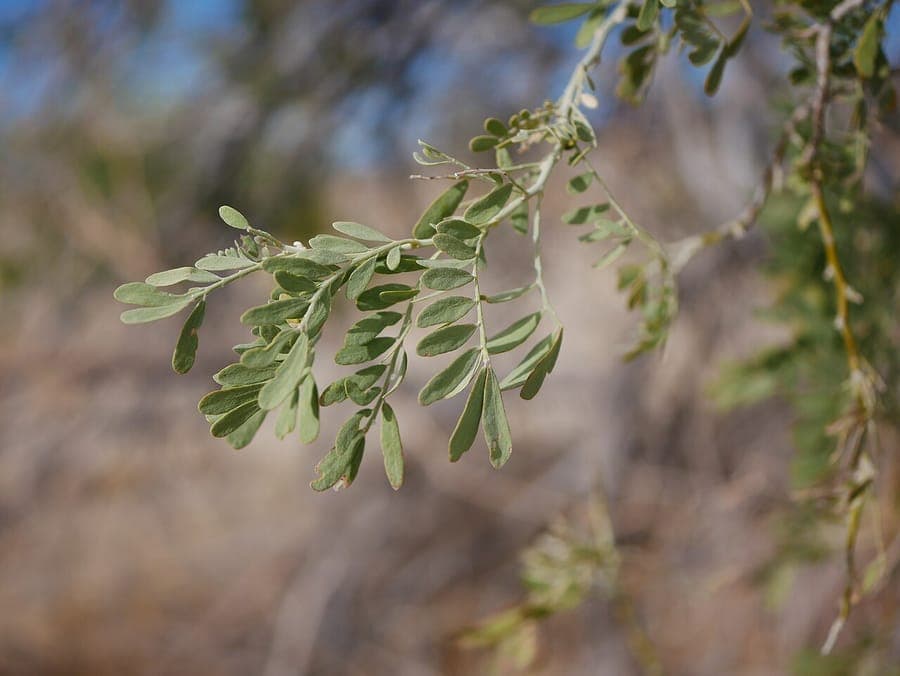
Thayne Tuason / CC BY 4.0, via Wikimedia Commons
Desert ironwood: complete guide
Olneya tesota
Want to see Desert ironwood: complete guide in your garden?
1 minute, no credit card
Overview
Desert ironwood (Olneya tesota) is one of the most remarkable trees of the Sonoran Desert. As the sole representative of the genus Olneya - a monotypic genus within the legume family Fabaceae - it occupies a unique ecological position in its native landscape. The tree grows naturally in southern Arizona, Baja California and the adjacent regions of the Mexican state of Sonora, where it dominates the dry arroyos, rocky bajadas and flat valley floors of the desert.
The common name 'ironwood' refers to the extraordinarily dense, hard timber, which is so heavy that it sinks in water. Its wood is among the hardest of any North American tree, with a density that exceeds iron by volume. Historically, the Tohono O'odham and other indigenous peoples made extensive use of this hardness, carving the wood into tool handles, throwing sticks and other objects requiring maximum strength.
In horticulture, Olneya tesota is increasingly valued as an ornamental plant for warm, dry gardens. Its purple-lavender flowers in May and June are genuinely spectacular: the entire tree transforms into a cloud of blossom. At gardenworld.app you can find inspiration for incorporating exceptional desert trees and specimens into modern, drought-tolerant garden designs.
Appearance and bloom cycle
Olneya tesota is a slow-growing, semi-evergreen tree or large multi-stemmed shrub that can reach 10 metres at maturity in ideal conditions, though in cultivation it typically stays between 4 and 8 metres. The trunk is often multi-stemmed with a broad, dense crown of grey-green foliage. The fine pinnate leaves give the tree an airy, feathery appearance that contrasts with the sturdy, spine-armed branches.
The flowers are the defining spectacle. They are lavender-purple to rose-purple, typically pea-shaped in the manner of the Fabaceae, and appear from April through June. The flowering display is so abundant that the tree is almost entirely hidden by blossom during its peak. After flowering, hairy brown seed pods form; the seeds within were traditionally eaten after roasting by indigenous communities.
The leaves are grey-green and finely pinnate, densely covering the branches. In mild winters the tree retains most of its foliage; hard frost causes greater leaf drop but the tree reliably re-leafs in spring. The branches carry short, sharp spines that give the tree a defensive character and make it useful as a wildlife habitat - birds nest safely within its canopy.
Ideal location
Olneya tesota is a full-sun tree that thrives only in an open position receiving maximum sunlight. It has evolved in one of the sunniest deserts on Earth and needs abundant light to remain healthy and produce generous flowering. Partial shade is tolerated but leads to less flowering and a more open crown.
In terms of climate, this tree is most suited to warm, dry regions corresponding to USDA zones 9 to 11. In cool-temperate European gardens - the Netherlands, Belgium, the United Kingdom and most of Germany - outdoor cultivation without protection is not feasible under normal conditions. In the Mediterranean basin, southern Spain, Portugal, southern Italy and the Canary Islands, the tree grows very well outdoors.
For enthusiasts in cooler climates, Olneya tesota makes a rewarding large container specimen: placed on a sunny terrace in summer and moved to frost-free shelter for winter.
Soil
In its native habitat, desert ironwood grows on dry, rocky to gravelly soils with a pH of 6.8 to 8.6. It handles alkaline conditions with ease - a natural result of its origin in the calcareous soils of the Sonoran Desert. Good drainage is essential: standing water is one of the few things that can seriously harm this otherwise tough tree.
As a legume, Olneya tesota has an important advantage: it can fix atmospheric nitrogen through symbiosis with root-nodule bacteria. This makes it largely independent of supplementary nitrogen feeding and explains how it thrives in soils that would starve most other trees.
In garden conditions, a loose, free-draining substrate is ideal. Incorporate 30 to 50 percent coarse sand or grit into heavy soils before planting. Soils that dry quickly after rain are ideal. Avoid planting in low-lying areas or anywhere with a high water table.
A gravel mulch of coarse stone chips around the root zone - kept away from the trunk - helps regulate soil temperature, reduce evaporation and mimic the surface conditions of the natural habitat.
Watering
Once established, desert ironwood is among the most drought-resistant trees in the world. Mature specimens in their natural range survive on fewer than 250 mm of rainfall per year and can endure extreme droughts lasting more than a year, thanks to their deep, wide-spreading root systems.
During the first and second growing seasons, however, deep and regular watering is essential. This encourages the roots to penetrate deeply into the soil, building the reserves that will later allow the tree to survive independently. In the first two years, water deeply every two weeks - allowing the soil to dry completely between sessions.
After an establishment period of two to three years, trees in dry climates need only a deep soak once a month in summer, or nothing at all if rainfall is adequate. In wetter climates outside the desert zone, the main concern shifts to preventing waterlogged conditions, because excess moisture is more dangerous to this tree than drought.
Container-grown trees need slightly more frequent watering than ground-planted specimens, but the pot must still be allowed to dry completely between waterings.
Free design
Want to see Desert ironwood: complete guide in your garden? Make a free design now.
Pruning
Olneya tesota grows naturally at a slow pace and requires little structural pruning. In its youth, however, some formative pruning is worthwhile: remove crossing branches, any stems with included bark, and low-hanging branches to develop a well-structured crown.
Prune at the end of winter or in early spring, before new growth begins. Use strong, sharp secateurs or a small pruning saw for thicker branches. Always wear protective gloves - the spines are short but sharp and can cause injury. Clean tools between cuts to avoid spreading any disease.
Spent flowers and seed pods can be removed for neatness, but this is not essential. The seed pods provide food for birds and wildlife. If the tree outgrows its allotted space, annual shortening of the longest new shoots maintains its size, but heavy pruning disrupts the characteristic natural form and is not recommended.
Dead branches should always be removed promptly to prevent fungal infections entering through the dead wood.
Maintenance calendar
January - February: Dormancy or near-dormancy in cooler climates. Keep container plants frost-free. Check for and remove dead wood.
March: Growth begins. Carry out any formative pruning before new growth emerges. In warm climates growth may already be well under way.
April: Warmth and growth increase. Buds swell; the onset of flowering in warm regions.
May - June: Peak flowering. The tree is at its most spectacular. Do not prune during this period.
July - August: Seed pod formation. In dry climates, consider a monthly deep watering for young trees.
September: Seed pods ripen and drop. In cooler climates, begin preparations for bringing container plants indoors.
October - November: Move container plants to frost-free shelter before the first hard frosts. In warm climates, normal growth continues.
December: Rest in cooler climates. Monitor stored container plants for signs of fungal problems or excess dryness.
Winter hardiness
Olneya tesota is hardy in USDA zones 9 to 11, corresponding to minimum temperatures of approximately -6 to -3 degrees Celsius. This limits its outdoor use to the mildest European climates: the Atlantic coasts of Portugal and southern Spain, the Canary Islands, Madeira, southern Italy, and the Azores.
In northern and central Europe, including the Netherlands, Belgium and most of the United Kingdom, the tree is not hardy enough for permanent outdoor planting. Young specimens are more frost-sensitive than mature trees. Temperatures below -5 degrees Celsius for extended periods are lethal to most plants.
As a container specimen, the tree overwinters in a bright, frost-free space - minimum 0 to 2 degrees Celsius - and returns outdoors once the risk of hard frosts has passed in late spring. This makes it a rewarding and exotic accent for sunny terraces through summer.
In areas that experience only occasional light frosts down to around -3 degrees - such as the mildest Atlantic coastal zones of western Europe - mature specimens may survive against a warm, south-facing wall, with some protection during severe cold snaps.
Companion plants
In its natural habitat, desert ironwood serves as a nurse tree for a wide range of other desert plants. Cacti, Palo Verde (Parkinsonia), Mesquite (Prosopis) and various desert shrubs preferentially germinate and grow in the dappled shade cast by ironwood trees, which shelter them from the most extreme desert heat.
For garden use in warm, dry climates, Olneya tesota works beautifully as a canopy tree above drought-tolerant shrubs and ground covers. Combine it with Agave, Dasylirion, Ferocactus or other cacti that share its preference for minimal water and maximum sun. The purple flowers of the ironwood look magnificent alongside the yellow flowers of Palo Verde trees.
In Mediterranean gardens, drought-adapted shrubs such as Cistus, Pistacia lentiscus and Olea (olive) make natural companions. These species need similarly little water and thrive in the same conditions.
For container growing in cooler climates, Olneya tesota pairs well with other exotic summer-terrace plants such as Bougainvillea, Hibiscus or Citrus. The purple flowers against large terracotta pots create a Mediterranean atmosphere.
At gardenworld.app you can see how specimen trees and unusual plants can be incorporated into a bespoke garden design, with advice tailored to your specific location and climate.
Closing thoughts
Desert ironwood (Olneya tesota) is one of those plants that combines quiet restraint with moments of pure spectacle. In its element - hot, dry and brilliantly sunny - it asks for almost nothing and gives everything: a magnificent display of purple blossom year after year, a sheltering canopy for wildlife, and an endurance that allows individual trees to live for several hundred years. It is a plant of extraordinary character and deserves to be better known outside specialist circles.
Want to see Desert ironwood: complete guide in your garden? Make a free design now.
Upload a photo, pick a style, and get a photorealistic design with plant list in under a minute.
10,000+ gardens designed already
No credit card required


Similar plants
Shortfruit evening primrose: complete guide
Oenothera brachycarpa
Everything about Oenothera brachycarpa - the shortfruit evening primrose from the American Southwest. Growing tips, placement and care for your garden.
Sundrops (Oenothera tetragona): complete guide
Oenothera tetragona
Everything about Oenothera tetragona - the cheerful daytime-blooming sundrops perennial. Growing tips, placement, pruning and care for a long summer display.