
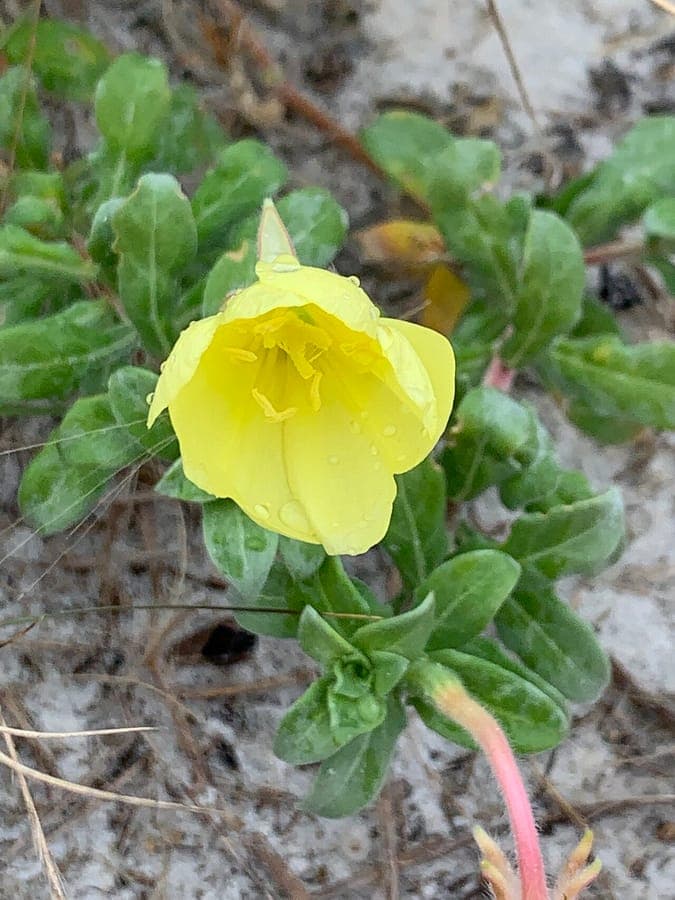
Claire Herzog / CC BY 4.0, via Wikimedia Commons
Seabeach evening primrose: complete guide
Oenothera humifusa
Want to see Seabeach evening primrose: complete guide in your garden?
1 minute, no credit card
Overview
Oenothera humifusa, commonly known as the seabeach evening primrose or seaside evening primrose, is a low-growing wildflower native to the Atlantic and Gulf coasts of the eastern United States. Its natural range runs from New Jersey southward through Delaware, Maryland, Virginia, the Carolinas, Georgia and Florida, continuing along the Gulf Coast through Mississippi, Louisiana and Alabama, with an additional population on the island of Bermuda.
This species belongs to the family Onagraceae and the large genus Oenothera, which contains dozens of species commonly called evening primroses. The species epithet 'humifusa' comes from Latin and means 'spreading along the ground', a perfect description of its growth habit: rather than standing upright, the plant trails along the surface in spreading mats.
For gardeners looking for something unusual in the evening primrose genus - a plant that brings genuine coastal character to a sunny, dry border - this species is worth tracking down. At gardenworld.app, you will find garden design inspiration featuring low-growing flowering plants that thrive in challenging dry, sunny spots.
Appearance and bloom cycle
Oenothera humifusa is a subshrub or perennial herb, distinguished from many other evening primroses by its strongly decumbent habit - the stems lie along the ground and branch outwards, forming a spreading mat rather than an upright clump. This pattern is a direct adaptation to life on exposed, wind-swept coastal dunes and beaches.
The leaves are oblong to spatula-shaped, greyish-green and covered in a fine, soft pubescence that gives the plant a subtly silvery appearance. This hairiness serves a practical purpose: it reduces moisture loss and reflects intense sunlight, helping the plant survive in harsh, sun-baked coastal conditions.
The flowers are four-petalled and a clear, bright yellow - characteristic of the Oenothera genus. Each bloom is around 3 to 5 cm across and opens in the evening or on overcast days, as the name 'evening primrose' suggests. Individual flowers are short-lived, lasting only a day or so, but the plant produces a continuous succession of buds throughout a long season.
Blooming runs from May through October, with peak flowering in the summer months of June, July and August. After blooming, elongated seed capsules form and split open when ripe, releasing fine seeds.
Ideal location
Oenothera humifusa is a plant of open, exposed positions in full sun. In its native habitat it grows on coastal dunes, sandy beaches, rocky shores and dry sandy roadsides close to the sea. It tolerates salt spray, strong winds, intense heat and very poor, dry soils without difficulty.
In the garden it performs best in a position with full, unobstructed sun for as much of the day as possible. It is not suited to shaded positions or areas with persistent soil moisture. A south-facing slope, a raised bed with good drainage or a gravel garden are ideal settings.
It also makes an excellent plant for rock gardens, between paving stones, along dry gravel paths and as ground cover on dry sunny banks. Its trailing habit makes it attractive spilling over walls or along path edges. It is a strong candidate for coastal and seaside gardens where salt-laden wind is a regular challenge.
Soil
This species positively thrives on poor, sandy or stony soil and does not need fertile, enriched growing conditions. In its coastal home it often grows on nearly pure sand, sometimes with a high mineral content and low organic matter. It tolerates alkaline, calcareous soils and is adapted to saline conditions near the sea.
Fertile, clay-rich or heavily composted soil is actually detrimental: in over-rich conditions the plant produces lush foliage at the expense of flowering and may become more prone to disease and rot in wet conditions.
If planting in ordinary garden soil, improve drainage by mixing in a generous amount of coarse sand and fine gravel. A surface mulch of gravel or grit helps keep the crown dry and the soil warm - the conditions this plant loves. Avoid heavy clay soils entirely.
Watering
Once established, Oenothera humifusa is highly drought tolerant and rarely needs supplemental water. In its natural habitat it survives extended dry periods without rain. In the garden, supplemental watering is only necessary during prolonged summer drought, and even then a moderate amount is better than generous watering.
Avoid overwatering and waterlogged conditions. The roots are sensitive to prolonged wet conditions, which can lead to root rot, especially in heavier soils. On sandy, well-drained soil, this plant needs virtually no watering once it is established.
The silver-grey hairy foliage is not merely decorative - it is a functional adaptation that reduces moisture loss through the leaf surface. This is part of why the plant manages so well in dry, exposed positions without supplemental water. At gardenworld.app, discover how to design drought-resilient gardens that use these natural adaptations to your advantage.
Free design
Want to see Seabeach evening primrose: complete guide in your garden? Make a free design now.
Pruning
Oenothera humifusa requires very little pruning. Deadheading spent blooms encourages further flower production and keeps the plant tidy, but it is not strictly necessary as the plant blooms prolifically with little intervention.
At the end of the season in October or November, cut the plant back lightly to just above ground level. This promotes fresh, vigorous regrowth the following spring. If you want the plant to self-seed into nearby suitable spots, leave a portion of the ripe seed capsules in place before cutting back.
The plant can also simply be left to its own devices in a naturalistic planting scheme, where it will spread gradually and self-seed in open, sandy areas. In this setting, minimal cutting back every few years to prevent any one patch becoming too dense is usually sufficient.
Maintenance calendar
Here is a practical monthly guide to caring for Oenothera humifusa in a temperate European climate:
January - February: Plant overwinters as a low basal rosette. No maintenance needed. In hard frost zones, a light dry mulch can be applied for extra protection.
March: First new shoots emerging. Remove dead stems from the previous year. No feeding required - this plant does not need fertilising.
April - May: Growth accelerates. No supplemental watering needed in normal conditions. Sow seeds now - surface-sow on sandy compost and barely cover.
June - August: Full bloom season. Remove spent flowers if desired for tidiness. No watering needed unless exceptionally dry. No feeding.
September - October: Bloom winds down. Seed capsules ripen. Leave some for self-seeding, cut back the rest.
November - December: Light tidy-up or cut back to basal rosette. Plant enters winter rest.
Winter hardiness
Oenothera humifusa is moderately frost tolerant. It overwinters as a low, flat rosette of leaves pressed close to the ground, which provides natural protection against cold winds and hard frost. The species tolerates temperatures down to around -10 to -15 degrees Celsius, placing it in USDA hardiness zone 6, making it suitable for outdoor cultivation across most of northern and western Europe.
Good drainage is the key to successful overwintering. The main risk in cold, wet winters is not frost damage to the top growth but rot at the root collar when soil remains wet for extended periods. On well-drained sandy or gravelly soil - which this plant prefers anyway - the risk of winter losses is minimal.
In milder coastal areas and western parts of Europe, this plant is a reliable perennial that returns year after year with minimal attention. In colder continental climates, a free-draining soil and a sheltered position will help ensure successful overwintering.
Companion plants
Because of its preference for dry, sunny, sandy conditions, Oenothera humifusa pairs naturally with other drought-tolerant species that share the same habitat requirements. Lavender (Lavandula), rock rose (Helianthemum), lamb's ears (Stachys byzantina), sea thrift (Armeria maritima), sea campion (Silene uniflora) and coastal forms of thyme (Thymus) are all excellent companions.
For a naturalistic coastal planting, combine it with low-growing grasses such as marram grass (Ammophila arenaria), dune fescue (Festuca arenaria) and hair grass (Corynephorus canescens). This combination creates an authentic dune-inspired garden with strong textural interest.
In a rock garden setting, early-flowering bulbs such as species tulips, small iris and squill (Scilla) make attractive companions that occupy the space before the evening primrose comes into its summer glory.
Closing
Oenothera humifusa is a genuine coastal wildflower that brings something different to the garden - a sprawling, silvery mat studded with bright yellow blooms through the long summer months, thriving in the kind of dry, sunny, sandy spots that challenge most plants. It is low-maintenance, drought-tolerant, reliably perennial and a proven plant for wildlife, attracting moths and night-flying pollinators with its evening-opening flowers. For anyone making a beach-inspired, coastal or gravel garden, it is an authentic choice that looks completely at home in these settings. Specialist garden centres with good ranges of native and coastal plants are the best source; it is also straightforward to raise from seed, which can be ordered from specialist seed suppliers who focus on North American native plants. For more garden design ideas using drought-tolerant plants, visit gardenworld.app.
Want to see Seabeach evening primrose: complete guide in your garden? Make a free design now.
Upload a photo, pick a style, and get a photorealistic design with plant list in under a minute.
10,000+ gardens designed already
No credit card required


Similar plants
Shortfruit evening primrose: complete guide
Oenothera brachycarpa
Everything about Oenothera brachycarpa - the shortfruit evening primrose from the American Southwest. Growing tips, placement and care for your garden.
Sundrops (Oenothera tetragona): complete guide
Oenothera tetragona
Everything about Oenothera tetragona - the cheerful daytime-blooming sundrops perennial. Growing tips, placement, pruning and care for a long summer display.
Scarlet beeblossom: complete guide
Oenothera suffrutescens
Full guide to growing Oenothera suffrutescens: ideal site, soil, watering, pruning, and companions for this prairie perennial.