
Stan Shebs / CC BY-SA 3.0, via Wikimedia Commons
Scarlet beeblossom: complete guide
Oenothera suffrutescens
Want to see Scarlet beeblossom: complete guide in your garden?
1 minute, no credit card
Overview
Oenothera suffrutescens, commonly called scarlet beeblossom or scarlet gaura, is an elegant, wiry-stemmed perennial in the Onagraceae family. Long known to gardeners under the name Gaura coccinea, it received its current scientific name in 2007 following molecular studies by Wagner and Hoch that placed it firmly within the genus Oenothera. Native to the prairies, grasslands, and semi-arid steppes of western and central North America - from Alberta and Saskatchewan south through the Great Plains to Texas, New Mexico, and deep into Mexico - this plant has adapted to extremes of heat, cold, and drought that few ornamental perennials can match.
The epithet suffrutescens means 'somewhat shrubby' or 'sub-shrubby', describing the plant's characteristic woody base from which fresh stems emerge each year. This semi-woody rootstock gives Oenothera suffrutescens notable cold hardiness and longevity in the garden. The common name 'scarlet beeblossom' refers to the plant's vivid flowers and its exceptional appeal to long-tongued bees, bumblebees, and butterflies.
For gardeners seeking an unusual, low-maintenance perennial that brings weeks of colour to a dry, sunny border without demanding irrigation or rich soil, Oenothera suffrutescens is a rewarding choice. Its delicate, airy habit also brings a sense of movement to the garden that few plants can replicate. You can explore how this species fits into a drought-tolerant planting design at gardenworld.app.
Appearance & bloom cycle
Oenothera suffrutescens forms an open, branching clump of slender stems reaching 30-80 cm in height and 40-60 cm across. The stems are wiry and slightly reddish-tinged, clothed in narrow, lance-shaped leaves 2-5 cm long. Foliage is deep green to grey-green with fine soft hairs; the undersides are a touch paler. Leaves are alternately arranged, giving the plant a see-through, transparent quality that works beautifully alongside denser, bolder-leaved perennials.
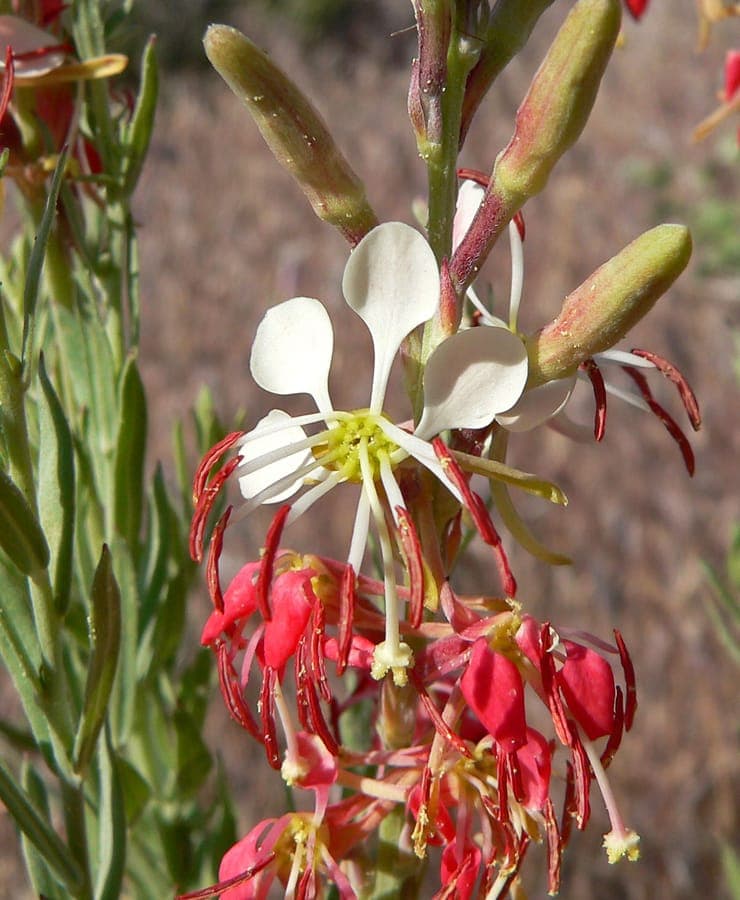
The flowers are the plant's most striking feature. Each flower is small - the four petals measure just 5-10 mm each - but the colour is intense: blooms open creamy white or light pink and age to vivid scarlet-red as the day progresses. This fascinating colour shift means that at any given moment the plant carries flowers in multiple shades simultaneously, from fresh white to deep red, creating a richly textured visual effect. Flowers are held in slender, upright spikes at the tips of the stems.
The flowering season is remarkably long: from mid-June through October in the Netherlands and Belgium. Plants bloom most freely in warm, dry summers. The flowers open in the late afternoon and evening - typical of the Oenothera genus - and are particularly attractive to long-tongued bees, bumblebees, clearwing moths, and hawkmoths. After flowering, small four-lobed seed pods develop. The plant self-seeds freely on open, sandy or gravelly ground.
Ideal location
Oenothera suffrutescens thrives in a fully sunny, warm position receiving at least five to six hours of direct sun daily. In its native prairie habitat it grows in full exposure to sun and drying wind, on open slopes and canyon edges. Replicating these open, bright, well-ventilated conditions in the garden is the key to success.
A south- or southwest-facing border, a raised bed, a gravel garden, or a slope is ideal. The plant can also be grown in larger pots (minimum 30 cm diameter) with very free drainage, though container plants rarely achieve the free-flowing grace of garden specimens. Light shade for one to two hours a day is acceptable but results in lax stems and reduced flowering. Sustained or deep shade should be avoided entirely.
In a prairie or steppe-style planting, Oenothera suffrutescens works beautifully as a filler between taller ornamental grasses and other drought-tolerant species. Its slender, wind-responsive stems add a dynamic, cinematic quality to the border that catches the eye even on still days. In more formal settings or in a gravel front garden it can serve as a striking accent plant.
Soil requirements
This plant has one straightforward requirement: free-draining, lean to moderately fertile soil. On its native Great Plains it grows on sandy, loamy, or gravelly soils with low organic matter. Rich, moisture-retentive garden soil or heavy clay gives disappointing results - stems become tall and floppy, flowering diminishes, and the plant becomes prone to crown rot.
The ideal soil pH is between 6.0 and 8.0. Slightly alkaline or calcareous soils - common in many European gardens - suit it particularly well. On heavy clay, significant amendment is needed: work 20-30% coarse sand or fine gravel into the top 25-30 cm of the planting area. Do not add compost or nitrogen-rich fertilisers; a lean soil is actively beneficial. A gravel mulch 5-8 cm deep around the plant suppresses weeds, regulates soil temperature, prevents splash of calcareous soil onto the stems during rain, and keeps the crown dry - all of which benefit long-term performance and winter survival.
Watering
Oenothera suffrutescens ranks among the most drought-tolerant perennials for European gardens. Once established - typically six to eight weeks after planting - the plant rarely needs supplemental water in typical Dutch or Belgian summers. It tolerates three to four weeks without rain without visible damage. Only during extreme heat combined with more than four to five weeks of drought is weekly deep watering beneficial.
In the first growing season, water once per week during dry spells to encourage good root establishment. Always water at the base of the plant, early in the morning, so the soil can dry before nightfall. Standing water at the crown, particularly during winter, is the most serious threat to this plant.
In winter, rainfall is generally sufficient; additional watering is almost never needed. The combination of excessive soil moisture and frost during the dormant season is far more damaging than cold alone. Ensure the site drains freely at all times of year.
Free design
Want to see Scarlet beeblossom: complete guide in your garden? Make a free design now.
Pruning
Pruning requirements are minimal. In autumn, after the first frost has blackened the upper stems, cut the stems back to 10-15 cm above ground level. Leave this short stub as a marker and as additional protection for the woody crown. Remove the stubs entirely in early spring only once new growth is visible emerging from the base.
During the growing season, removing spent flower spikes regularly stimulates the production of fresh side-shoots with new flower buds, significantly extending the flowering period. Cut back spent tips to the first pair of healthy leaves below the spike.
If after several years the plant becomes overly sprawling or the centre dies out, cut the whole clump back hard to 5-10 cm in early spring. It recovers vigorously from the woody base. Division of the crown is possible in spring but the plant dislikes disturbance; raising new plants from seed or from semi-ripe cuttings taken in summer is a gentler approach.
Maintenance calendar
January - February: Check the site is free of standing water. In persistent hard frost without snow cover, a thin layer of dry straw or pine branches over the stubs provides extra insulation. No watering needed.
March: Remove winter protection once hard frosts ease. Cut back dead stem stubs once new growth appears at the base. Apply a fresh layer of gravel mulch around the crown. No fertilising needed.
April: Keep the site weed-free. The plant begins to grow strongly from the base. No feeding; a lean soil in early spring produces the most compact, upright stems. Transplant seedlings if self-seeding is welcome.
May - June: Build-up to flowering. Keep weeds cleared. First flowers appear in warm years by late May or early June. Water only during extended dry spells.
July - August: Peak flowering. Remove spent spikes regularly to prolong the season. Drought periods of three to four weeks are well tolerated.
September - October: Flowering continues in mild autumns. Allow a few seed pods to ripen if self-seeding is welcome; remove the rest. Cut stems back after the first hard frost.
November - December: Plant dormant. No feeding, minimal watering. Leave the stub for crown protection.
Winter hardiness
Despite its southwestern North American roots, Oenothera suffrutescens is surprisingly cold hardy. Its native range extends north to Alberta and Saskatchewan, where winter temperatures of -25 to -30 °C are routine. In garden cultivation across the Netherlands, Belgium, and northern Germany (USDA zones 6-7, locally zone 5), the plant survives reliably on well-drained soils without special protection.
The chief winter risk is not cold but moisture combined with frost: waterlogged soil that freezes and thaws repeatedly around the woody crown can damage or kill the rootstock. On dry, well-drained sites this is rarely a problem. A gravel mulch around the crown provides effective protection. On heavy, poorly drained soils the plant is less reliable over winter; improving drainage before planting is strongly recommended, or overwinter rooted cuttings under glass as insurance.
In zones 5-6 the plant is fully hardy and returns vigorously from the crown each spring. In zone 4 or colder, some supplemental protection of the crown may be worthwhile. Even when stems are killed by frost, the woody rootstock typically survives and produces new shoots in spring. Discover more drought-tolerant planting ideas at gardenworld.app.
Companion plants
Oenothera suffrutescens is ideally suited to prairie- and steppe-style borders but also works as an airy filler in more formal dry borders. Recommended companions include:
- Echinacea purpurea (purple coneflower) - shares the preference for dry, sunny conditions and blooms at the same time. The broad, rose-purple flower heads contrast beautifully with the slender scarlet spikes of Oenothera.
- Agastache foeniculum (anise hyssop) - drought-tolerant and attracts the same pollinator guild. Blue or purple flower spikes harmonise with the red tones of Oenothera.
- Penstemon digitalis (foxglove beardtongue) - similar site requirements; white to pale-pink tubular flowers bloom slightly earlier and provide a smooth visual transition into the Oenothera season.
- Sporobolus heterolepis (prairie dropseed) - a fine-textured ornamental grass with warm-season movement that accentuates the airiness of Oenothera stems.
- Salvia nemorosa 'Caradonna' - dark stems and blue flowers provide a strong colour complement to the warm reds of Oenothera. Plant 40-50 cm apart to avoid root competition.
- Sedum 'Herbstfreude' - broad, fleshy foliage and rosy autumn flower heads provide a grounding counterpart to the slender Oenothera stems.
Place plants 40-50 cm apart to allow the characteristic open, branching habit to develop fully. Closer spacing results in taller, leaning stems that need support. Visit garden centre herbaceous perennial sections to find Oenothera plants in spring or early summer.
Closing thoughts
Oenothera suffrutescens is a perennial that genuinely earns its place in the low-maintenance garden. It asks little - a sunny spot, lean, well-drained soil, and minimal watering - and delivers months of vivid, wildlife-friendly colour from midsummer through autumn. Whether you are planning a prairie border, a dry gravel garden, or simply a front garden that looks after itself, the scarlet beeblossom is a reliable, characterful choice that improves year after year.
Want to see Scarlet beeblossom: complete guide in your garden? Make a free design now.
Upload a photo, pick a style, and get a photorealistic design with plant list in under a minute.
10,000+ gardens designed already
No credit card required


Similar plants
Shortfruit evening primrose: complete guide
Oenothera brachycarpa
Everything about Oenothera brachycarpa - the shortfruit evening primrose from the American Southwest. Growing tips, placement and care for your garden.
Sundrops (Oenothera tetragona): complete guide
Oenothera tetragona
Everything about Oenothera tetragona - the cheerful daytime-blooming sundrops perennial. Growing tips, placement, pruning and care for a long summer display.
Seabeach evening primrose: complete guide
Oenothera humifusa
Full guide to Oenothera humifusa, the seabeach evening primrose native to the US Atlantic coast. Yellow blooms, silvery foliage, drought-tolerant.