
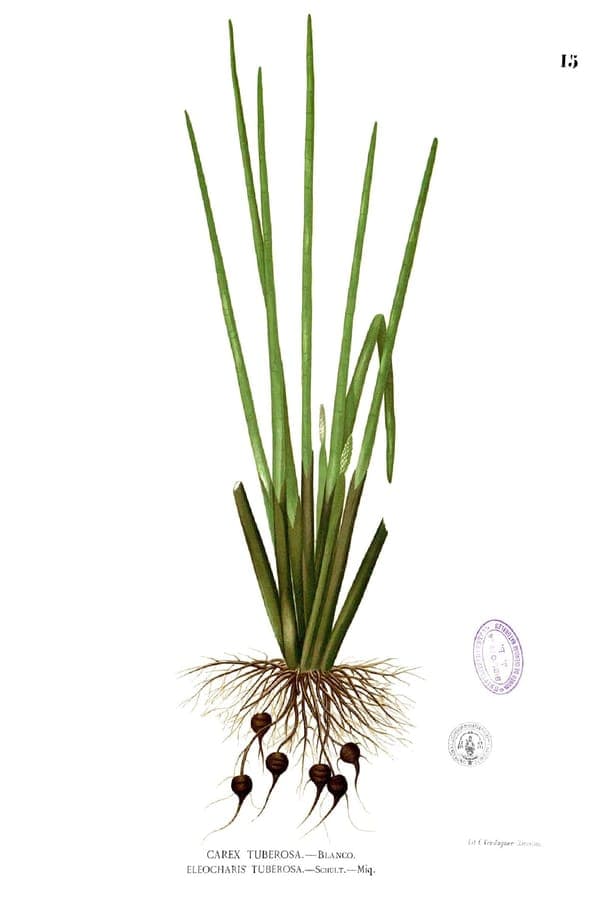
Francisco Manuel Blanco (O.S.A.) / Public domain, via Wikimedia Commons
Chinese water chestnut: complete guide
Eleocharis dulcis
Want to see Chinese water chestnut: complete guide in your garden?
1 minute, no credit card
Overview
Eleocharis dulcis, commonly known as Chinese water chestnut or simply water chestnut, is a marsh plant cultivated in East and Southeast Asia for thousands of years. The botanical name translates literally as 'sweet water plant': Eleocharis from the Greek 'helos' (marsh) and 'charis' (grace), and dulcis the Latin word for sweet. The plant belongs to the sedge family (Cyperaceae) and is closely related to common bulrush and umbrella sedge. Its corms - brown on the outside, white within - are the actual harvest and are widely used in Asian cooking in stir-fries, soups, and salads.
Native across a vast area of tropical and subtropical Africa and Asia - China, Japan, India, Australia, Vietnam, the Philippines and more - the water chestnut has been cultivated in China for at least 2,000 years in wet paddy fields. In Europe it remains a novelty crop, but interest is growing as enthusiasm for Asian ingredients increases and more gardeners experiment with edible pond and marsh plants.
For gardeners in the UK, Netherlands, Belgium, and northern France, Eleocharis dulcis makes a rewarding choice for the pond margin, a wet border, a large water tub, or a kitchen garden with a water feature. It produces fresh green, upright stems 60 to 120 cm tall that are ornamental throughout summer. The harvest of small corms takes place in October and November, once the above-ground parts have died back. The corms taste fresh, mildly sweet, and crunchy - similar to young water cress or bamboo shoots.
At gardenworld.app you can explore garden designs for pond gardens or wet borders incorporating edible marsh plants like Eleocharis dulcis - combining ornamental value with culinary usefulness.
Appearance & bloom cycle
Eleocharis dulcis forms dense clumps of upright, cylindrical, dark green stems without leaves. This is characteristic of the genus Eleocharis: instead of leaves, the plant bears only stems that carry out photosynthesis. The stems are smooth, round in cross-section, and hollow with internal diaphragms that provide rigidity. A mature stem is 60 to 120 cm long and 3 to 8 mm in diameter.
The flower head is a small, oval spike carried at the tip of the stem. The tiny flowers are inconspicuous - small and greenish to brownish, produced from May through August. Pollination is by wind. The plant is ornamental not for its flowers but for its elegantly straight, green stems that bring an architectural quality to the water's edge.
Below ground, the plant produces a network of white runners (stolons) that develop small corms at their tips, each 2 to 4 cm across. These corms are brown, glossy, rounded, and covered with two to three papery layers. The white flesh inside is firm, juicy, and crunchy. A well-grown plant can produce 20 to 50 corms in a good growing season.
Several selections and landraces are cultivated in China and other Asian countries. The cultivar 'Guangzhou' is known for large, smooth corms; 'Guilin' for a high sugar content. In Europe these named selections are almost impossible to source; typically you simply buy Eleocharis dulcis as a species without a cultivar name.
Ideal location
Eleocharis dulcis needs full sun for good corm development. In its Asian homeland it grows in wet paddy fields and marshes receiving direct sun all day. In a European garden, choose a spot with at least six hours of direct sunlight daily. Light midday shade is tolerable but significantly reduces the corm yield.
The ideal position combines full sun with permanently wet or constantly moist conditions at the root zone. Pond margin, streambank, wet border, or an isolated water container all work well. In a pond, plant at a depth of 5 to 20 cm below the water surface; in a tub or bucket, use nutrient-rich clay and stand the container in a basin of water. Water temperature should not drop below 10 °C; this significantly impairs corm formation.
Avoid dry spots, shady corners, or locations where water dries out completely in summer. The plant needs permanently available water throughout the growing season from May to October. Wind reduces transpiration and aids stem stability, but very strong gusts can snap the tall stems. A sheltered pond margin is ideal.
Soil requirements
The ideal growing medium for Eleocharis dulcis is heavy, nutrient-rich clay or loam with a pH of 6.0 to 7.0. Clay retains nutrients and moisture and provides firm anchorage. Light sandy growing media yield poor harvests; compensate by incorporating at least 5 litres of mature compost per square metre.
The plant thrives in high-organic soil. Rich pond sediment, reed-bed clay, or fertile garden clay soil enriched with mature compost are all excellent. Avoid strongly acidic peat; the plant prefers neutral to mildly acidic conditions. In containers, use a mix of three parts heavy clay or soil-based potting compost to one part mature compost without sand additions - the medium must retain rather than drain moisture.
Nutrient requirements are moderate to high. At planting, incorporate 50 g of slow-release nitrogen fertiliser (horn meal) per square metre. During the season, apply a liquid aquatic and marsh plant fertiliser monthly to encourage corm formation. A high phosphorus level in the growing medium promotes corm size and sugar content.
Free design
Want to see Chinese water chestnut: complete guide in your garden? Make a free design now.
Watering
Eleocharis dulcis is a true water plant requiring permanently wet to flooded conditions throughout the growing season. In pond cultivation no supplemental watering is needed: the pond itself provides it. In tub or container cultivation it is essential that the container always holds at least 5 to 10 cm of water around the roots.
In the establishment phase - from planting out in May until the plant is fully rooted, roughly four to six weeks - keep the water level stable. After that, some variation is tolerable, but the water must never disappear entirely. In hot summers, water in shallow containers evaporates quickly; check levels daily and top up with rainwater or tap water.
Water quality affects corm quality. Rainwater or pond water is preferred; hard tap water with high calcium content is less ideal but acceptable. Standing water with high nutrient content can promote algae growth; changing the water in cultivation containers every three to four weeks prevents this.
In September and October, as stems begin to yellow and corms ripen, gradually reduce the water level. Slightly drier conditions encourage the corms to raise their sugar content in preparation for winter. But never drain completely before harvest.
Pruning
Eleocharis dulcis requires almost no management during the growing season. The stems grow upright and need no guiding. Remove yellowing or dead stems promptly; left in the water they can rot and lower water quality.
After the first frost - typically in October in northern Europe - all above-ground stems die back. This is the signal that the corms are ripe for harvest. Cut or snap off the dead stems at ground level before beginning the harvest. The corms sit 10 to 25 cm deep, spread over a radius of 30 to 50 cm around the plant.
Harvest by hand or with a garden fork: carefully work through the soft clay, feeling for the small, round, brown corms. Wash them clean and store cool and moist (4 to 8 °C in moist sawdust or moist sand) for use within four to eight weeks without any quality loss. Keep a few healthy corms as planting material for the following season.
Maintenance calendar
February to March: Bring stored corms out of cold storage and allow to sprout at 20 to 25 °C in a warm, bright spot. Small green shoots appear after one to two weeks.
April: Plant sprouting corms into small pots of heavy clay soil, submerge the pots in a tray holding 5 cm of warm water. Keep indoors until night temperatures reliably stay above 10 °C.
May (after 15 May): Plant out at the pond margin or in marsh containers at final spacing of 30 to 40 cm. Water level 5 to 15 cm above soil level.
June to August: Growing season. Maintain stable water level, apply monthly liquid fertiliser. Remove yellowing stems.
September: Stems start to yellow. Lower water level slightly. Prepare for harvest.
October to November: Above-ground parts die after first frost. Harvest the corms. Retain some as planting stock for next year.
December to January: Store corms cool (4 to 8 °C) in moist sand or sawdust.
Winter hardiness
Eleocharis dulcis is a warmth-loving plant from tropical and subtropical regions. The corms tolerate light frost down to about -5 °C, provided they sit deep enough in the ground (at least 15 to 20 cm) and the soil does not freeze solid. In mild winters in the Netherlands and Belgium, corms can overwinter outdoors if buried deeply enough and the bed or pond is covered with a thick mulch layer of 15 to 20 cm of straw or leaves.
USDA hardiness zones 8 to 12 apply. In zone 7 (average minimum temperature -17 to -12 °C) outdoor overwintering is risky. To be safe, always bring a portion of the corms indoors as planting material for the following year. Store at 4 to 8 °C in moist sand; storage that is too dry causes shrinkage and loss of viability.
In a heated greenhouse or when growing in indoor containers year-round, the plant can be maintained throughout winter. The stems remain green; new corms do form, but less abundantly than in the summer outdoor growing season with high light levels.
Companion plants
Eleocharis dulcis pairs well with other plants in a wet border, pond zone, or edible water garden. Good companions include:
-
Iris pseudacorus (Yellow flag iris) as a tall structural pond-edge plant. Both enjoy wet feet and full sun, and flower in complementary succession (Iris in May–June, Eleocharis ornamental all summer).
-
Mentha aquatica (Water mint) as a low-growing, aromatic companion in the wet zone. The mint deters insects and is itself culinary.
-
Sagittaria sagittifolia (Common arrowhead) as an elegant fellow pond-margin plant. Arrow-shaped leaves create a beautiful textural contrast with the round stems of Eleocharis.
-
Nasturtium officinale (Watercress) as a culinary companion in shallow water. Both plants are edible and thrive in the same wet conditions.
-
Typha angustifolia (Lesser reedmace) as a tall background plant. The brown flower heads are decorative in autumn and provide shelter for birds and insects.
-
Oenanthe javanica (Asian water parsley) as a related Asian marsh plant with edible leaves and comparable site requirements.
Avoid combining with strongly invasive marsh plants such as Glyceria maxima or Sparganium that can crowd out the water chestnut.
Conclusion
Eleocharis dulcis is a versatile marsh plant that combines ornamental value at the pond margin with a culinary harvest of crunchy, mildly sweet corms. Cultivation requires some preparation - sprouting corms, guaranteeing permanent water, harvesting after the first frost - but is quite manageable for gardeners with a wet corner or pond. The yield of dozens of small corms per plant makes the effort entirely worthwhile.
To design a pond garden or wet border with edible marsh plants like Eleocharis dulcis, explore the design possibilities at gardenworld.app for inspiration. Corms and plants can be ordered from specialist aquatic nurseries and online marsh plant suppliers.
Want to see Chinese water chestnut: complete guide in your garden? Make a free design now.
Upload a photo, pick a style, and get a photorealistic design with plant list in under a minute.
10,000+ gardens designed already
No credit card required


Similar plants
Flat-stemmed club-rush: complete guide
Bolboschoenus planiculmis
Everything about Bolboschoenus planiculmis: growing conditions, watering, care, and use as a pond margin or wetland plant in garden design.
Great Plains flatsedge: complete guide
Cyperus lupulinus
Everything about Great Plains flatsedge (Cyperus lupulinus): growing conditions, care, garden uses, and ecological value. Tips for pond margins and dry sandy soils.
Golden beak sedge: complete guide
Rhynchospora corymbosa
Everything about golden beak sedge (Rhynchospora corymbosa): a dramatic tropical marginal for pond edges, bog gardens, and wet habitats.