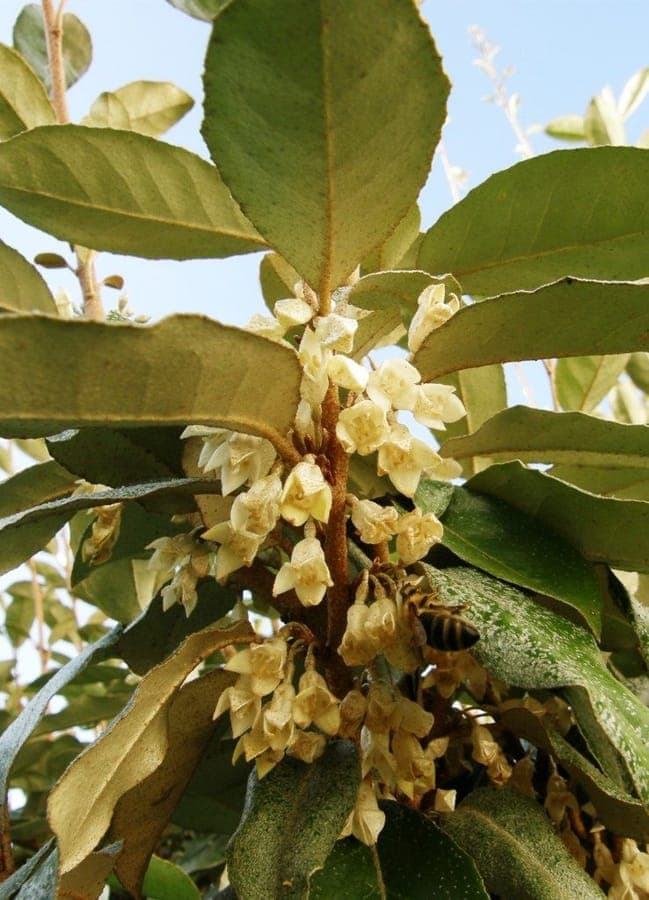
VoDeTan2Dericks-Tan / CC BY-SA 3.0, via Wikimedia Commons
Elaeagnus × submacrophylla (ebbingei): complete guide
Elaeagnus × submacrophylla
Want to see Elaeagnus × submacrophylla (ebbingei): complete guide in your garden?
Full design in HD: €7.99
Look after your Elaeagnus × submacrophylla with the GardenWorld app
Identify plants with your camera and get a care calendar with reminders for this plant.


Overview
Elaeagnus × submacrophylla is still sold in most garden centres under its old name, Elaeagnus × ebbingei, or simply as oleaster or silverberry. It is a cross between Elaeagnus macrophylla and Elaeagnus pungens, raised in the Netherlands in the 1920s by the nurseryman S. G. A. Doorenbos in The Hague. It belongs to the oleaster family (Elaeagnaceae) and has become one of the most widely planted evergreen shrubs for hedges and windbreaks in western Europe.
It is easy to see why. This shrub grows quickly, stays green all year, shrugs off wind, salt spray, drought, shade and poor soil, and needs very little attention. In autumn, just as the rest of the garden winds down, its small flowers release a surprisingly strong, sweet scent. On gardenworld.app you can create a garden design that uses Elaeagnus as an evergreen hedge or as a sheltering backdrop to a border.
The botanical name was changed in 2014 because the older one had never been validly published. In the trade you will see both names used side by side, but they refer to the same plant.
Appearance and bloom cycle
Left to grow freely, Elaeagnus × submacrophylla reaches 3 to 4 metres in height and spread, occasionally 5 metres in favourable conditions. As a hedge it is easily kept at 1.5 to 2 metres. The habit is dense and somewhat spreading, with long, sometimes arching shoots. The odd branch may carry a short spine, inherited from its parent Elaeagnus pungens.
The leaves are leathery, oval to elliptic and 5 to 10 cm long. They are glossy dark green above and strikingly silvery beneath, thanks to tiny scales. When the wind turns the foliage over, the whole shrub briefly shimmers. Young twigs are covered in brown scales. Well-known cultivars include 'Gilt Edge' with a golden-yellow margin, 'Limelight' with a lime-yellow centre and 'Compacta', which stays lower and denser.
Flowering comes in October and November. The flowers are small, tubular, about 1 cm long and creamy white with silvery brown scales. They hang in small clusters in the leaf axils and are easy to overlook, yet on a mild autumn day their fragrance fills an entire garden. Bees and bumblebees visit them eagerly, which is valuable so late in the year. In April and May oval red fruits flecked with silver may follow. They are edible, with a sweet-sharp flavour, but they do not appear every year and are often few in number.
Ideal location
This shrub is remarkably adaptable. It grows in full sun, partial shade and even fairly deep shade beneath trees, although it becomes looser there. Variegated cultivars colour best in sun. It tolerates wind and salt exceptionally well, making it one of the most reliable hedging plants for coastal gardens.
For a hedge, plant two to three plants per metre, depending on their size. As a specimen or in a mixed border, allow a space about 3 metres across. Plant ideally in April or May, or in September while the soil is still warm. Container-grown plants can go in at almost any time, except during frost or a heatwave.
Soil requirements
Elaeagnus × submacrophylla is undemanding about soil. Sand, loam and lighter clay all suit it, as do chalky or slightly acidic soils. Like other members of the genus, it fixes nitrogen from the air with the help of soil bacteria living in root nodules. As a result it thrives even on poor, hungry ground where other shrubs struggle.
What it does not tolerate is soil that stays wet and airless for long periods. On heavy, wet clay, improve the ground first with grit and organic matter, or plant slightly proud of the surrounding soil. Extra feeding is rarely needed; a layer of compost in spring is more than enough.
Watering
Regular watering matters after planting. In the first year, give a thorough soak once a week in dry weather, about 10 litres per plant. A mulch of bark chips keeps the soil moister and suppresses weeds along a young hedge.
Once established, usually after the second year, the plant is highly drought tolerant. Only during long, hot dry spells is an extra watering welcome. Plants in a large container do need regular watering in summer, but never leave the pot standing in a full saucer.
Free preview
Want to see Elaeagnus × submacrophylla (ebbingei): complete guide in your garden? Make a free preview of your design.
Pruning
Elaeagnus takes pruning well and will even regrow from old wood after a hard renovation. Trim a hedge twice a year: first in May or June, after the spring flush, and again at the end of August. If you want as many scented flowers as possible, avoid cutting after mid-September, as the flower buds form on the current season's shoots.
A free-standing shrub only needs light shaping, cutting over-long shoots back to just above a leaf or side branch. A neglected shrub can be renovated in April over three years, removing a third of the oldest stems near the base each year. On variegated cultivars, cut out any plain green reverted shoots at their base straight away, or they will take over.
Keep an eye out for branches that suddenly die back. Elaeagnus is prone to a dieback often linked to fungal infection. Cut any affected branch back well into healthy wood and disinfect your secateurs afterwards.
Maintenance calendar
March-April: Spread a thin layer of compost around the base. Remove frost damage. Carry out any renovation pruning now.
May-June: First hedge trim after spring growth. The fruits turn red and can be picked and eaten raw.
July-August: Water young plants during dry spells. Second hedge trim at the end of August.
September: A good month for planting. Stop pruning so the flowers are not lost.
October-November: Flowering and fragrance. Check for dieback and cut out affected branches.
December-February: Dormant season. Shield young plants from cold easterly winds in a hard winter.
Winter hardiness
Elaeagnus × submacrophylla is reliably hardy across most of the UK and the Low Countries. Established plants tolerate frost down to about -15 °C, and colder for short periods. In severe winters the foliage may brown or partly drop, especially with drying east winds and frozen ground, but the shrub usually reshoots normally in spring. Young plants and variegated forms are more sensitive, and a fleece windbreak helps them through their first winters.
On safety: the plant is not toxic to people or pets, and the fruits are actually edible. That said, the shrub has been recorded escaping from gardens in parts of the Netherlands, and land managers are watching this. It is not on the EU list of invasive species, but it is wise not to plant it right next to a nature reserve and to pull up any seedlings you find outside your garden.
Companion plants
As an evergreen hedge, Elaeagnus provides a calm backdrop for flowering borders. Combine it with other tough, wind-resistant shrubs such as cherry laurel (Prunus laurocerasus), Viburnum tinus, Pittosporum tenuifolium or red-tipped Photinia × fraseri in a mixed hedge. For a scented garden, Mexican orange blossom (Choisya ternata) is an excellent partner: it flowers in spring and Elaeagnus in autumn, so you have fragrance twice a year.
In a mixed border, echo the silvery leaf undersides with grey-leaved perennials such as lavender, sage or lamb's ears (Stachys byzantina) at the front. On the coast, pair it with sea buckthorn, tamarisk and ornamental grasses. Elaeagnus pungens is a close relative with a similar character and a slightly spinier habit.
Final thoughts
Elaeagnus × submacrophylla is one of the most trouble-free evergreen shrubs you can plant: fast, tough, tolerant of wind, salt and drought, with fragrant autumn flowers as a bonus. The secret is simple: plant in well-drained soil, water during the first year and trim the hedge twice a year.
If you want to enjoy that autumn scent, place the shrub close to a path or terrace. The plant calendar on gardenworld.app shows month by month when to prune and when to leave well alone, so the flowers appear again every October.
Frequently asked questions about Elaeagnus × submacrophylla
Is Elaeagnus × submacrophylla winter hardy?
Elaeagnus × submacrophylla is reliably hardy across most of the UK and the Low Countries. Established plants tolerate frost down to about -15 °C, and colder for short periods.
When and how do you prune Elaeagnus × submacrophylla?
Elaeagnus takes pruning well and will even regrow from old wood after a hard renovation. Trim a hedge twice a year: first in May or June, after the spring flush, and again at the end of August.
How much water does Elaeagnus × submacrophylla need?
Regular watering matters after planting. In the first year, give a thorough soak once a week in dry weather, about 10 litres per plant.
Where does Elaeagnus × submacrophylla grow best?
This shrub is remarkably adaptable. It grows in full sun, partial shade and even fairly deep shade beneath trees, although it becomes looser there.
What soil does Elaeagnus × submacrophylla need?
Elaeagnus × submacrophylla is undemanding about soil. Sand, loam and lighter clay all suit it, as do chalky or slightly acidic soils.

See it in your garden
See Elaeagnus × submacrophylla in your garden
One photo of your garden and a few questions. You see the result in about a minute.
Try it with a photoIdentify this plant in your own garden. Identify a plant
Similar plants
Spiny oleaster: complete guide
Elaeagnus pungens Thunb.
Discover everything about Elaeagnus pungens, the spiny oleaster. Learn how to care for this evergreen plant in your garden.
Laurustinus: complete guide
Viburnum tinus
Everything about Laurustinus (Viburnum tinus): planting, care, pruning and winter flowering. Expert tips for this evergreen winter-blooming shrub.
Choisya ternata: complete guide
Choisya ternata
Mexican orange: fragrant blooming shrub for warm spots. Elegant foliage and white flowers. Mediterranean character for gardens.
