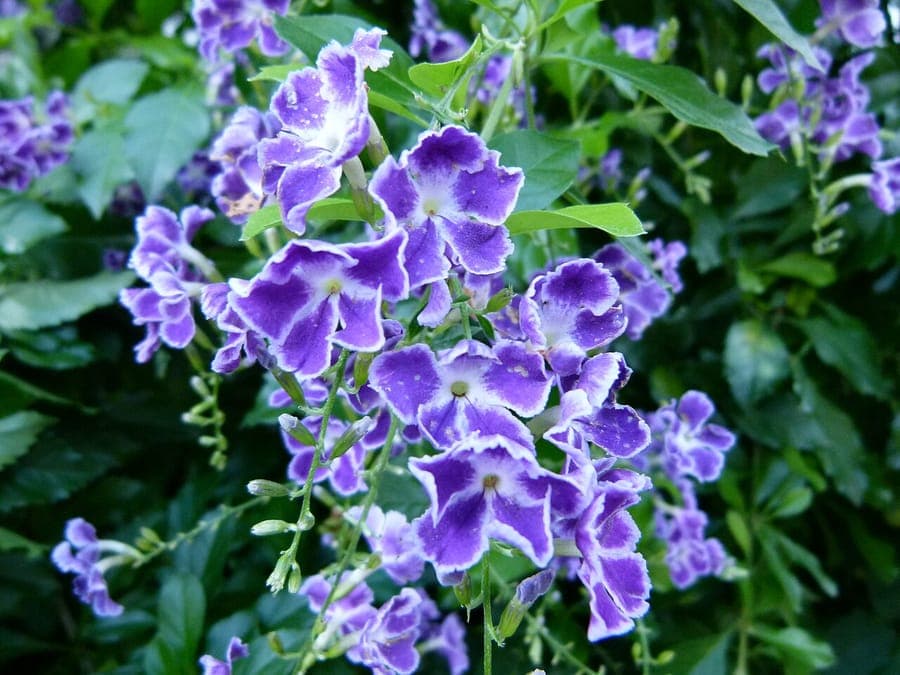
Dinkum / CC0, via Wikimedia Commons
Duranta: complete guide
Duranta erecta
Want to see Duranta: complete guide in your garden?
Full design in HD: €7.99
Look after your Duranta with the GardenWorld app
Identify plants with your camera and get a care calendar with reminders for this plant.


Duranta erecta, commonly called Pigeonberry, Golden Dewdrop, or simply Duranta, is a magnificent flowering shrub belonging to the Verbenaceae family. Native to southern Florida, Caribbean islands, Mexico, and Central America, this species was first described by Linnaeus in 1753 and has remained highly valued.
The shrub typically achieves 2 to 3 meters height, though ideal conditions enable growth to 4 meters. The plant exhibits lush, fountain-like growth habit with initially upright branches becoming gracefully arching with maturity. Foliage is elongate to oval, bright green, measuring 2 to 5 centimeters in length.
Duranta erecta's primary ornamental appeal derives from its distinctive flowers. These appear in dense terminal racemes displaying striking purple to lavender coloration with yellow undersides. Flowering initiates in June and continues through October, providing exceptionally long bloom periods. Following flower senescence, attractive golden to orange berries develop, proving highly attractive to birds.
Duranta thrives in warm to subtropical climates. The plant displays poor frost tolerance and requires temperatures above 5 degrees Celsius. In temperate regions, young plants experience frost damage. However, container cultivation with winter protection enables cultivation in cooler zones.
Full sun exposure proves essential for optimal growth and prolific flowering. Locate Duranta where it receives minimum six hours direct daily sunlight. In intensely hot climates, partial afternoon shade proves beneficial.
Soil preparation matters significantly. Duranta performs best in well-draining substrates with pH ranging from 6.0 to 7.0. The plant tolerates sandy, loamy, and clay soils provided drainage remains excellent. Incorporate compost or organic matter before planting.
Watering demands consistency, particularly during growth and flowering. Soil should dry slightly between waterings but never completely desiccate. Following establishment, mature plants demonstrate enhanced drought tolerance. Drip irrigation produces optimal results.
Fertilization occurs two to three times during growing seasons using balanced formulations (10-10-10) or specialized flowering plant fertilizers. Reduce applications during autumn and winter.
Pruning benefits form and vigor. Conduct annual post-bloom pruning. Remove dead or diseased branches. Regular pruning maintains compact, attractive form. Duranta responds well to heading-back, producing denser branching.
Overwintering presents challenges in temperate regions. Cultivate Duranta in containers, overwintering indoors in greenhouses, conservatories, or protected shelters. Reduce watering significantly during winter months. Return plants to outdoor locations in spring after frost danger passes.
Propagation occurs readily from seed or softwood cuttings during spring and summer months. Direct seed sowing in well-draining potting medium succeeds readily.
Pest management proves important. Monitor for spider mites, whiteflies, and mealybugs. Encourage beneficial insects through diversity plantings. Good air circulation deters many arthropod pests.
Duranta serves beautifully as focal points, specimen plantings, or grouped in borders. The combination of vibrant flowers and ornamental berries extends landscape interest for extended periods. Bird enthusiasts particularly appreciate the species for its capacity to attract numerous avian visitors.
In UK regions, Duranta remains relatively uncommon in standard garden centers but appears in specialty nurseries. Resources like gardenworld.app provide detailed cultivation guidance specific to temperate zone gardeners.

See it in your garden
See Duranta in your garden
One photo of your garden and a few questions. You see the result in about a minute.
Try it with a photoIdentify this plant in your own garden. Identify a plant
Similar plants
Lemon verbena: care, harvesting and overwintering
Aloysia citrodora
Lemon verbena (Aloysia citrodora) has the strongest lemon scent of any herb. Advice on position, pruning, harvesting, tea and overwintering in a pot.
Bigbract verbena: complete guide
Verbena bracteata
Full guide to Verbena bracteata, the creeping North American vervain. Growth habit, care, soil needs, and use as ground cover in drought-tolerant gardens.
Purpletop vervain: complete guide
Verbena incompta
Verbena incompta, a South American charmer. Discover long blooming period and care for sunny borders.
