
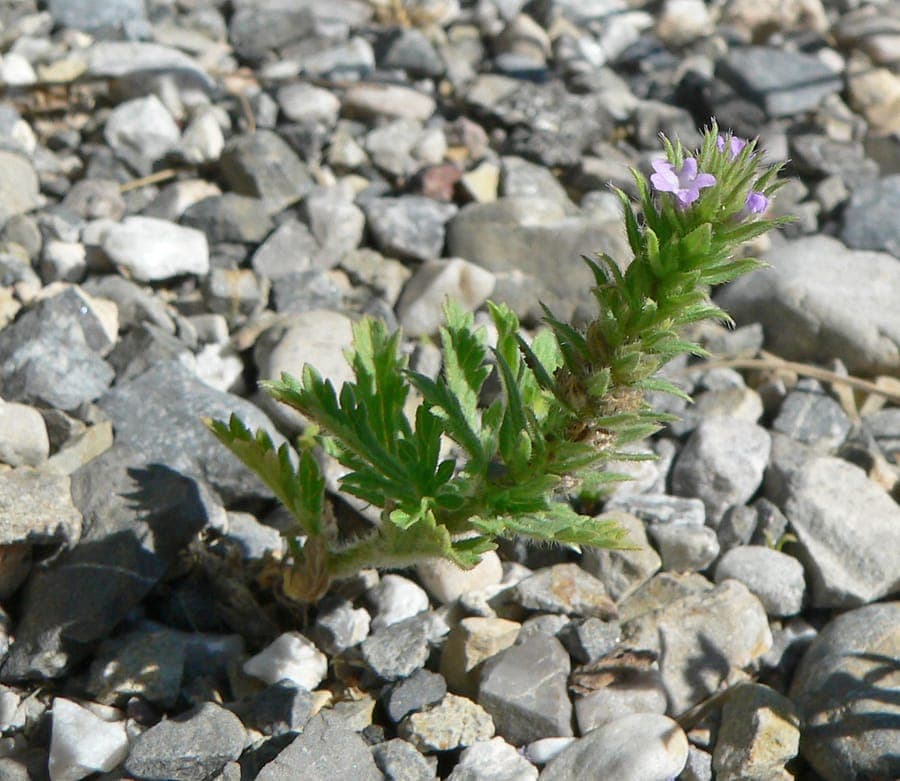
Stan Shebs / CC BY-SA 3.0, via Wikimedia Commons
Bigbract verbena: complete guide
Verbena bracteata
Want to see Bigbract verbena: complete guide in your garden?
1 minute, no credit card
Overview
Verbena bracteata, commonly called bigbract verbena, carpet vervain, or creeping vervain, is an annual to short-lived perennial herb in the verbena family (Verbenaceae). Native across virtually all of North America from Canada to Mexico, it grows naturally on dry, open ground: roadsides, bare paths, field margins, rocky outcrops, and disturbed soils of all kinds. Its ecological role is that of a pioneer - it colonises bare ground quickly, stabilises soil, and provides pollen and seeds for pollinators and small birds.
For European gardens, Verbena bracteata is most valuable as a low-maintenance, drought-tolerant ground cover that thrives in the conditions that defeat most other plants: poor soil, intense sun, and long dry spells. It asks almost nothing in return and rewards the gardener with months of lavender-purple flower colour.
The species name 'bracteata' refers to the conspicuous, leaf-like bracts that surround each flower spike and extend visibly beyond the tiny individual flowers - a feature that immediately distinguishes it from related verbenas. The species was first formally described in 1801 from North American material.
On gardenworld.app, Verbena bracteata can be visualised as a low ground-layer element in a gravel garden or drought-themed front garden design, filling gaps between stones and softening hard landscaping materials.
Appearance and bloom cycle
Verbena bracteata has a characteristically prostrate to ascending growth habit. Its stems lie flat on the ground initially, branch freely, and can reach 60 cm in length. They are coarsely hairy, giving the plant a grey-green, somewhat rough appearance. The overall plant forms a dense, mat-like carpet 10 to 20 cm high.
The leaves are opposite, deeply lobed (often three-lobed), rough-hairy on both surfaces, and variable in shape from oval to oblong. They measure 2 to 5 cm in length. Even without flowers, the foliage has an interesting texture.
The flower spikes (spicae) are dense, narrow, and carried at the tips of stems. The individual florets are tiny - only 3 to 4 mm - funnel-shaped, and lavender to blue-purple in colour. The defining feature is the long, leaf-like bracts that visibly project beyond the florets. Flowering extends from May well into autumn, often until October in mild years. The plant flowers longest in its first season from seed and may decline somewhat in the second year.
The fruits are small, dry schizocarps splitting into four tiny nutlets (mericarps). These are dispersed by wind, water flow, and by adhering to animal fur or human clothing - enabling the plant to spread readily along paths and roadsides.
Ideal location
Verbena bracteata thrives in dry to moderately moist, full-sun positions. In its native range it consistently avoids shade and avoids rich, humus-heavy soil. It is therefore well suited to:
- Gravel gardens and drought-themed plantings
- Rock gardens and crevice plantings
- Roadside-style plantings along driveways or paths
- The base of sun-trapping walls
- Filling gaps in paving or between cobbles
A south- or west-facing aspect is ideal. The plant tolerates occasional foot traffic better than most perennials, making it useful in spots that are occasionally walked across.
Garden centres may stock it occasionally as part of a mixed wildflower range. Specialist native plant nurseries and seed suppliers are more reliable sources. On gardenworld.app you can experiment with positioning ground covers like Verbena bracteata in a visual design for your front garden before committing to any plants.
Soil
Verbena bracteata is genuinely adapted to poor, dry soils. It does not need - and actively dislikes - rich, fertilised ground. On humus-rich soil it becomes lax and floppy and may be more susceptible to fungal problems. Ideal soil characteristics are:
- Poor to moderately fertile
- Sandy, stony, or gravelly (well-draining)
- Neutral to slightly alkaline (pH 6 to 8)
- Dry to moderately moist
Heavy clay is unsuitable. If your soil is clay-dominant, improve drainage by incorporating coarse sand, fine gravel, or perlite before planting. In containers, a cactus substrate or a sharply draining proprietary mix works well.
Once established, Verbena bracteata needs little to no supplementary feeding. Extra nitrogen stimulates leafy growth at the expense of flowers and makes the plant more susceptible to fungal disease.
Free design
Want to see Bigbract verbena: complete guide in your garden? Make a free design now.
Watering
Verbena bracteata is a genuinely drought-tolerant plant. Once established in a border or garden, it rarely needs supplementary watering except during extreme dry spells lasting more than four weeks without rainfall. It is essentially a plant that rewards neglect.
In containers, a little more attention to watering is needed, but even here the rule is to let the substrate dry out completely between waterings. Consistently wet conditions are poorly tolerated and promote root rot.
Newly planted specimens need more water for the first two to four weeks while they establish. After that, watering can be reduced to near zero except during prolonged drought.
Overwatering is the most common mistake with Verbena bracteata in garden cultivation. Keeping the roots too wet leads to root rot and fungal stem diseases.
Pruning
Verbena bracteata needs very little pruning. After the first flush of bloom, cutting back lightly can encourage a further flush, but this is not essential. In autumn, the dead plant material can be removed, but if you want the plant to self-seed, leave the stems in place until spring.
Self-seeding is one of the most appealing characteristics of Verbena bracteata: young plants appear spontaneously near the parent plant each year, filling gaps in gravel, crevices in paving, and bare patches in borders. To limit this behaviour, deadhead before seeds ripen.
A hard cutback in early spring (April) stimulates fresh, compact new growth where the plant has struggled through winter. In mild winters, Verbena bracteata may remain semi-evergreen.
Maintenance calendar
January - February: Plant is dormant or semi-evergreen. No action needed. Remove frost-killed stems if severe cold has occurred.
March: Check whether the plant has survived winter. Remove dead material carefully. Light cutback if needed.
April - May: New growth begins. Planting time for new specimens. Direct sowing in warm, open ground is possible.
June - August: Full bloom period. No special care needed. Monitor for drought stress during prolonged dry spells.
September - October: Late flowering. Seeds begin to ripen. Decide whether to allow self-seeding or deadhead.
November - December: Plant goes dormant. Leave stems standing as overwintering habitat for beneficial insects.
Winter hardiness
Verbena bracteata is considerably hardier than most other verbenas. It is rated for USDA zones 3 to 9, meaning it can theoretically survive temperatures as low as -40 degrees Celsius in zone 3. In practice, severe winters may kill individual plants, but self-seeding compensates for losses naturally.
In the UK (USDA zone 7-8 in most regions), the plant generally overwinters without difficulty. A light mulch of gravel or dry leaves around the roots provides useful insulation in very cold winters, though this is rarely necessary.
On heavy, wet clay soils, winter losses are higher than on free-draining sandy ground. The best guarantee of survival is good drainage: wet roots freeze and rot more easily than dry roots.
As an annual or short-lived perennial, Verbena bracteata reliably self-seeds, so the loss of individual plants to hard winters is automatically compensated by new seedlings each spring.
Companion plants
Verbena bracteata fits naturally into informal, naturalistic plantings with other drought-tolerant species. Good companions include:
- Erigeron karvinskianus (Mexican fleabane): similar sprawling habit, equally long flowering season
- Thymus serpyllum (creeping thyme): shares the same habitat preference and creates a pleasing textural contrast
- Festuca glauca (blue fescue): colour contrast and the same drought tolerance
- Dianthus deltoides (maiden pink): comparable low growth and preference for sunny, dry positions
- Origanum vulgare (wild marjoram): similar soil needs and overlapping flowering season
On gardenworld.app you can experiment with combinations of Verbena bracteata and other low-growing perennials in a visual design for your drought garden or gravel front garden. The plant works especially well filling gaps between paving stones or edging a gravel path.
Closing
Verbena bracteata is an understated plant that rarely gets the attention it deserves, but in an era of increasing summer heat and drought it becomes more valuable every year. Its ability to thrive on poor, dry ground while delivering months of flower colour makes it a genuinely useful addition to any low-maintenance garden.
For front garden design it is a practical choice: virtually no upkeep, self-seeding, tolerant of light foot traffic, and attractive to bees and butterflies. It is available from specialist perennial nurseries and seed suppliers.
Want to see how Verbena bracteata would look in your own front garden? Visit gardenworld.app to generate a photorealistic garden design that shows how low ground-cover plants like this one can transform a bare or uninspiring front garden into an attractive, low-maintenance composition.
Want to see Bigbract verbena: complete guide in your garden? Make a free design now.
Upload a photo, pick a style, and get a photorealistic design with plant list in under a minute.
10,000+ gardens designed already
No credit card required


Similar plants
American blue vervain: complete guide
Verbena hastata
American blue vervain (Verbena hastata) is a tall, native wildflower thriving in moist soils. Attracts pollinators, grows 5–6 ft. Blooms July–September.
Verbena stricta: complete guide
Verbena stricta
Discover hoary vervain, a stunning flowering plant with woolly blooms perfect for pollinators. Learn how to grow this native North American verbena in your garden.
Phyla nodiflora: complete guide
Phyla nodiflora (L.) Greene
Phyla nodiflora (Fogfruit) is a creeping ground cover with beautiful purple flowers. Learn about cultivation, maintenance, and garden uses.