El Grafo / CC BY-SA 3.0, via Wikimedia Commons
Twinspur (Diascia barberae): complete guide
Diascia barberae
Want to see Twinspur (Diascia barberae): complete guide in your garden?
Full design in HD: €7.99
Look after your Twinspur with the GardenWorld app
Identify plants with your camera and get a care calendar with reminders for this plant.


Overview
Twinspur (Diascia barberae) is a graceful summer flower with loose spikes of small pink blooms that dance above the foliage from June well into autumn. Look closely at a flower and you will see where the name comes from: two small, downward-curving spurs stick out from the back of each bloom.
Diascia barberae belongs to the figwort family (Scrophulariaceae) and comes from southern Africa. In the wild it grows in the mountains of Lesotho and the Drakensberg, in wet, gravelly spots along streams and around seepages. That origin tells you straight away what it needs in the garden: cool, moist roots in soil that still drains well, and plenty of light.
By nature twinspur is a short-lived perennial that spreads by runners. In Britain and the Low Countries it is mostly sold as summer bedding, because it copes poorly with cold, wet winters. Most plants in garden centres are hybrids with Diascia barberae as the main parent, in shades ranging from white and apricot to salmon, coral, red and lilac. Well-known series include Juliet, Flying Colours, Breezee and Diamond, while 'Ruby Field' is an older, sturdy selection. On gardenworld.app you can have a garden design made that gives twinspur a home in a container, along the front of a border or between the stones of a rock garden.
Appearance and bloom cycle
Twinspur forms a loose, slightly spreading clump 20 to 30 cm tall and 30 to 50 cm across. The stems are thin, branching and slightly hairy. The leaves are arranged in opposite pairs, oval to triangular, 1 to 3 cm long, glossy mid-green and toothed along the edge.
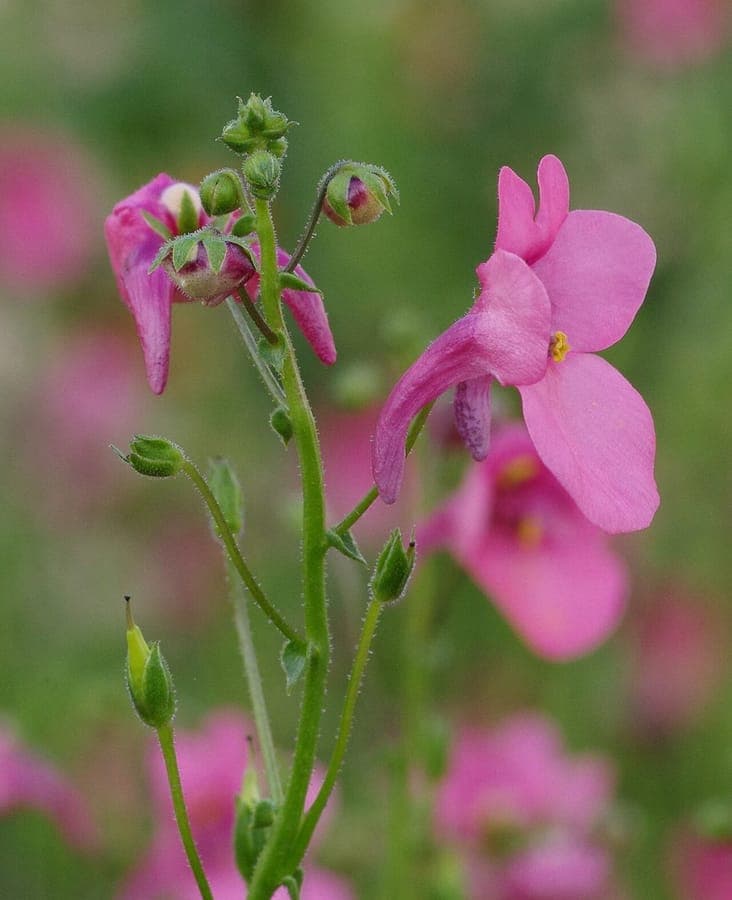
The flowers are carried in loose, upright spikes at the tips of the stems. They are 1.5 to 2 cm across and have a distinctive shape: a broad lower lip, two side lobes and a short upper lip, with two hollow spurs on the back. Those spurs hold not nectar but oil. In South Africa, specialist bees of the genus Rediviva collect the oil with their long front legs and use it to feed their larvae. In our gardens, ordinary bees and hoverflies visit the flowers instead.
The photo shows a bright pink flower with a darker spur at the back, beside a stem of round, hairy buds still waiting to open. Flowering starts in June and, with good care, continues until October. After the first big flush, flowering often slows, especially in hot summers; cutting the plant back brings a second wave.
Ideal location
Twinspur flowers most freely in full sun or in a spot that gets sun until early afternoon. On a very hot south-facing balcony it may take a break in July and August, and a little shade during the hottest hours helps. In too much shade the plant becomes floppy and flowers poorly.
It does well in window boxes, bowls and pots, and as a low edging plant in a sunny border. Because the stems lean outwards slightly, it also looks good in hanging baskets and along the edges of containers. In a well-drained rock garden or raised bed it may survive for a few years in milder areas. Space plants about 25 cm apart in containers.
Compost and soil
In pots, use a good multipurpose or container compost, ideally with a handful of fine grit or perlite added for extra drainage. In open ground twinspur wants humus-rich soil that holds moisture yet drains freely. Heavy clay that stays wet in winter is fatal; work in coarse grit and compost there. Slightly acidic to neutral soil is ideal.
Always make sure containers have a drainage hole and a layer of crocks or gravel at the bottom. Twinspur likes moisture, but not standing water around its roots.
Watering and feeding
Keep the soil evenly moist. Twinspur is less drought tolerant than many container plants: if the rootball dries out, the flowers droop and the plant stops blooming for a while. In summer, water window boxes every day or two and hanging baskets daily, whenever the top centimetre feels dry. Water at the base rather than over the flowers, and do not leave water standing in the saucer.
From June to the end of August, give a liquid feed for flowering plants every fortnight at the normal rate. Too much nitrogen produces long, floppy stems, so stick to a balanced fertiliser.
Free preview
Want to see Twinspur (Diascia barberae): complete guide in your garden? Make a free preview of your design.
Pruning
Pruning is the key to a long flowering season with twinspur. Regularly snip off faded spikes just above a pair of leaves, and the plant will quickly produce new side shoots with buds.
If flowering tails off towards the end of July, or the plant looks tired after a hot spell, cut all the stems back by half. Water well and give a dose of feed. Three to four weeks later twinspur will be in full flower again, often until the first frost.
Slugs enjoy the young shoots of plants in the ground, so keep an eye out in spring and after rain. Aphids sometimes appear on the shoot tips and can be washed off with water.
Maintenance calendar
March-April: Move overwintered plants somewhere brighter and trim them back. Sow seed or take cuttings indoors if you like.
May: Plant twinspur outside from mid to late May, once frost is no longer a risk. Young plants cope with a cool night better than many summer bedding plants, but not with frost.
June-July: First flush of flowers. Keep the soil moist, feed every fortnight and snip off faded spikes.
Late July-August: Cut the whole plant back by half for a second flush. Take cuttings from non-flowering shoots if you want to keep the plant.
September-October: Second flowering, which carries on until the first frost. Stop feeding in September.
November-February: Leave plants in the ground with dry winter protection, or overwinter pots somewhere cool and bright.
Winter hardiness and overwintering
Diascia barberae and its hybrids are only borderline hardy in north-western Europe. In a dry winter and on free-draining soil, some plants survive a few degrees of frost, down to around -5 °C. Cold, wet soil kills them far more quickly than frost itself. In the UK and the Low Countries they often fail outdoors, which is why most gardeners treat twinspur as an annual.
If you want to give garden plants a chance, grow them in a sheltered, sunny spot with gravel or in a raised bed, and cover them in winter with a few conifer branches. Pots are best moved before the frost to a bright, frost-free and cool place, around 5 to 10 °C, and kept on the dry side. Taking cuttings in August is a reliable way to keep a favourite colour: tip cuttings 5 cm long without flowers root easily.
Twinspur is not known to be toxic to people or pets. There are no reports of poisoning, but as with any ornamental plant it is best to stop children and animals from eating it.
Companion plants
The pink, salmon and apricot shades of twinspur go beautifully with blue, white and silver. A white marguerite (Argyranthemum frutescens) in the middle of a container ringed with twinspur makes a fresh, summery picture. Blue trailing lobelia (Lobelia erinus) fills the edges and adds contrast.
Nemesia strumosa looks very similar to twinspur and is often confused with it; together they create a rich display in pastel colours. White sweet alyssum (Lobularia maritima) adds scent and fills any gaps. In a border or rock garden, twinspur sits well beside the silvery-blue grass Festuca glauca, which enjoys the same sunny, well-drained spot.
Avoid pairing twinspur with true drought lovers that can go for weeks without water; twinspur wants evenly moist soil.
Final thoughts
Twinspur is a charming plant for anyone who loves soft colours and a long flowering season. Give it sun, moist but free-draining soil and a firm cut back in midsummer, and it will flower from June until the first frost. Its two spurs and its unusual relationship with oil-collecting bees also make it a plant with a story to tell.
The planting calendar on gardenworld.app shows when to plant twinspur outside, when to cut it back and when to take cuttings. Put a container of twinspur on your sunny patio this spring and discover just how long this little South African plant can keep flowering.
Frequently asked questions about Twinspur
Is Twinspur winter hardy?
Diascia barberae and its hybrids are only borderline hardy in north-western Europe. In a dry winter and on free-draining soil, some plants survive a few degrees of frost, down to around -5 °C.
When and how do you prune Twinspur?
Pruning is the key to a long flowering season with twinspur. Regularly snip off faded spikes just above a pair of leaves, and the plant will quickly produce new side shoots with buds.
How much water does Twinspur need?
Keep the soil evenly moist. Twinspur is less drought tolerant than many container plants: if the rootball dries out, the flowers droop and the plant stops blooming for a while.
Where does Twinspur grow best?
Twinspur flowers most freely in full sun or in a spot that gets sun until early afternoon. On a very hot south-facing balcony it may take a break in July and August, and a little shade during the hottest hours helps.

See it in your garden
See Twinspur in your garden
One photo of your garden and a few questions. You see the result in about a minute.
Try it with a photoIdentify this plant in your own garden. Identify a plant
Similar plants
Nemesia: complete guide
Nemesia strumosa
Nemesia strumosa, the Cape jewels from South Africa, delivers months of brilliant color. Perfect annual for borders, containers, and cutting gardens. Learn growing and propagation tips.
Lobelia erinus: complete guide
Lobelia erinus L.
Lobelia erinus is popular trailing plant with blue or red flowers, perfect for hanging baskets and containers. Flowers continuously all summer long.
Boston daisy: complete guide
Argyranthemum frutescens
Boston daisy is a prolific Canary Island shrub with vibrant green foliage and abundant flowers from spring through autumn. Ideal for borders, containers, and patio plantings.
