
Mason Brock (Masebrock) / Public domain, via Wikimedia Commons
Deutzia: Spring Flowering Guide & Hardiness
Deutzia scabra
Want to see Deutzia: Spring Flowering Guide & Hardiness in your garden?
1 minute, no credit card
Overview
Deutzia (Deutzia scabra) is an elegant deciduous shrub from the Hydrangeaceae family, native to eastern and southern Japan. This early bloomer is renowned for its prolific production of delicate white or pale pink star-shaped flowers arranged in long panicles. Due to its compact habit (usually 150-250 cm), vigorous growth, and easy care, deutzia is extremely popular in European gardens, particularly for hedging, border edging, and as a spring specimen.
Appearance & Bloom Cycle
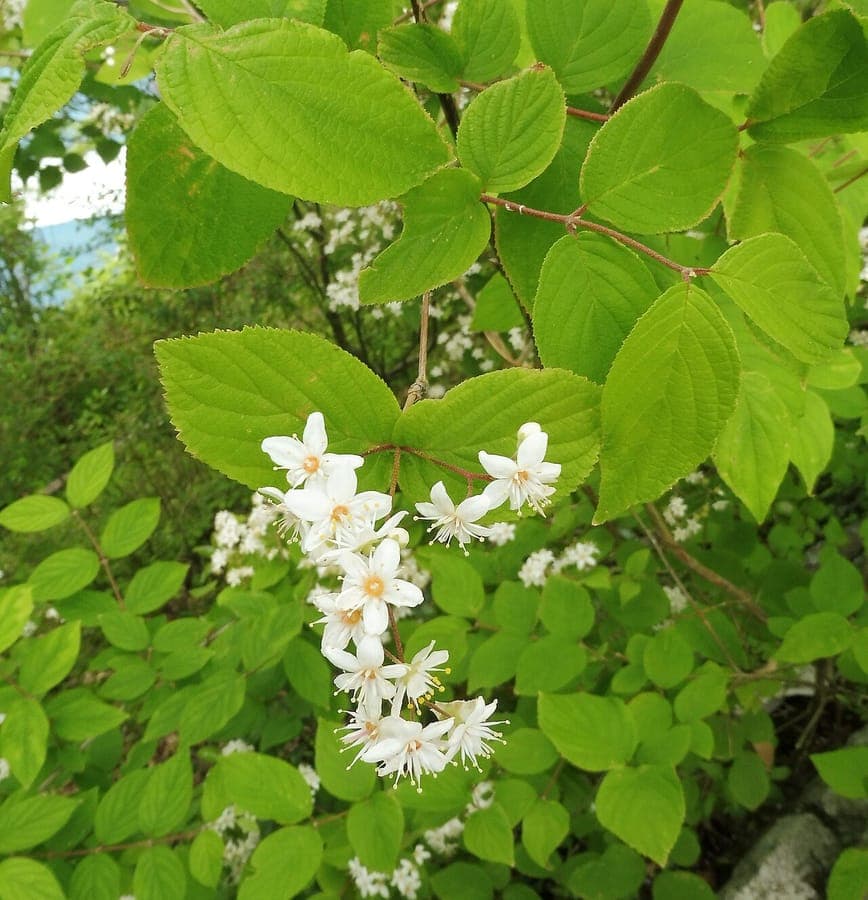
Deutzia forms an upright, densely branched shrub with a fine network of slender, brown twigs. Leaves are small, elliptical shapes of 3-7 cm length with rough surface texture (hence the species name 'scabra'). In April-May, countless flowers appear in 5-8 cm long, densely packed panicles: typically pure white (some cultivars show pale pink or salmon tinges). Each flower has 5 white petals with a yellowish centre. After flowering, small, dry seed capsules form that are botanically interesting but not ornamental.
Ideal Location
Deutzia thrives in USDA zones 5-8 (-23°C to 5°C). The plant prefers full sun (4-6 hours direct sunlight) for best flowering. In partial shade, blooming is less profuse. Protect from very strong winds that can snap slender branches. Plant in sheltered locations where flowers display prominently. Space at least 2-3 metres from other shrubs. Deutzia is ideal for hedging, border edging, or as an accent specimen.
Soil Requirements
Deutzia grows in both poor and fertile soils, but prefers moderately nutrient-rich, well-draining garden loam (pH 6.0-7.5). Heavy clay must be amended with 30% compost. Waterlogged conditions are detrimental; ensure good drainage. At planting, incorporate garden compost and slow-release fertiliser for the first growing season. Deutzia is extremely flexible regarding soil type - it thrives even in less-than-ideal conditions.
Watering
After planting (first season, April-October), water regularly: soil should remain evenly moist. Young plants require consistent water - approximately 15-20 litres weekly during growing season in dry weather. Established shrubs are drought-resistant and largely self-sufficient. During exceptionally dry summers, provide supplementary watering. After leaf fall in autumn, watering needs become minimal. Winter natural precipitation suffices.
Free design
Want to see Deutzia: Spring Flowering Guide & Hardiness in your garden? Make a free design now.
Pruning
Deutzia responds well to regular pruning. Annually, immediately after flowering (June), remove old flowering canes near ground level - this stimulates new shoots for next season. Avoid heavy winter pruning; deutzia suffers from snow and frost damage. On frost-damaged specimens, injured branches may be gently removed in March. An open, airy shrub form is achieved through annual post-flowering pruning. Wild growth may be controlled by mid-summer cutting.
Maintenance Calendar
April: Flowering in full swing; no maintenance needed. May-June: Flowering declining; execute immediate post-flowering pruning. July-August: New growth beginning; water during dry spells. September-October: Growth slows; reduce watering. November-March: Winter dormancy; no maintenance required. Gently shake snow accumulation to prevent branch breakage.
Winter Hardiness
Deutzia scabra is winter-hardy to zone 5a (-20°C). In the UK, northern France, and central Europe, no protection is needed. During very severe winters, leaf tips may experience slight frost damage, but the plant recovers fully in spring. Snow and ice accumulation may be gently shaken off.
Companion Plants
Deutzia combines beautifully with other spring bloomers: forsythia (Forsythia x intermedia), spiraea (Spiraea thunbergii), and star magnolia (Magnolia stellata). For summer continuity, plant smooth hydrangea (Hydrangea arborescens) behind it. Underplant with spring bulbs (Chionodoxa, muscari) to extend the season. Ivy (Hedera helix) can climb deutzia without harming it. For design ideas around spring borders, consult gardenworld.app where landscape designers showcase multi-season plant associations.
Propagation
Deutzia propagates easily via hardwood cuttings. In June-July, cut healthy young stems of 10-15 cm, remove basal leaves, and place in gritty potting compost under light plastic tent at 18-20°C. Root formation occurs within 4-6 weeks. Pot into 8 cm containers; plant outdoors the following May. Seed is viable but much slower (2-3 years to flowering).
Conclusion
Deutzia is a reliable spring-flowering shrub that delivers prolific blooms year after year. With minimal pruning and feeding, it grows lustily. Ideal for those seeking Japanese elegance in hedging and group plantings. For more tips on spring bloomers and shrub combinations, visit gardenworld.app where garden designers create seasonally resolved designs.
Want to see Deutzia: Spring Flowering Guide & Hardiness in your garden? Make a free design now.
Upload a photo, pick a style, and get a photorealistic design with plant list in under a minute.
No credit card required


Similar plants
Cliff fendlerbush: complete guide
Fendlera rupicola
Everything about Fendlera rupicola, the rare rocky-slope shrub with fragrant white spring flowers that thrives on lean, dry, calcareous soils.
Fivepetal cliffbush: complete guide
Jamesia americana
Everything about Jamesia americana, the fivepetal cliffbush: rocky sites, white blooms, autumn colour, winter hardiness and garden care.
Deutzia parviflora: complete guide
Deutzia parviflora
Discover Deutzia parviflora, an elegant flowering shrub with white blossoms. Growing guide with tips for sunny placement, fertile soil, and regular pruning.