
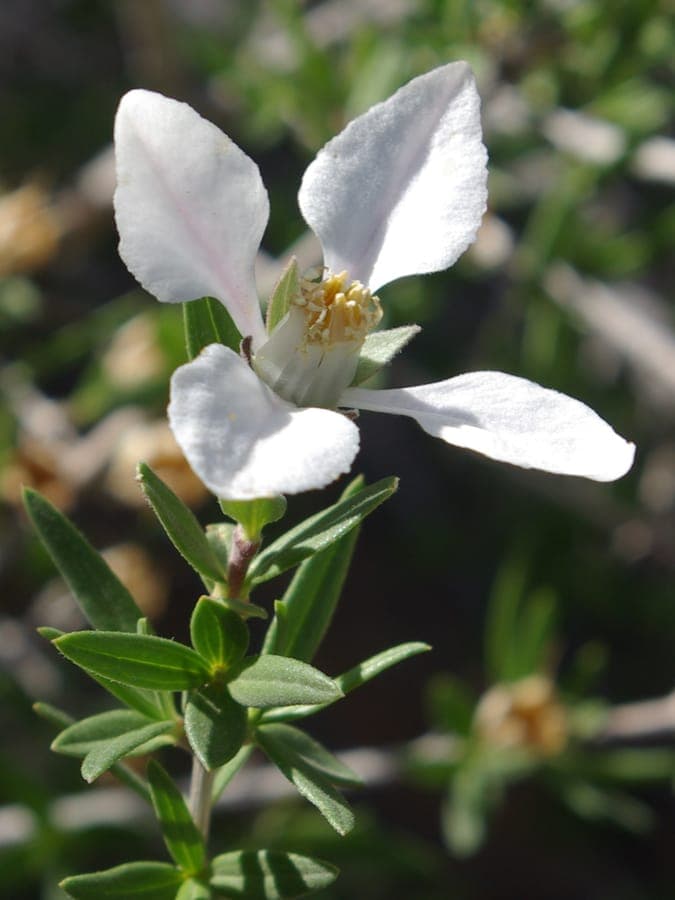
JerryFriedman / CC BY-SA 3.0, via Wikimedia Commons
Cliff fendlerbush: complete guide
Fendlera rupicola
Want to see Cliff fendlerbush: complete guide in your garden?
1 minute, no credit card
Overview
Cliff fendlerbush (Fendlera rupicola) is a distinctive deciduous shrub in the hydrangea family (Hydrangeaceae), native to the rocky canyon walls, limestone slopes and dry ravines of the southwestern United States and northern Mexico. Its natural range covers Arizona, Colorado, Nevada, New Mexico, Texas and Utah, where it makes its home on sites too lean, too dry and too rocky for most other plants. This resilience makes it particularly valuable for gardeners dealing with challenging, fast-draining or stony ground.
The shrub typically reaches 60 to 150 cm in height, forming a dense, well-branched framework that carries showy white flowers in spring. It belongs to the genus Fendlera, named for the nineteenth-century botanist Augustus Fendler. It was formally described in 1852 by Asa Gray and has since been appreciated in drought-tolerant and rock garden plantings across warm temperate climates. At gardenworld.app you will find garden designs that incorporate tough, character-rich shrubs like this one into robust, low-maintenance planting schemes.
The genus Fendlera contains only a handful of species, of which Fendlera rupicola is the best-known and most widely cultivated. The species epithet "rupicola" translates as "rock-dweller", a perfect description of its preferred habitat. It is a rewarding addition to any garden where drought, heat and poor soils are the main challenges.
Appearance and bloom cycle
Fendlera rupicola is a multi-stemmed shrub with stiff, somewhat angular branching that gives it a distinctive character. Young shoots are lightly hairy and mature to grey-brown or reddish tones. The leaves are narrow, lance-shaped and finely hairy, giving the plant a soft grey-green colour overall.
Flowering occurs from April to June depending on the site and climate. The blooms are white, sometimes faintly flushed with pink, and carry four broad petals forming a flower about 2 to 3 cm across. They are produced freely across the whole plant and are sweetly fragrant, drawing in bees and butterflies. This spring flowering display is the main ornamental event, contrasting beautifully with the plant's lean winter silhouette.
After flowering, small horn-like seed capsules develop, which have modest ornamental value. Autumn leaf colour is a muted yellow, so the flower season is the undisputed highlight. The branching structure in winter, however, has its own quiet appeal as a garden framework.
Ideal location
Cliff fendlerbush needs a sunny position. It performs best in full sun but tolerates some afternoon shade, though flower production drops noticeably in shadier spots. In its native habitat it clings to sheer rocky faces and limestone outcrops, sometimes literally rooting in crevices with minimal soil. This tells us it excels in dry stone walls, rock gardens, xeriscape borders and sloping sites.
It handles heat, drought and wind with ease and can be planted where most other shrubs would fail. It suits south-facing banks and sunny path edges as well. On gardenworld.app you can explore how tough shrubs like this integrate into challenging garden situations and request a bespoke design for your own outdoor space.
Cliff fendlerbush is not widely stocked in mainstream garden centres, but specialist nurseries carry it. Ask at local independent garden centres or search online retailers for availability.
Soil
Fendlera rupicola has a clear preference for well-drained to very dry soils. It thrives at a pH of 7 to 8.5, meaning neutral to mildly alkaline and calcareous conditions suit it perfectly. It handles rocky and gravelly substrates without complaint and has no need for rich or fertilised ground. In clay-heavy gardens, drainage improvement is essential: dig in coarse grit or perlite when planting.
The plant's main enemy is poor drainage and standing water in winter, which causes rapid root rot. Raised beds and sloping ground are therefore the best situations in a European garden context. A light layer of compost in spring is ample feeding. Avoid heavy nitrogen fertilisers, which push leafy growth at the expense of flower bud development.
Free design
Want to see Cliff fendlerbush: complete guide in your garden? Make a free design now.
Watering
Once established, Fendlera rupicola is among the most drought-tolerant shrubs available. In the first year, regular but deep watering helps the roots establish. Once the plant is settled, supplementary watering is rarely needed in normal conditions.
In extended dry summers, a thorough watering once a month is sufficient. Always favour deep, infrequent watering over shallow, frequent sprinkling: deep irrigation encourages the roots to penetrate further into the ground, improving long-term drought resilience. Drip irrigation at the base of the plant is more effective than overhead watering and keeps the foliage dry, reducing fungal risks. In areas with regular rainfall, established plants need almost no additional water.
In containers, more frequent watering is required, but always ensure adequate drainage holes. Waterlogged pots rapidly cause root damage.
Pruning
Fendlera rupicola naturally forms a compact, attractively branched structure and requires little attention. The best time for light corrective pruning is immediately after flowering, in June or July, giving the plant the rest of the season to develop flower buds for the following spring. Remove dead, damaged or crossing stems at this time.
Avoid pruning in autumn or early winter, as this removes the already-formed buds for next season's flowers. If the plant becomes too large or overly woody, it can be cut back hard to 20 to 30 cm above the ground in early spring and will reshoot vigorously, though the following year's flowering will be reduced. Such rejuvenation cuts are best limited to every five or more years.
Maintenance calendar
January-February: No action required. Plant is dormant. March: Check for winter damage. Remove frost-killed shoots once hard frosts are past. April-May: Flowering season. Enjoy the fragrant white blooms. No pruning at this stage. June: Prune lightly immediately after flowering to maintain shape and encourage next year's buds. July-August: Plant grows and ripens. Little water needed except in prolonged dry spells. September-October: Plant prepares for winter. Add a light layer of compost around the base if desired. November-December: Dormancy. Enjoy the structural winter silhouette.
Winter hardiness
Fendlera rupicola is hardy in USDA zones 5 to 9, tolerating temperatures down to approximately -20 degrees Celsius in a well-suited position. In milder parts of northern and western Europe it performs well provided drainage is excellent. Wet winter soil is far more dangerous than cold. First-year plants benefit from a protective mulch of 8 to 10 cm of bark or straw around the base.
In hard winters some shoot-tip dieback may occur, but the plant rebounds strongly from the old wood in spring. Container-grown specimens are less root-protected and benefit from overwintering in a cool, frost-free space. In climates where winters are mild but persistently wet, good drainage remains the single most important factor in success.
Companion plants
Fendlera rupicola pairs beautifully with other drought-tolerant plants that enjoy similar site conditions:
- Fallugia paradoxa (Apache plume): a related rocky-slope shrub with white flowers and feathery seed plumes.
- Penstemon pseudospectabilis (desert penstemon): vivid pink-red flowers that contrast with the white fendlerbush blooms.
- Agave parryi: a low rosette that accentuates the base of the shrub and tolerates the same dry conditions.
- Salvia pachyphylla (desert sage): blue flowers and aromatic grey-green foliage.
- Eriogonum umbellatum (sulphur buckwheat): low and mat-forming, with yellow summer flowers.
- Juniperus communis (common juniper): a European native that also does well on dry calcareous ground.
Closing thoughts
Fendlera rupicola is a rare gem for the dry and rocky garden. Its fragrant spring flowering display, its robust character and its ability to thrive on the most challenging soils make it genuinely distinctive. Minimal care is needed once it is established, and it rewards patient gardeners with a long and dependable life. Look for it at specialist nurseries and independent garden centres. Want to see how cliff fendlerbush could work in your own front garden? Visit gardenworld.app and get a tailored garden design to bring your planting vision to life.
Want to see Cliff fendlerbush: complete guide in your garden? Make a free design now.
Upload a photo, pick a style, and get a photorealistic design with plant list in under a minute.
10,000+ gardens designed already
No credit card required


Similar plants
Apache plume: complete guide
Fallugia paradoxa
Everything about Fallugia paradoxa, the desert shrub with white rose-like flowers and feathery seed plumes that shrug off drought and heat.
Dwarf witch alder: complete guide
Fothergilla gardenii
Everything about Fothergilla gardenii, the popular ornamental shrub with fragrant white bottle-brush flowers in spring and blazing autumn colour.