
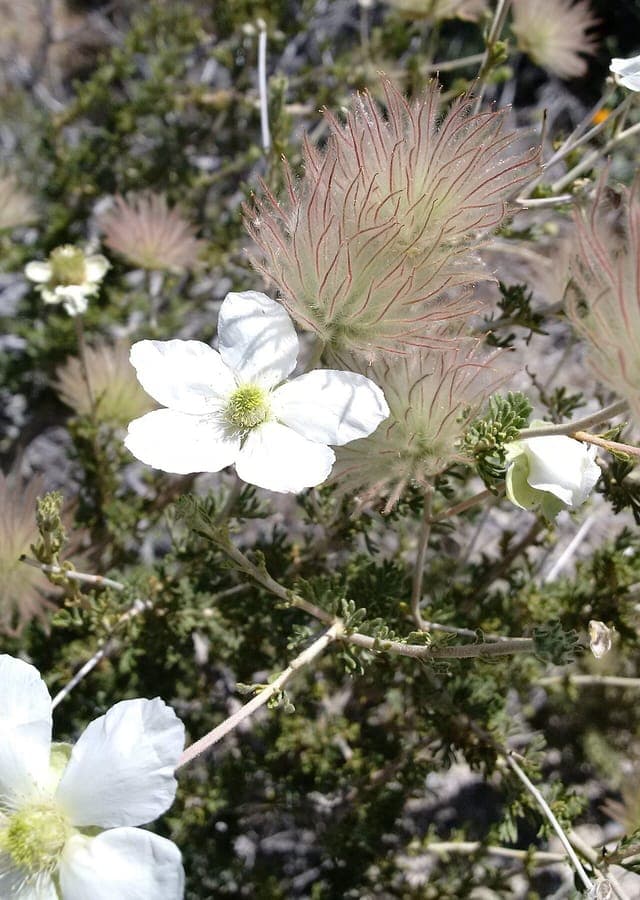
Andrew Hart / CC BY-SA 4.0, via Wikimedia Commons
Apache plume: complete guide
Fallugia paradoxa
Want to see Apache plume: complete guide in your garden?
1 minute, no credit card
Overview
Apache plume (Fallugia paradoxa) is a remarkable deciduous shrub in the rose family (Rosaceae) native to the dry deserts and rocky slopes of the southwestern United States and northern Mexico. The plant takes its common name from the spectacular feathery seed clusters that follow the flowers, giving the shrub an almost ethereal, cloud-like appearance in late summer and autumn. In the wild it grows across Arizona, New Mexico, Texas, Colorado, Utah, Nevada and California, where it has adapted to extreme drought, intense heat and nutrient-poor soils.
Typically reaching 60 to 150 cm in height and a similar spread, Apache plume is an excellent choice for drought-tolerant gardens, rock gardens and xeriscape plantings. It is one of the few shrubs that delivers both decorative flowers and highly ornamental seed heads, providing two distinct seasons of garden interest. At gardenworld.app you will find inspiring garden designs that use Apache plume as a centrepiece in water-wise planting schemes.
Fallugia paradoxa is the sole species in its genus, which makes it botanically unique. It was scientifically described in 1848 and has since earned a following among gardeners who want a low-maintenance shrub with genuine character.
Appearance and bloom cycle
Apache plume is a multi-stemmed shrub with an open, airy growth habit. The stems are grey-white and carry small, deeply lobed leaves that resemble those of an oak. The leaves are green on their upper surface and covered with white woolly hairs beneath, giving the whole plant a silver-grey shimmer.
Flowering runs from May through September and sometimes beyond. Each bloom is white, five-petalled and closely resembles a small wild rose, measuring 2 to 4 cm across. The flowers appear in abundance across the entire shrub and attract bees, butterflies and hummingbirds. Alongside the last blooms, the characteristic seed heads develop: clusters of feathery styles 2 to 4 cm long that start off reddish-purple and age to a shimmering silver. By autumn the whole shrub can be draped in these plumes, creating an effect that is unlike almost anything else in the garden.
Autumn leaf colour is not the plant's main asset, but the foliage persists late into the season. The combination of white blooms and glistening plumes gives Fallugia paradoxa a distinctive, jewel-like quality that few other shrubs can match.
Ideal location
Apache plume performs best in a sunny to fully open position. It needs at least six hours of direct sun each day to bloom freely and develop the dense plume formation that makes it so attractive. In part shade it will grow but flower less generously.
In its native range it colonises rocky hillsides, dry canyon washes and calcareous soils at elevations between 1,000 and 2,500 metres. It handles urban conditions well, including heat reflected from walls and paving, and tolerates wind and air pollution. It suits sloping gardens, dry-stone walls, or as a free-standing specimen on a warm, dry border. On gardenworld.app you can see how the plant fits into different garden styles and request a custom design for your own outdoor space.
Soil
Fallugia paradoxa is not fussy about soil. It prefers well-drained to very dry conditions and grows happily in sand, loam, clay or rocky substrates. It copes with both acid and alkaline soils, but the optimum pH is 7 to 8 - neutral to mildly calcareous.
What it cannot tolerate is poor drainage or standing water. Waterlogged conditions lead rapidly to root rot and plant death. In clay-heavy gardens, improve drainage by incorporating coarse grit, perlite or sharp sand into the planting hole. Fertilising is rarely needed and can actually be counterproductive, encouraging leafy growth at the expense of flowers.
Free design
Want to see Apache plume: complete guide in your garden? Make a free design now.
Watering
Once established, Apache plume is among the most drought-tolerant shrubs available to European gardeners. In the first growing season regular watering helps the roots establish. From the second year onwards irrigation can be greatly reduced. In dry summers, watering once or twice a month is usually sufficient; in regions with regular rainfall, supplementary watering is barely needed at all.
When you do water, do so deeply and infrequently to encourage the roots to penetrate deep into the soil. Shallow, frequent watering keeps roots near the surface and weakens the plant over time. Drip irrigation at the base is more efficient than overhead watering and keeps the foliage dry, reducing the risk of fungal problems.
Pruning
Apache plume needs little pruning. It grows naturally in a tidy, compact form and usually requires no shaping. In early spring, once the risk of hard frost has passed, remove any dead or damaged stems. Older, overly woody plants respond well to a hard rejuvenation cut - reducing them to 15 to 30 cm above the ground encourages fresh, flower-bearing new wood.
Avoid pruning in autumn or early winter, as the flower buds for the following season are already set. Leave the plumes on the plant as long as possible: they are highly decorative and provide some insulation for the woody framework during cold periods. If size control is needed, do this after flowering, in August or September.
Maintenance calendar
January-February: No action required. Plant is dormant. March: Check for winter damage. Remove any frost-killed shoot tips once hard frosts are over. April-May: Add a light layer of compost around the base, keeping it clear of the stem. The plant is beginning to break dormancy and forming flower buds. June-July: First flowers open. Water deeply once a month during prolonged dry spells. August-September: Peak flowering and plume development. Any shape trimming can be done after peak bloom. October-November: Plumes dry on the plant. Reduce watering. December: Enjoy the ornamental winter silhouette.
Winter hardiness
Fallugia paradoxa is hardy in USDA zones 5 to 9, meaning it can withstand temperatures down to roughly -20 degrees Celsius in a suitable position. It is reliably hardy across most of northern and western Europe provided the roots stay dry in winter. Wet winter conditions are more dangerous than cold alone.
In severe winters the shoot tips may die back, but the plant reshoot vigorously in spring. Plants in their first year are more vulnerable; a 10 cm mulch of bark or straw around the base offers helpful protection. Container-grown specimens are less protected at the roots and benefit from overwintering in a cool, frost-free space.
Companion plants
Apache plume combines beautifully with other drought-tolerant species from similar climates. Good companions include:
- Salvia greggii (Autumn sage): long flowering period in pink and red tones that complement the white blooms.
- Agave americana: the bold architectural rosette contrasts dramatically with the light feathery plumes.
- Juniperus horizontalis (creeping juniper): a low ground cover that shields the plant's base.
- Penstemon strictus (Rocky Mountain penstemon): blue-purple flowers that harmonise with the white.
- Yucca filamentosa: another southwestern native that shares the same site conditions.
- Agastache rupestris (licorice mint): orange-yellow flowers that attract the same pollinators.
Avoid pairing with moisture-loving plants such as hydrangeas or rhododendrons, which need far wetter conditions.
Closing thoughts
Apache plume (Fallugia paradoxa) is one of the most underrated ornamental shrubs for dry, sunny gardens. Low-maintenance, heat and drought tolerant, it delivers a procession of decorative highlights from May right through winter - from charming white rose-like blooms, through vivid reddish plumes, to a silver-frosted winter framework. Look for it at specialist nurseries and online garden centres. Want to see how Apache plume might look in your own front garden? Visit gardenworld.app and get a personalised garden design.
Want to see Apache plume: complete guide in your garden? Make a free design now.
Upload a photo, pick a style, and get a photorealistic design with plant list in under a minute.
10,000+ gardens designed already
No credit card required


Similar plants
Cliff fendlerbush: complete guide
Fendlera rupicola
Everything about Fendlera rupicola, the rare rocky-slope shrub with fragrant white spring flowers that thrives on lean, dry, calcareous soils.
Dwarf witch alder: complete guide
Fothergilla gardenii
Everything about Fothergilla gardenii, the popular ornamental shrub with fragrant white bottle-brush flowers in spring and blazing autumn colour.