
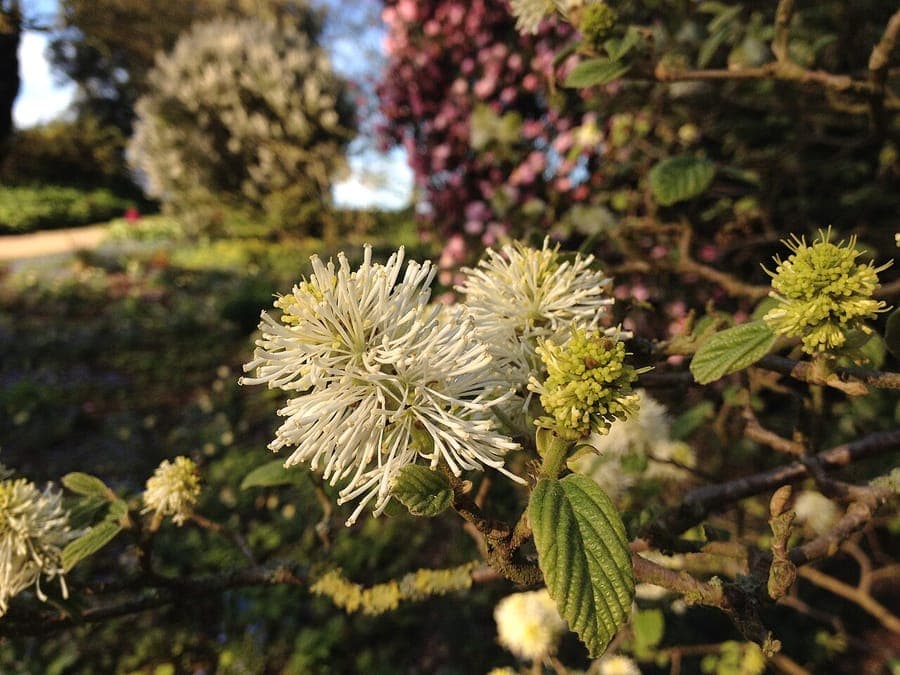
Lyonothamnus / CC BY-SA 4.0, via Wikimedia Commons
Dwarf witch alder: complete guide
Fothergilla gardenii
Want to see Dwarf witch alder: complete guide in your garden?
1 minute, no credit card
Overview
Fothergilla gardenii, commonly called dwarf witch alder or dwarf fothergilla, is one of the most rewarding ornamental shrubs for the European garden. It belongs to the witch hazel family (Hamamelidaceae) and is native to the coastal plains of the southeastern United States, from North Carolina through South Carolina to Georgia. In the wild it grows in moist, sandy, acidic soils along streams, in pocosins and at the margins of pine-oak woodlands.
This compact shrub typically reaches 60 to 100 cm in height, occasionally to 120 cm, and spreads to a similar width. It delivers garden interest across three seasons: in early spring it bears conspicuous white bottle-brush flower clusters before the leaves emerge; through summer it forms a tidy, rounded mass of attractive foliage; and in autumn it transforms into one of the most vivid colouring shrubs available, displaying leaves in red, orange, yellow and purple, often simultaneously on the same plant. It was described by Linnaeus in 1774 and named in honour of the English physician and botanist John Fothergill.
At gardenworld.app you will find garden designs that use Fothergilla gardenii as a colourful anchor in mixed borders, shade planting and spring-focused schemes near water features.
The genus Fothergilla contains only two species: this dwarf species and the larger Fothergilla major. The dwarf witch alder's compact habit makes it particularly suitable for smaller gardens and borders, and it is now well-stocked at specialist nurseries and garden centres across Europe.
Appearance and bloom cycle
Fothergilla gardenii is a multi-stemmed, compact shrub with a rounded to slightly upright habit. The leaves are alternate, broadly elliptic to obovate, with a coarsely toothed margin. They are dark green above and paler beneath, with a firm texture.
Flowering occurs from March to May depending on the site. The blooms are white and consist of tightly packed clusters of long white stamens with no visible petals - resembling small bottle brushes or powder puffs. They carry a gentle honey-like fragrance and are visited by early bees and butterflies. Particularly striking is the fact that the flowers appear before the leaves fully open, creating a beautiful display of white plumes against bare brown branches.
Autumn colour is the plant's second great attraction. From September through November the leaves turn in a broad palette of yellow, orange, fiery red and deep purple, sometimes showing all these tones simultaneously on a single plant or even a single leaf. This makes dwarf witch alder one of the most spectacular autumn-colouring shrubs for smaller gardens. The colour display is most vivid in a sunny to lightly shaded position.
Ideal location
Fothergilla gardenii performs best in a sunny to lightly shaded position. Full sun produces the richest flowering and the most intense autumn colour. In partial shade it blooms somewhat less freely but retains good autumn tones. Deep shade is not suitable.
In the wild it grows at the margins of moist woodlands, in coastal wetlands and along streams in sandy, acidic soils. In the ornamental garden it suits shade and semi-shade borders, as a specimen in a lawn, alongside ponds and water features, in heathland and woodland gardens, and in combination with other acid-loving shrubs. It also works well as a low informal hedge or on slopes. On gardenworld.app you can explore how dwarf witch alder fits into a layered spring border and get a custom design for your own outdoor space.
Soil
Dwarf witch alder has clear soil preferences: it wants moist to consistently moisture-retentive, acidic soil at pH 5 to 6. Calcareous or neutral soils are unsuitable and lead to chlorosis - yellowing of the leaves caused by iron deficiency. It cannot cope with alkaline ground and also dislikes standing water.
Sandy or loamy soils enriched with organic matter are ideal. When planting, incorporate well-rotted leaf compost or composted bark to increase the organic content and improve moisture retention. Mulching with bark chips or oak leaf compost lowers pH and keeps the root zone cool and moist through summer, which the plant greatly appreciates.
In gardens with alkaline soil, enlarge the planting hole significantly and fill it with ericaceous compost and acidic grit, or grow the plant in a large container with ericaceous potting mix.
Free design
Want to see Dwarf witch alder: complete guide in your garden? Make a free design now.
Watering
Fothergilla gardenii prefers evenly moist soil. It does not tolerate prolonged drought or waterlogged conditions. In dry summers regular watering is needed, particularly in the first few years after planting. Once established it becomes more resilient, but under extreme drought it shows stress - premature leaf drop and sparse foliage.
Water deeply and infrequently rather than shallowly and daily. A generous mulch layer of 8 to 10 cm of bark chips around the plant helps retain moisture and keeps soil temperatures stable through summer. Drip irrigation at the base is more effective than overhead watering. In areas with regular summer rainfall, supplementary watering is generally not needed. In urban gardens with heavy paving or on warm, dry sites, monitoring soil moisture is important during hot spells.
Pruning
Fothergilla gardenii needs little pruning. Its naturally compact, rounded growth form rarely requires correction. The best time for any pruning is immediately after flowering, in May or June. At this point remove damaged, dead or heavily crossing stems. Hard rejuvenation cuts are generally not necessary or recommended for this slow-growing species.
Avoid pruning in autumn or winter, as the flower buds for the following season are already set. If the plant has grown too open due to insufficient light, a light reduction in early spring can help restore density, though the following year's flowering will be reduced. The slow-growing nature of the plant means a mature form is long-lasting; choose the right position from the start rather than needing to move established plants.
Maintenance calendar
January-February: Plant is dormant. No action needed. Enjoy the bare branch structure. March-April: Flowering season. White flower clusters appear before the leaves emerge. No pruning at this stage. May: Leaves fully open. Prune lightly immediately after flowering if needed. June-July: Plant is in full leaf. Check moisture levels and water during extended dry spells. Refresh the mulch layer if needed. August: Final growth push of the season. September-October: Spectacular autumn colour in yellow, orange, red and purple. Enjoy the display. November: Leaves fall. Add fresh mulch around the base. December: Winter dormancy. Check mulch layer.
Winter hardiness
Fothergilla gardenii is hardy in USDA zones 5 to 9, tolerating temperatures down to approximately -20 degrees Celsius. It is reliably hardy across most of northern and western Europe without additional protection. It handles frost well, though the early spring flower buds can be damaged by late hard frosts.
A layer of bark mulch around the base in November protects the shallow roots during severe winters. Container-grown specimens are less insulated at the roots and benefit from overwintering in a cool, frost-free space. After hard winters the flowering in the first subsequent year may be slightly reduced, but the plant recovers quickly. It is more robust than its delicate appearance suggests.
Companion plants
Fothergilla gardenii is an excellent partner for other acid-loving shrubs and perennials:
- Rhododendron (dwarf cultivars): flower at the same time or just before Fothergilla, creating a dramatic spring spectacle together.
- Vaccinium corymbosum (highbush blueberry): same soil preference, edible fruit and fine autumn colour.
- Enkianthus campanulatus: bell-flowered shrub also celebrated for spectacular autumn tones.
- Kalmia latifolia (mountain laurel): evergreen shrub with pink-white flowers, thriving in the same acidic moist conditions.
- Leucothoe fontanesiana (drooping leucothoe): low evergreen ground layer that weaves gracefully around Fothergilla's base.
- Hosta: thrives in the same partial-shade conditions and provides bold textural contrast to Fothergilla's toothed leaves.
Closing thoughts
Fothergilla gardenii is one of the most rewarding ornamental shrubs for the modern garden. It delivers three distinct seasons of decorative beauty: fragrant white spring flowers, healthy green summer foliage and unmatched autumn colour. Low-maintenance, at home in small and large gardens alike, and an ideal partner for many other garden plants, it deserves a place in far more gardens than it currently occupies. Look for it at specialist nurseries and independent garden centres. Want to see how dwarf witch alder could transform your front garden? Visit gardenworld.app and get a personalised garden design.
Want to see Dwarf witch alder: complete guide in your garden? Make a free design now.
Upload a photo, pick a style, and get a photorealistic design with plant list in under a minute.
10,000+ gardens designed already
No credit card required


Similar plants
Apache plume: complete guide
Fallugia paradoxa
Everything about Fallugia paradoxa, the desert shrub with white rose-like flowers and feathery seed plumes that shrug off drought and heat.
Cliff fendlerbush: complete guide
Fendlera rupicola
Everything about Fendlera rupicola, the rare rocky-slope shrub with fragrant white spring flowers that thrives on lean, dry, calcareous soils.