
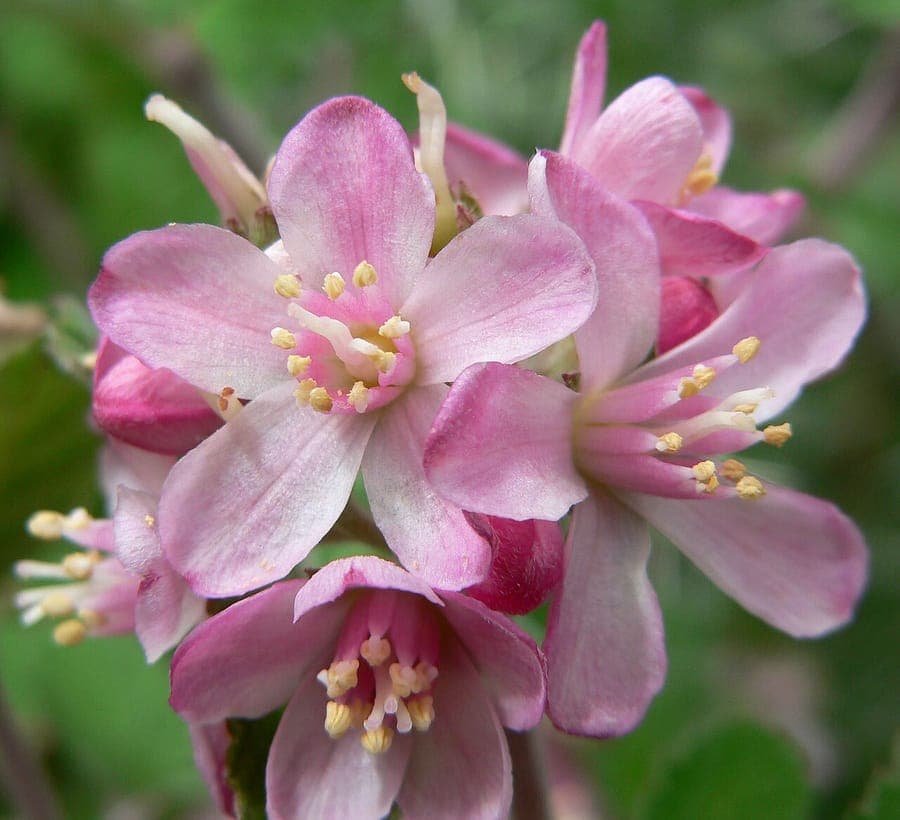
Stan Shebs / CC BY-SA 3.0, via Wikimedia Commons
Fivepetal cliffbush: complete guide
Jamesia americana
Want to see Fivepetal cliffbush: complete guide in your garden?
1 minute, no credit card
Overview
Jamesia americana, commonly known as fivepetal cliffbush or cliff jamesia, is a striking and little-known flowering shrub belonging to the Hydrangeaceae family - the same family that includes hydrangeas, Deutzia, and Philadelphus. The species was first formally described in 1840 by botanists John Torrey and Asa Gray in their foundational Flora of North America. The genus name Jamesia honours Edwin James, the American botanist and explorer who in 1820 made the first recorded successful ascent of Pike's Peak and documented the plant during that journey.
In its native range, Jamesia americana inhabits the rocky mountain terrain of the west-central United States and northern Mexico: Wyoming, Colorado, Utah, Nevada, New Mexico, Arizona, and California. It is a specialist of rock crevices, limestone cliffs, rocky slopes, and mountain meadows at elevations of 1,500 to 3,500 metres - a challenging environment characterised by thin, calcareous, rapidly draining soils, intense sunlight, and extreme temperature fluctuations between seasons and between day and night.
The common name 'fivepetal cliffbush' refers directly to the five broad, pure white petals that characterise each flower - an immediately distinctive feature at bloom time. The flowers are arranged in dense, corymb-like clusters at stem tips. Though the flowers themselves are not scented, they produce generous nectar that attracts bees and bumble bees. Autumn colour provides a second ornamental season: leaves turn from orange-red to deep burgundy from September onward, giving the plant three-season garden value.
For European gardens, Jamesia americana is a genuine discovery: a tough, drought-tolerant shrub for rock gardens, dry borders, and calcareous soils, combining white summer flowers with fiery autumn colour and extraordinary cold hardiness. Browse garden designs featuring rock garden shrubs like Jamesia americana at gardenworld.app.
Appearance & bloom cycle
Jamesia americana is a multi-stemmed shrub that reaches 60 to 150 cm in height and similar spread in garden conditions. The stems are straight to lightly arching, with reddish-brown bark that begins to peel and exfoliate on older specimens - a decorative feature that adds winter interest when the plant is leafless. Growth rate is moderate and the plant forms a compact, well-branched habit without becoming invasive.
Leaves are arranged in opposite pairs, broadly oval to nearly round, 3 to 7 cm long and wide, with a notably wrinkled or rugose surface texture and a finely toothed to serrated margin. The upper surface is matte dark green, the underside lighter green and softly hairy. The leaf shape and texture are reminiscent of small hydrangea leaves - an apt resemblance given the family relationship. Autumn colour is a visual highlight: leaves turn from September through November to attractive orange-red, cherry red, and sometimes deep burgundy, depending on site and weather.
Blooming occurs from May to July, depending on elevation and exposure. In garden settings at low elevation, June is typically peak bloom month. Flowers are arranged in corymb-like to loosely paniculate clusters at stem ends. Each individual flower has five broadly oval, pure white petals of 8 to 15 mm, numerous stamens with yellow anthers, and a small crown of green sepals. Though not fragrant, the abundant nectar draws bees and bumble bees reliably. The bloom period lasts three to five weeks.
After flowering, small, oval seed capsules develop and ripen to pale brown. The capsules are modest in size and remain on the plant for several months.
Ideal location
Jamesia americana is pre-eminently a plant for sunny, warm positions with well-drained, preferably calcareous soil. In its mountain home, it grows on sun-drenched cliffs and rocky slopes where the substrate is calcareous rubble that dries quickly in summer. This origin defines its garden preferences.
Full sun to light partial shade (no more than three hours less direct sun per day) is ideal. In more shade, growth elongates, flowering becomes less abundant, and autumn colour is less intense. A south- or west-facing slope, a dry stone wall, a gravel bed, or a calcareous border are all excellent positions.
The plant suits rock gardens, dry borders, alpine beds, limestone borders, and the tops of retaining walls. It tolerates the reflected heat of stones and pebbles well and benefits from the additional warmth these surfaces radiate. Wind exposure is not a problem: on its native mountain cliffs, the plant is accustomed to strong, drying winds.
Avoid wet, heavy clay soils and positions in the deep shade of large trees, as both lead to weaker growth and increased susceptibility to fungal diseases. At gardenworld.app you will find further guides to rock garden shrubs and drought-tolerant plants for challenging dry positions.
Soil requirements
Jamesia americana thrives on poor, well-drained soils and actually performs less well in rich, moist garden soil. Its pH preference is notable: the species does best at a neutral to slightly alkaline pH, ideally between 7.0 and 8.5. This makes it one of the relatively few flowering shrubs that actively prefers calcareous conditions and performs poorly in acidic, peat-rich, or heavily fertilised soil.
On calcareous loam, stony clay, or even rocky rubble substrates, the plant grows well. On heavy, wet clay, improvements are necessary: mix coarse grit and stone rubble in a 1:1 ratio through the upper 30 cm before planting, and plant on a raised position or mound to ensure drainage. On sandy soil with a neutral to slightly alkaline pH, Jamesia americana is in its element.
Nutrient-poor soil is an advantage, not a drawback. Excessive fertilisation promotes lush vegetative growth at the expense of blooming and makes the plant less compact. An annual light dressing of limestone grit or lime-rich garden compost is sufficient on most soils. Regular application of nitrogen-rich fertilisers is not recommended.
Planting depth: set the shrubs at the same depth as in the nursery container, with the root ball well settled but the root crown above soil level. Spacing: 90 to 120 cm centre-to-centre for a planted effect, 120 to 150 cm for solitary specimens.
Free design
Want to see Fivepetal cliffbush: complete guide in your garden? Make a free design now.
Watering
Once well established, Jamesia americana is a genuinely drought-tolerant plant requiring minimal additional water in a well-prepared rock border or gravel garden. The robust roots penetrate deeply into rocky substrate and draw moisture from crevices and deeper soil layers - an adaptation to the dry mountain climate of its native habitat.
In the first year after planting, moderate but consistent watering helps the plant establish. Water once a week generously, reaching down to 20 cm depth. Apply water slowly and deeply at the base rather than light overhead irrigation. Avoid keeping the soil persistently wet, as the roots are sensitive to waterlogging.
From the second growing season onward, irrigation frequency can be substantially reduced. On well-drained soil in the typical rainfall of north-west European gardens, supplemental watering is rarely needed unless summer is exceptionally dry - four weeks or more without rainfall. In that case, a thorough deep soak every two weeks is sufficient.
Autumn and winter irrigation are unnecessary unless the autumn season is particularly dry. The plant enters dormancy in October and needs minimal water from that point.
Pruning
Jamesia americana has a naturally compact, well-branched habit and requires little corrective pruning. It is not a vigorous grower and forms a balanced shrub of its own accord that remains well within bounds even in small rock garden positions.
The best time for tidying pruning is directly after flowering, in July or at the latest early August. At this point, remove spent flower clusters back to just above a healthy leaf pair or side shoot. This prevents energy going into seed development and encourages denser branching. Never cut back in autumn or winter, as this removes the flower buds that are already set in the wood during summer for the following year's bloom.
Neglected or oversized specimens can be carefully cut back in early spring (February-March), but recovery from heavy pruning is slow. Cutting back to 30 cm above ground is possible but takes two to three years for the plant to fully recover. In early spring, always first remove winter storm-damaged or dead branches before any shaping work.
For most garden situations, an annual light trim after flowering and removal of dead wood in spring are entirely sufficient to keep Jamesia americana healthy and floriferous.
Maintenance calendar
January–February: Minimal activity. Inspect for storm damage and remove broken branches. Add a small amount of limestone grit around the base if the soil tends toward acidity.
March–April: New leaves begin to appear. Plant new specimens now if desired, or wait until September. Apply calcareous compost at the base of established plants if needed.
May–June: Flowering period begins. Enjoy the white flower clusters. Protect young flowering shoots against late frosts with light garden fleece if expected.
July–early August: Bloom is finished. Remove spent flower clusters. This is the best time for any reshaping work.
September–October: Autumn colour begins in orange-red and burgundy. No pruning. The plant can also be divided or transplanted now.
November–December: Leaf drop. Clear fallen leaves from around the base before winter. No further intervention needed.
Winter hardiness
Jamesia americana is remarkably cold-hardy for a plant from high mountain environments. The species is rated for USDA zones 4 to 8, meaning it reliably survives temperatures as low as approximately -34 degrees Celsius. This places it among the hardiest of ornamental flowering shrubs, and it is entirely at home through the severest winters that the Netherlands, Belgium, or the UK typically experience.
In its native mountain habitat, the plant is accustomed to deep snow cover in winter and enormous temperature swings between seasons and between day and night. Winter dormancy is deep and complete: all leaves drop in November and the plant stands bare but with an attractive branch structure through to early spring. Flower buds are embedded in the wood and well protected against cold.
Young specimens in their first planted year are slightly more vulnerable, particularly to late spring frost damage on young shoots in April. A light mulch layer of 5 cm dry leaves over the root zone provides useful additional protection in that establishment period without compromising drainage.
The plant can also be grown in a large container on a sheltered terrace, provided the container is sufficiently large (at least 40 litres) and positioned on an insulating surface during winter. Specialist nurseries and some garden centres carry the species in containers suitable for rock garden or courtyard plantings.
Companion plants
Jamesia americana looks finest in the company of plants that share its preference for dry, calcareous, sun-drenched conditions:
- Penstemon strictus (Rocky Mountain penstemon): deep blue-purple flower spikes in June-July, the same preference for dry, calcareous mountain soil and full sun. A stunning contrast to the white Jamesia flowers.
- Eriogonum umbellatum (sulfur buckwheat): yellow umbel-like flowers from June to August, a low ground-covering companion for dry rock gardens. Both are native to the same rocky western mountain environments.
- Symphoricarpos oreophilus (mountain snowberry): white berries after summer, similar mountain habitat and lime tolerance. Works well as background planting behind Jamesia.
- Heterotheca villosa (hairy false goldenaster): yellow daisy flowers from August to October when Jamesia is in autumn colour mode. Extends the seasonal interest of the border.
- Artemisia frigida (fringed sage): silver-grey feathery leaves as a permanent textural accent alongside the dark green wrinkled Jamesia foliage.
- Sedum integrifolium (ledge stonecrop): mat-forming succulent for filling rock crevices around the base of the shrubs; both thrive in dry, calcareous conditions.
Avoid moisture-loving plants such as Astilbe, Ligularia, hostas, and other water-demanding perennials, whose requirements are fundamentally incompatible with the dry site preference of Jamesia americana.
Closing
Jamesia americana is a small discovery for the adventurous gardener: barely known in European horticultural circles, yet possessed of all the qualities that distinguish an excellent ornamental shrub. Five-petalled white summer flowers, spectacular autumn colour, extreme cold hardiness, drought tolerance, and a compact growth habit that makes it ideal for rock gardens, dry borders, and calcareous terrain.
Interested in how Jamesia americana could fit into your own garden? Visit gardenworld.app for a personalised garden design where unusual and underused shrubs like this one can find their rightful place. You will find further articles on outstanding flowering shrubs for every garden style and position at gardenworld.app.
Want to see Fivepetal cliffbush: complete guide in your garden? Make a free design now.
Upload a photo, pick a style, and get a photorealistic design with plant list in under a minute.
10,000+ gardens designed already
No credit card required


Similar plants
Cliff fendlerbush: complete guide
Fendlera rupicola
Everything about Fendlera rupicola, the rare rocky-slope shrub with fragrant white spring flowers that thrives on lean, dry, calcareous soils.
Deutzia parviflora: complete guide
Deutzia parviflora
Discover Deutzia parviflora, an elegant flowering shrub with white blossoms. Growing guide with tips for sunny placement, fertile soil, and regular pruning.
Fuzzy Mock Orange: complete guide
Philadelphus tomentosus
Discover Fuzzy Mock Orange (Philadelphus tomentosus), an elegant shrub with fragrant white flowers. Ideal for borders and privacy screens.