Prenn / CC BY-SA 3.0, via Wikimedia Commons
Garden delphinium (Delphinium × cultorum): growing tall spires
Delphinium × cultorum
Want to see Garden delphinium (Delphinium × cultorum): growing tall spires in your garden?
Full design in HD: €7.99
Look after your Garden delphinium with the GardenWorld app
Identify plants with your camera and get a care calendar with reminders for this plant.


Overview
A row of garden delphiniums in full flower is one of the great sights of the English border: ramrod-straight spires 1.5 to 2 metres tall, packed from bottom to top with blue, purple, pink or white flowers. Delphinium × cultorum is the collective name for these large garden hybrids. They descend mainly from Delphinium elatum with other species mixed in, which is why they are usually sold as Elatum hybrids.
This is not a plant to put in and forget. To get the famous spires you need to stake, thin, feed generously and stay ahead of the slugs. In return you get a June and July display that no other perennial can match. It also needs placing with care, because like every delphinium it is highly poisonous in all its parts.
Broadly, there are three strands within the group. The English Elatum cultivars such as 'Faust', 'Fenella' and 'Sungleam' are long-lived and propagated from cuttings. The German selections of Karl Foerster, including 'Finsteraarhorn' and 'Berghimmel', are known for sturdy stems and good health. The Pacific hybrids, such as 'Black Knight', 'Galahad' and 'King Arthur', are raised from seed, cheap and quick to flower, but often last only a few years in damp maritime winters. To see how such a tall plant would sit among the rest of your planting, have a garden design made on gardenworld.app.
Appearance and bloom cycle
In spring a strong rootstock throws up a clump of large, palmate, deeply cut leaves. From May the flowering stems shoot up, thick and hollow, and each ends in a single dense, narrow spike 50 to 90 cm long. Where the Belladonna Group branches and looks airy, the garden delphinium is upright and architectural.
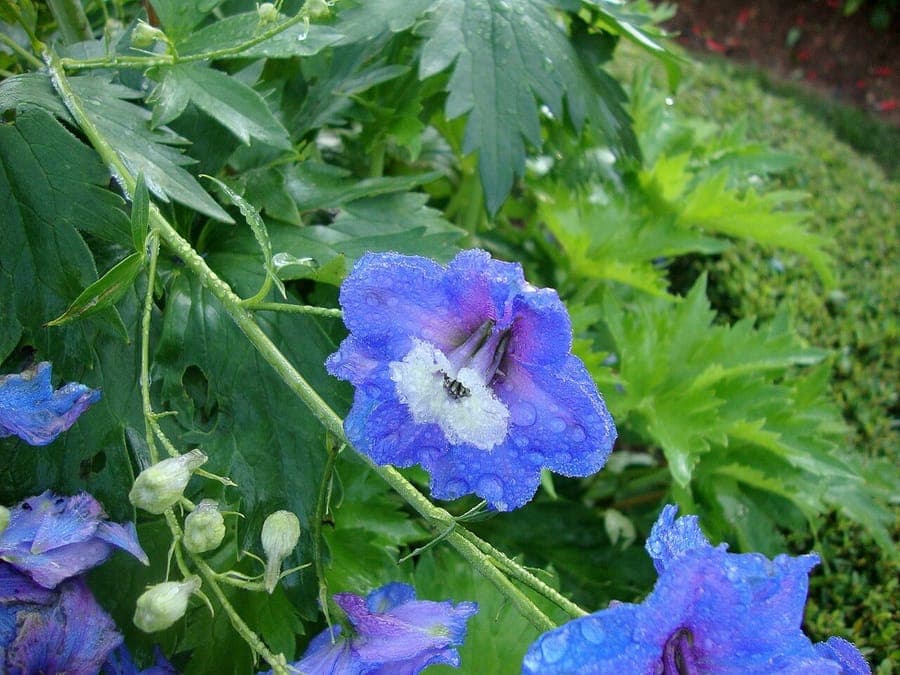
The flowers are 5 to 8 cm across and usually semi-double: a double ring of coloured sepals, often with a sheen or a second shade, around a conspicuous 'bee' at the centre. That bee may be white, black or matched to the petals, and it gives each cultivar much of its character. The photograph shows a blue flower with a white eye, with buds and the deeply cut foliage behind.
The main flowering comes in late June and July. Each spike opens from the bottom upwards and stays at its best for two to three weeks. Remove spent spikes promptly and a smaller second show often appears in September on short side shoots, though it is less reliable than with the Belladonna types.
Ideal location
Garden delphiniums want full sun and shelter from wind. A border backed by a hedge or wall, with enough space in front for air to move, is ideal. In an open, windy spot the heavy spikes can snap after a summer downpour even when staked.
Place the plants at the back of the border, 60 to 75 cm apart. They need room: crowded plants suffer more mildew and compete for food. A group of three or five of one cultivar has far more impact than single plants in mixed colours.
Soil requirements
These are hungry plants. They need deep, fertile, humus-rich soil that stays moist in summer and drains freely in winter. Dig the planting hole at least 40 cm deep and mix in two buckets of compost or well-rotted manure. Neutral to slightly alkaline ground with a pH of 6.5 to 7.5 gives the best results.
On heavy clay add coarse grit as well and set the crown slightly above the surrounding soil. On light sand add plenty of extra organic matter and expect to water more often. April is the best time to plant, when the soil is warming and slugs are still manageable.
Watering
From May until flowering the stems grow astonishingly fast, sometimes 5 cm a day, and the plant needs plenty of water. In dry spells give 10 to 15 litres per plant twice a week, at the base. A compost mulch holds moisture and feeds the soil at the same time.
Keep the foliage as dry as possible and water in the morning. After flowering you can ease off, unless you are hoping for a second flush. In winter give nothing, and never let water pool around the crown.
Free preview
Want to see Garden delphinium (Delphinium × cultorum): growing tall spires in your garden? Make a free preview of your design.
Staking, thinning and pruning
Staking. Put supports in early, when the stems are 30 to 40 cm tall, not when they are already leaning. The traditional method is one 1.5-metre cane per stem, with the stem tied in loosely every 30 cm. Simpler options are a metal ring support at two heights, or a cage of canes and twine around the whole clump. Supports should reach about two thirds of the final height.
Thinning. A mature clump often produces ten or more shoots in April. Leave five to seven on an established plant and two or three on a young one, snapping the weakest off at the base. Each remaining stem then gets more light and food and forms a longer, denser spike. The shoots you remove make good cuttings.
Pruning. After flowering cut the spike off below the lowest flower. For a second flush cut the whole stem back to just above the fresh foliage at the base, then feed and water. In autumn cut everything down to 10 cm. Wear gloves for all of these jobs.
Maintenance calendar
March: Scatter ferric phosphate slug pellets or put a barrier around the young shoots. Give a first dose of organic fertiliser.
April: Thin the shoots and root the thinnings as cuttings. Plant new delphiniums or divide old clumps.
May: Stake when stems reach 30 to 40 cm and tie in regularly. Feed again and water in dry weather.
June-July: Main flowering. Check ties after every heavy shower and watch for mildew.
August: Cut back spent stems. Feed lightly if you want a second flush.
September-October: Possible second flowering. Afterwards cut everything to 10 cm.
November-February: Dormant. Keep wet leaves off the crown.
Winter hardiness
Delphinium × cultorum is hardy to about -25 °C and needs no protection from cold in Britain. What kills plants is cold, wet soil in which the crown rots. Long-lived Elatum and Foerster cultivars can last ten years or more given good drainage and division every three or four years. Pacific hybrids often give up after two or three winters, so treat them as short-lived perennials.
Replace tired, woody clumps with young plants from cuttings. Basal cuttings 8 to 10 cm long, taken in April with a sliver of the white base, root in damp sharp sand in a cool, bright spot within a few weeks.
Toxicity to people and pets
Garden delphiniums are highly poisonous. Every part contains diterpenoid alkaloids that interfere with the signals from nerves to muscles; seeds and young shoots carry the highest levels. Because these plants are so large, they also produce a lot of prunings, and that is where much of the risk to animals lies.
In people, swallowing any part causes burning in the mouth and throat, nausea, vomiting and muscle weakness, and in serious cases heart rhythm disturbances and breathing problems. The sap may irritate skin, so wear gloves when thinning and taking cuttings. Dogs and cats can become ill from chewing stems or leaves. Delphinium poisoning in cattle and horses is well documented and small quantities can be fatal, so prunings belong on the compost heap, never in a field.
Teach children that flowers and seeds are not for eating. If you suspect someone has swallowed part of the plant, call NHS 111 or your doctor, or the emergency services if symptoms are severe. For a pet, contact your vet straight away.
Companion plants
A tall delphinium calls for partners that either echo its vertical line or soften it. Lupins (Lupinus polyphyllus) flower slightly earlier with the same spire shape in other colours. Peonies (Paeonia lactiflora) give round, heavy blooms at the base in June. Milky bellflower (Campanula lactiflora) and border phlox (Phlox paniculata) take over in July and August, so the border does not look empty once the delphiniums are over.
Thalictrum delavayi adds a cloud of tiny lilac flowers at the same height and softens the rigid spikes. Plant lower perennials in front of the delphiniums to hide the bare lower stems, which tend to look untidy after flowering.
Final thoughts
Garden delphiniums are for gardeners who enjoy the work. Rich soil, full sun, timely staking, thinning and feeding, and a battle with slugs in spring: that is the recipe for two-metre spires. If you would rather do less, the lower, branching Belladonna Group is a better choice. And wherever children or animals use the garden, keep the toxicity in mind.
To remember when to stake, feed and thin, use the plant calendar on gardenworld.app, which sends a reminder for each task at the right moment in the season.
Frequently asked questions about Garden delphinium
Is Garden delphinium winter hardy?
Delphinium × cultorum is hardy to about -25 °C and needs no protection from cold in Britain. What kills plants is cold, wet soil in which the crown rots.
How much water does Garden delphinium need?
From May until flowering the stems grow astonishingly fast, sometimes 5 cm a day, and the plant needs plenty of water. In dry spells give 10 to 15 litres per plant twice a week, at the base.
Where does Garden delphinium grow best?
Garden delphiniums want full sun and shelter from wind. A border backed by a hedge or wall, with enough space in front for air to move, is ideal.
What soil does Garden delphinium need?
These are hungry plants. They need deep, fertile, humus-rich soil that stays moist in summer and drains freely in winter.

See it in your garden
See Garden delphinium in your garden
One photo of your garden and a few questions. You see the result in about a minute.
Try it with a photoIdentify this plant in your own garden. Identify a plant
Similar plants
Washington lupin: complete guide
Lupinus polyphyllus
Everything you need to know about Washington lupin (Lupinus polyphyllus): care, planting, bloom season, and ideal garden companions for vibrant summer borders.
Milky Bellflower: complete guide
Campanula lactiflora
The Milky bellflower is an impressive perennial flowering plant. Learn how to cultivate and care for this striking tall campanula with our practical tips.
Garden peony: complete guide
Paeonia lactiflora
Everything about the garden peony (Paeonia lactiflora): planting depth, fragrant blooms, cultivars and long-term care. Expert tips for flowers that last a lifetime.
