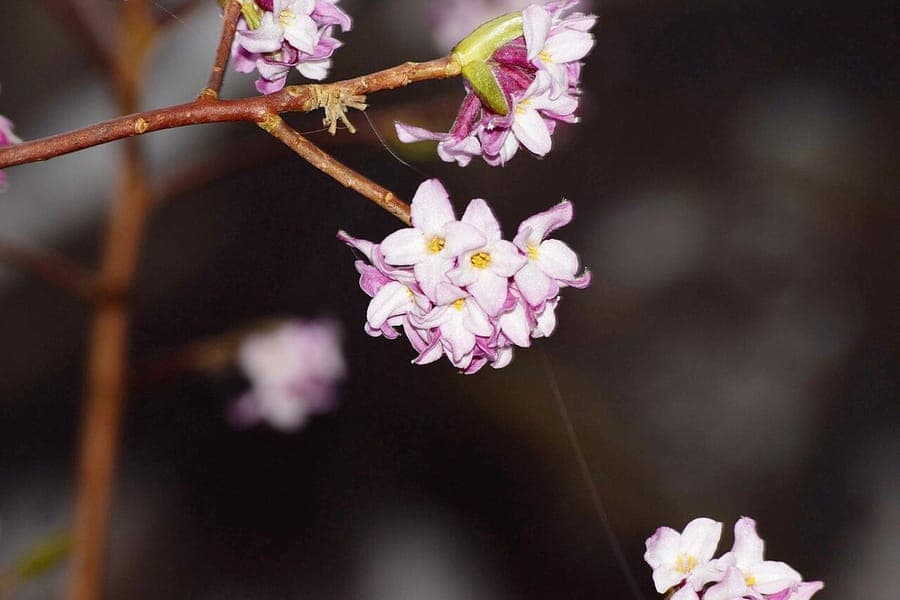
Rohit / CC BY-SA 4.0, via Wikimedia Commons
Daphne bholua: growing the Nepalese paper plant
Daphne bholua
Want to see Daphne bholua: growing the Nepalese paper plant in your garden?
Full design in HD: €7.99
Look after your Daphne bholua with the GardenWorld app
Identify plants with your camera and get a care calendar with reminders for this plant.


Overview
Few shrubs can stop you in your tracks in January, but Daphne bholua does it every year. In the bleakest weeks of winter its bare-looking stems carry clusters of pink and white flowers with a scent that drifts across the garden and greets you long before you see the plant. It is known in English as the Nepalese paper plant or Himalayan daphne, and most nurseries sell it as the cultivar 'Jacqueline Postill'.
The species belongs to the Thymelaeaceae family and comes from the Himalaya, where it grows wild from Nepal and Sikkim to Bhutan and south-west China, on forest edges and in clearings between roughly 1,700 and 3,500 metres. For centuries the tough, fibrous bark has been pounded into pulp and turned into lokta, the handmade paper of Nepal that is still produced today.
Before anything else, one point matters: every part of Daphne bholua is highly poisonous. A separate section below explains what that means in practice. If you are wondering where a winter-flowering shrub would work best in your own plot, gardenworld.app can create a garden design that takes account of light, shelter and the paths you actually use in winter.
Appearance and bloom cycle
Daphne bholua has an upright, rather narrow habit. In British and northern European gardens it usually reaches 1.5 to 2.5 metres in height and 1 to 1.5 metres across after ten years. The leaves are leathery, narrowly elliptic and 5 to 10 cm long, a matt mid-green.
Flowering starts in December or January, depending on the weather, and carries on into March. Deep purple-pink buds open into small star-shaped tubular flowers about 1.5 cm across, rosy on the outside and almost white within, gathered in dense heads at the shoot tips. The fragrance is sweet and spicy, strongest on a sunny, still afternoon.
Glossy, purple-black berries about 1 cm across may follow. Many garden plants set few or none, but when they do appear they look worryingly like small blueberries. Good cultivars include 'Jacqueline Postill' (strongly scented and largely evergreen), 'Darjeeling' (paler, often in flower from November), 'Peter Smithers' (deeper pink) and 'Gurkha' (deciduous and slightly tougher).
Toxicity: read this before planting
Daphne bholua is one of the most poisonous shrubs commonly grown in gardens. All parts contain irritant compounds, including daphnetoxin and mezerein: berries, seeds, bark, leaves, roots and sap. There are three main risks.
The berries. They hang at a child's eye level and look edible. Even a few can cause burning in the mouth and throat, swelling, vomiting, stomach cramps and bloody diarrhoea.
The bark and sap. Cutting or snapping stems releases sap that can redden and blister the skin. Always wear gloves and long sleeves when you prune, keep your hands away from your eyes and wash them afterwards. Do not leave prunings where animals can chew them.
Pets and livestock. Dogs, cats, rabbits, horses and grazing animals are just as vulnerable.
If you suspect someone has eaten part of the plant, rinse the mouth, do not induce vomiting and seek medical advice at once; in the UK you can call NHS 111 or go to A&E. For animals, phone your vet straight away. If you have toddlers or a dog that tastes everything, keep this shrub well away from play areas, or wait a few years before planting it.
Ideal location
Give Daphne bholua a sheltered spot in light shade, or in sun with some protection from the harshest summer afternoons. The base of a south- or west-facing wall is ideal: the brickwork softens hard frosts, and the plant is kept out of the drying east winds that scorch evergreen leaves. Above all, plant it where you walk past in winter, near the front door, beside a path or next to a terrace, so the scent is not wasted.
Choose the position carefully, because daphnes resent being moved. Their fine, brittle roots rarely recover well from transplanting, so think of it as a permanent planting. In a large container of at least 40 litres it can thrive for several years, provided drainage is excellent and the pot stands against a sheltered wall in winter.
Free preview
Want to see Daphne bholua: growing the Nepalese paper plant in your garden? Make a free preview of your design.
Soil requirements
The ideal soil is rich in humus, retains moisture and yet drains freely, so that it never dries out in summer and never sits wet in winter. A light loam with plenty of organic matter suits it perfectly. It is happy in mildly acid to neutral conditions and will grow on slightly chalky soils provided they do not become too dry.
On heavy clay, work generous amounts of leaf mould and grit into the top 40 cm before planting. On thin, sandy soil, add well-rotted compost or leaf mould to the planting hole. Never plant deeper than the plant sat in its pot, as a buried stem base is prone to rot. A 5 cm mulch of leaf mould or composted bark each spring keeps the roots cool and evenly moist.
Watering
Regular watering matters in the first year. In dry spells give a full 10-litre can each week, aimed at the root ball.
Daphnes dislike both extremes. Drought weakens the plant and costs next winter's buds, while waterlogging in poorly drained soil leads to root rot and the notorious sudden collapse for which the genus is known. Check with your finger first: if the soil is still moist 5 cm down, wait. Container plants need watering twice a week in summer and only occasionally in winter, during dry, frost-free weather.
Pruning
Daphne bholua needs very little pruning, which is just as well, because it recovers slowly from hard cuts. Straight after flowering, in March or April, remove only dead, damaged or awkwardly placed shoots. An over-long stem can be shortened to just above a leaf or side shoot. Never prune in autumn or early winter, or you will remove the flower buds.
Always wear gloves and use clean, sharp secateurs. Put prunings in the green waste bin rather than on a heap where pets or children might find them.
Maintenance calendar
January to March: Peak flowering. Cut a few sprigs for a small vase indoors, wearing gloves.
March to April: Light tidy-up straight after flowering. Scatter a handful of organic shrub fertiliser around the base and apply a mulch of leaf mould.
May to June: New shoots extend. Check the soft tips for aphids; a sharp jet of water usually deals with them.
July to August: Water during dry spells. Remove any berries if children or pets use the area.
September to October: Next winter's flower buds are forming. Stop feeding and do not prune.
November to December: Keep horticultural fleece to hand for hard frosts. Move containers against a sheltered wall.
Winter hardiness
Daphne bholua is only moderately hardy. The Royal Horticultural Society rates both the species and 'Jacqueline Postill' as H4, which corresponds to roughly -5 to -10 °C. Established plants in a sheltered position often survive brief dips to around -12 °C, though they may lose some leaves. Deciduous forms such as 'Gurkha' are a little tougher.
That means it grows well across most of southern and western Britain, in towns and against house walls, and in mild parts of the Low Countries and France. In colder or more exposed gardens, choose your most sheltered spot. For the first two winters, wrap young plants in a double layer of fleece when forecasts drop below -8 °C, and remove it once the weather turns milder.
Companion plants
Pair Daphne bholua with other plants that earn their keep in winter. Around its feet, Lenten roses (Helleborus orientalis), snowdrops (Galanthus nivalis) and Cyclamen coum all flower at the same time and enjoy the same humus-rich soil.
For colour and structure behind it, the red stems of Cornus alba are hard to beat. Skimmia japonica adds evergreen leaves and red berries or buds, though skimmia is also poisonous, so think twice about the combination if young children play nearby.
Final thoughts
Daphne bholua is not a plant for every garden, but nothing else gives you quite this much scent in the depths of winter. Give it shelter, a humus-rich soil that never bakes and never floods, and a place close to the house, and it will reward you year after year. The price is its toxicity: plant it knowingly, always wear gloves and keep children and animals away from the berries.
The plant calendar on gardenworld.app reminds you when each job is due, so you will not miss the light trim straight after flowering. Plant your Daphne bholua in spring or early autumn, and next winter you will smell for yourself why gardeners go out of their way to find it.
Frequently asked questions about Daphne bholua
Is Daphne bholua winter hardy?
Daphne bholua is only moderately hardy. The Royal Horticultural Society rates both the species and 'Jacqueline Postill' as H4, which corresponds to roughly -5 to -10 °C.
When and how do you prune Daphne bholua?
Daphne bholua needs very little pruning, which is just as well, because it recovers slowly from hard cuts. Straight after flowering, in March or April, remove only dead, damaged or awkwardly placed shoots.
How much water does Daphne bholua need?
Regular watering matters in the first year. In dry spells give a full 10-litre can each week, aimed at the root ball.
Where does Daphne bholua grow best?
Give Daphne bholua a sheltered spot in light shade, or in sun with some protection from the harshest summer afternoons. The base of a south- or west-facing wall is ideal: the brickwork softens hard frosts, and the plant is kept out of the drying east winds that scorch evergreen leaves.
What soil does Daphne bholua need?
The ideal soil is rich in humus, retains moisture and yet drains freely, so that it never dries out in summer and never sits wet in winter. A light loam with plenty of organic matter suits it perfectly.

See it in your garden
See Daphne bholua in your garden
One photo of your garden and a few questions. You see the result in about a minute.
Try it with a photoIdentify this plant in your own garden. Identify a plant
Similar plants
Lenten-rose: complete guide
Helleborus orientalis
Learn how to grow and care for Helleborus orientalis. This early-blooming perennial thrives in shady spots and flowers from February to April, adding colour when little else is blooming.
Common snowdrop: complete guide
Galanthus nivalis
Common snowdrop growing guide. The world's most familiar snowdrop with delicate white pendant flowers.
Cyclamen coum: complete guide
Cyclamen coum
Spring cyclamen (Cyclamen coum) is a delicate plant with heart-shaped leaves and pink flowers blooming early.
