
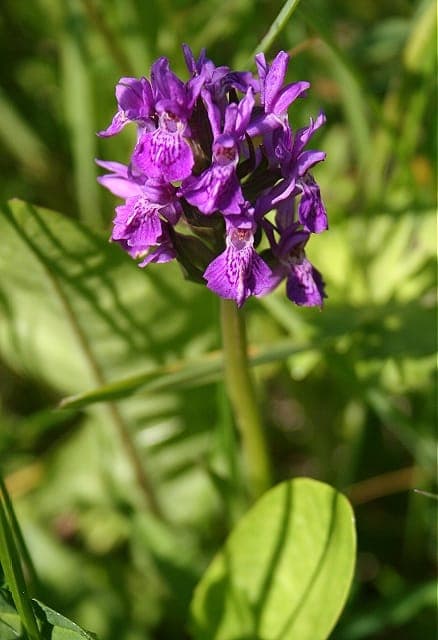
Anne Burgess / CC BY-SA 2.0, via Wikimedia Commons
Dactylorhiza purpurella: complete guide
Dactylorhiza purpurella
Want to see Dactylorhiza purpurella: complete guide in your garden?
1 minute, no credit card
Overview
Dactylorhiza purpurella, commonly called Northern Marsh-orchid or Purperrode Orchis, is a moisture-loving orchid native to North European regions, particularly British Isles, Scandinavia, and Netherlands. With purple flowers and characteristic spotted leaves, this orchid is uniquely appealing.
Appearance and Bloom
The plant forms rosette-like leaf bases with elongated, dark green foliage bearing distinctive dark spots and blotches. May through July produces stiff flower spikes with purple to magenta blooms. Plants reach 30-50 centimeters and grow in small clusters.
Ideal Location
Northern marsh-orchid thrives in semi-waterlogged wetland areas with high summer groundwater tables. Prefers half-shade to full sun with morning sun preferred. Position in natural marsh ecosystems or artificial water features with rich water supply.
Soil
This orchid grows on highly moisture-retentive, humus-rich mineral soils. pH range is weakly acidic to neutral (6-7). High humus content is essential; peaty wetland substrate with accumulated plant material is ideal. Avoid artificial fertilization.
Watering
Maintain constantly high soil moisture during growing season (April-September). Water should remain 10-15 centimeters high or groundwater very near surface. After blooming, gradually reduce moisture for winter dormancy.
Pruning
Pruning limited to removing faded flower spikes after blooming (July-August). Allow wild growth as excessive pruning damages the orchid. Remove only dead material.
Free design
Want to see Dactylorhiza purpurella: complete guide in your garden? Make a free design now.
Maintenance Calendar
April: Begin growing period, monitor soil moisture. May-June: Full growth, water regularly. July-September: Blooming, peak water management. October-November: Reduce watering, prepare dormancy. December-February: Minimal moisture, maintain groundwater only. March: Prepare growth restart, gradually increase moisture.
Winter Hardiness
Dactylorhiza purpurella is very hardy for North European climates. Plant actually flowers better after severe winters, especially moderate frost. Winter protection unnecessary; location should remain frost-free but fully saturated.
Companion Plants
Northern marsh-orchid pairs beautifully with other wetland orchids like Dactylorhiza fuchsii, Epipactis palustris, and Limodorum abortivum. Smaller wetland plants like water-violet and water-soldier provide support. Include in wild marsh ecosystems with reeds, sedges, and purple loosestrife.
Final Thoughts
Northern marsh-orchid is a unique wild orchid for moisture-rich gardens. With minimal care requirements, ecological value, and stunning purple flowers, this orchid offers years of natural beauty. Select established marsh ecosystems or artificial water features with rich water discharge. Not available in regular garden centers; contact specialist growers. Visit gardenworld.app for wild plant inspiration.
Discover more wild orchids on gardenworld.app guides!
Want to see Dactylorhiza purpurella: complete guide in your garden? Make a free design now.
Upload a photo, pick a style, and get a photorealistic design with plant list in under a minute.
10,000+ gardens designed already
No credit card required


Similar plants
Ram's-head lady's slipper: complete guide
Cypripedium arietinum
Everything you need to know about growing Cypripedium arietinum, a rare woodland orchid for cool, moist garden settings. Soil, care and planting tips.
Sparrow's-egg lady's slipper: complete guide
Cypripedium passerinum
Everything about growing Cypripedium passerinum, a cold-hardy subarctic orchid suited to cool, moist, shaded garden spots. Soil, care and companion plants.
Algerian Butterfly-orchid: complete guide
Platanthera algeriensis
Everything about Platanthera algeriensis, the rare Mediterranean orchid with greenish flowers native to Algeria, Morocco, Corsica and Spain.