
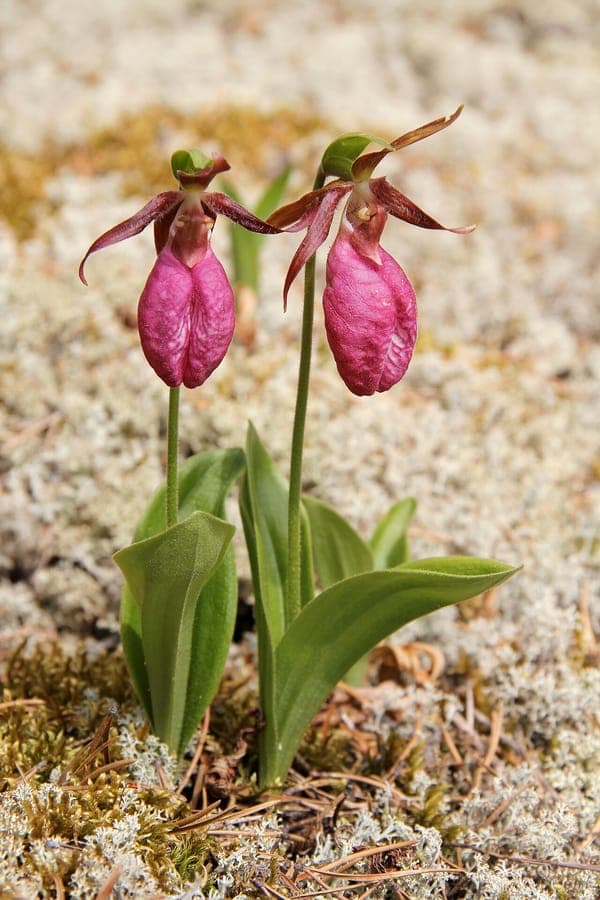
Sasata (edited by Noodle snacks / CC BY-SA 3.0, via Wikimedia Commons
Pink lady's-slipper: complete guide
Cypripedium acaule
Want to see Pink lady's-slipper: complete guide in your garden?
1 minute, no credit card
Pink Lady's-Slipper (Cypripedium acaule), also known as Moccasin Flower or Stemless Lady's-Slipper, is an enchanting native North American orchid belonging to the family Orchidaceae. This rare, protected plant grows naturally in mixed and coniferous forests from Canada to the Southeastern United States and is a highlight for experienced gardeners and ecologically oriented heritage plant enthusiasts.
The plant forms a horizontal growth habit with two broad, ribbed leaves the size of a hand, dark green and elegant. In May-June, depending on climate, a single flower stem rises bearing one, occasionally two, spectacular blooms. Each flower features a large, pink to white-pink labellum (lip) measuring 5-7 cm, with darker pink or purple-red veining. The rest of the flower consists of lance-shaped sepals and petals in red-purple to white.
This is a "slipper" orchid in the truest sense: the labellum is a specialized trap for pollinators. Insects are attracted to sweet fragrance, enter the 'slipper' opening, and exit via upper ports, carrying pollen.
Growing requirements and location
Pink Lady's-Slipper grows in partial to full shade, typically beneath deciduous or coniferous trees on forest soil. Direct sunlight is harmful and causes leaf scorch. Ideal is a location receiving 2-4 hours of indirect morning sun, with protection from afternoon sun.
The plant is hardy in USDA zones 3 to 8, tolerating very cold winters. It thrives in cool, temperate climates. In southern zones, it may perform poorly or not survive outside very shady, moist, cool microclimates.
Soil - critically important
This is the challenge. Pink Lady's-Slipper inhabits very acidic, humus-rich soil (pH 4.5 to 5.5) composed largely of decomposing leaf material. Commercial orchid potting mix does NOT work. You must:
- Use acidic larch bark (pine tree bark) - not regular tree bark.
- Add native humus: leaf compost made from rotting leaf litter from forests. This is essential.
- Ensure drainage: soil must drain very well, yet retain moisture.
- Avoid fertilizer. The plant works with mycorrhizal fungi (symbiotic root associations); fertilizer destroys this relationship.
Many garden culture attempts fail due to incorrect soil chemistry. This is not something you can improvise around.
Site preparation
Landscape this orchid beneath trees, in shady corners or woodland edges where forest conditions are imitated: moist, cool, acidic, humus-rich soil. If you lack a natural forest environment, create a small "forest bed" by:
- Excavating to approximately 20 cm depth.
- Adding acidic larch bark (60%), leaf compost (30%), sand (10%).
- Adjusting pH to 4.5-5.5 with sulfur or acid amendment if needed.
- Mulching with dark leaf compost.
Avoid very wet areas, but also ensure soil does not completely dry out.
Free design
Want to see Pink lady's-slipper: complete guide in your garden? Make a free design now.
Planting
Best plant in autumn (September-October) so the plant can prepare for winter. Plant carefully - do not damage fine roots. The labellum (slipper-shaped lip) must be visible above ground, with both leaves fully above soil.
Depth is important: the plant's crown (where leaves emerge) must be at ground level, not underground. Water carefully after planting.
Watering and humidity
Pink Lady's-Slipper dislikes stagnant water but accepts and requires consistent soil moisture. Water deeply but carefully once weekly during growth period (April-July), more if very dry. In winter, water minimally.
Humidity: the plant grows better with higher air humidity (55-75%), but this is difficult to control in gardens.
Maintenance and growth years
This is a plant of patience. The first 3 years after planting, it may remain dormant, forming leaves without flowering. This is NORMAL. Flowering usually begins in year 3-4 or later. Some plants flower sporadically, then suddenly bloom profusely one year.
Remove withered leaves carefully in autumn, but do not disturb the root zone. No pruning needed.
Winter
Breaking dormancy is ESSENTIAL. The plant must undergo a cold winter (below 15 degrees Celsius for months). Without this winter period, it will likely not flower.
In very mild climates (southern England, southern America), winter cold may be insufficient. Consider overwintering in a cool house if needed.
Pests and diseases
Rot and fungal diseases are the primary concerns, usually from overwatering or incorrect soil. Improve through better drainage. Slugs may eat young leaves.
Virus can occur; infected plants show spots on leaves. Destruction of infected material is the only option.
Propagation
Seed: Cypripedium seed requires highly specialized treatment - symbiosis with specific fungi is necessary for germination. This is not practical for hobbyists.
Division: Carefully split the plant in autumn or early spring if growth groups are clearly separated. This is risky and harms the plant.
Conservation and ethics
This orchid is protected in many states and provinces. Check local regulations before collecting wild seed or plants. North American nurseries grow this from seed for trade.
Buy only from reputable growers offering seed-grown material. Wild harvest is devastating and illegal.
Recommendations for gardenworld.app
This is NOT an easy plant for beginners. It suits:
- Experienced orchid growers
- Wildflower gardens with acidic soil
- Heritage and native plant collectors
- Cold-climate gardens (zones 3-6)
For milder zones or inexperienced gardeners: consider the similar European orchid Cypripedium calceolus, which has similar requirements but sometimes more hardiness.
Planting recommendations: Install beneath existing trees in woodland-like gardens, not in full sun. Group 3-5 plants together for dramatic effect when flowering.
Conclusion: Pink Lady's-Slipper is not a "plant and forget" species. It requires research-oriented culture, patience, and reverence for natural support systems. The reward - elegant, native orchid flowers in your own garden - is priceless.
Want to see Pink lady's-slipper: complete guide in your garden? Make a free design now.
Upload a photo, pick a style, and get a photorealistic design with plant list in under a minute.
No credit card required


Similar plants
Ram's-head lady's slipper: complete guide
Cypripedium arietinum
Everything you need to know about growing Cypripedium arietinum, a rare woodland orchid for cool, moist garden settings. Soil, care and planting tips.
Sparrow's-egg lady's slipper: complete guide
Cypripedium passerinum
Everything about growing Cypripedium passerinum, a cold-hardy subarctic orchid suited to cool, moist, shaded garden spots. Soil, care and companion plants.
Algerian Butterfly-orchid: complete guide
Platanthera algeriensis
Everything about Platanthera algeriensis, the rare Mediterranean orchid with greenish flowers native to Algeria, Morocco, Corsica and Spain.