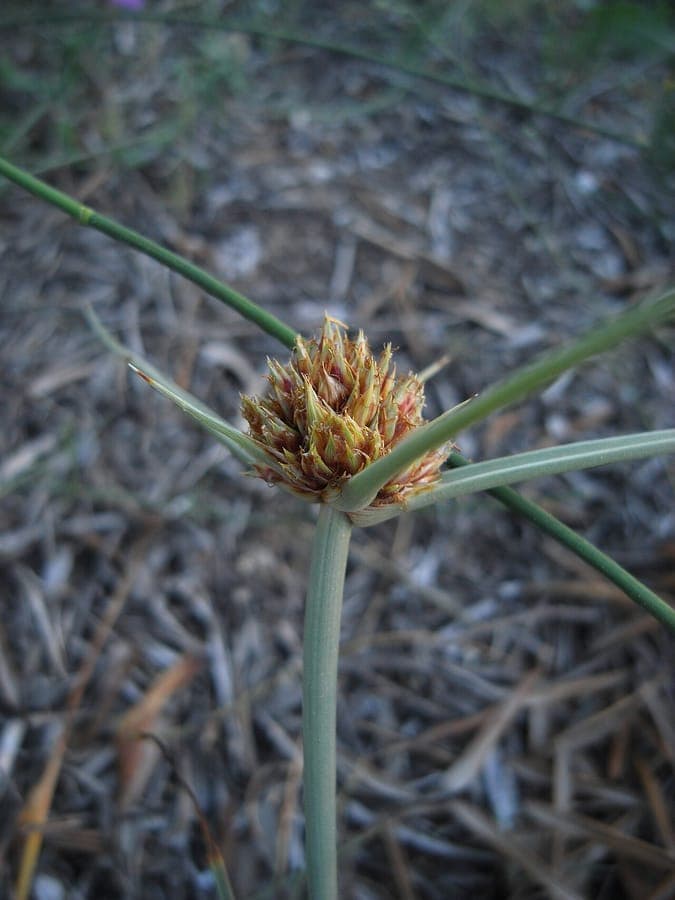
Denis Barthel / CC BY-SA 3.0, via Wikimedia Commons
Cyperus capitatus: complete guide
Cyperus capitatus
Want to see Cyperus capitatus: complete guide in your garden?
Full design in HD: €7.99
Look after your Cyperus capitatus with the GardenWorld app
Identify plants with your camera and get a care calendar with reminders for this plant.


Overview
Cyperus capitatus, also known as "Knick sedge" or "Dune sedge", is an elegant grass-like plant from the Mediterranean region and North Africa. The plant is known for its ornamental value and is widely used in modern gardens. It is a perennial plant that reaches 15-30 cm in height.
Appearance and bloom
The plant has very fine, gray-green foliage that grows in elegant clumps. The plant forms characteristic, spherical flower heads (capitules) that are golden to brownish in color. These appear from May to October. After flowering, the structures remain decorative for a long time.
Ideal location
Cyperus capitatus loves sun and can also grow in partial shade. Plant it in a very sunny spot with well-draining soil. The plant is suitable for dry slopes, rock gardens and Mediterranean gardens.
Soil type
Use very well-draining, sandy or stony garden soil. The plant thrives on poor soils where many other plants do not flourish. Ensure good drainage as wet feet are not desired.
Watering
Water very minimally. After planting, water until established. After that virtually no water is needed. The plant is very drought-tolerant and withstands long dry periods.
Free preview
Want to see Cyperus capitatus: complete guide in your garden? Make a free preview of your design.
Pruning
Pruning is not really necessary. You can remove dead foliage. After flowering, you can remove the browned flower heads if you find that more aesthetic.
Maintenance calendar
In spring (March-April) plant or divide existing plants. May through October the plant flowers and shows ornamental value. November through February is dormancy. Winter pruning (removing dead parts) can be done in late winter.
Winter hardiness
Cyperus capitatus is moderately winter-hardy in temperate climates. In northern Europe it grows outdoors in dry, protected spots. The plant tolerates temperatures down to about -5 to -10 degrees Celsius.
Companion plants
Cyperus capitatus combines beautifully with other Mediterranean plants such as lavender, sage and santolina. It also looks lovely among stones, gravel and other drought-loving plants.
Conclusion
Cyperus capitatus is a beautiful plant for modern gardens and xeriscape projects. It provides elegance and texture with minimal maintenance. The plant is available from specialized plant nurseries. Visit gardenworld.app for more inspiration and plant advice.
Frequently asked questions about Cyperus capitatus
Is Cyperus capitatus winter hardy?
Cyperus capitatus is moderately winter-hardy in temperate climates. In northern Europe it grows outdoors in dry, protected spots.
When and how do you prune Cyperus capitatus?
Pruning is not really necessary. You can remove dead foliage.
How much water does Cyperus capitatus need?
Water very minimally. After planting, water until established.
Where does Cyperus capitatus grow best?
Cyperus capitatus loves sun and can also grow in partial shade. Plant it in a very sunny spot with well-draining soil.
What soil does Cyperus capitatus need?
Use very well-draining, sandy or stony garden soil. The plant thrives on poor soils where many other plants do not flourish.

See it in your garden
See Cyperus capitatus in your garden
One photo of your garden and a few questions. You see the result in about a minute.
Try it with a photoIdentify this plant in your own garden. Identify a plant
Similar plants
Carex conica: a small evergreen sedge for edges
Carex conica
Carex conica is a compact evergreen sedge from Japan and Korea. A guide to 'Snowline', where to plant it, soil, tidying, dividing and how hardy it really is.
Carex oshimensis: the evergreen striped sedge
Carex oshimensis
Carex oshimensis is an evergreen Japanese sedge with fine, striped leaves. How to plant, place, tidy and divide 'Evergold' and the EverColor series in your garden.
Orange New Zealand sedge (Carex testacea): a guide
Carex testacea
Orange New Zealand sedge (Carex testacea) turns copper and orange in sun and cold. Where to plant it, which soil it likes, how to tidy it and how hardy it is.
