
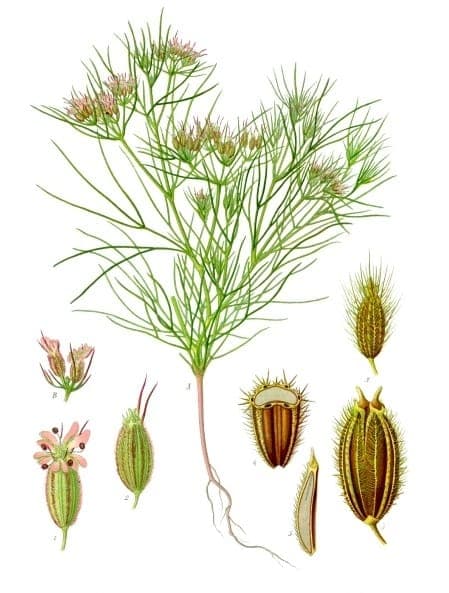
Franz Eugen Köhler, Köhler's Medizinal-Pflanzen / Public domain, via Wikimedia Commons
Cumin: complete guide
Cuminum cyminum
Want to see Cumin: complete guide in your garden?
1 minute, no credit card
Overview
Cumin (Cuminum cyminum) is an annual herb crop native from Iraq to Afghanistan. This slender-growing herb is cultivated primarily for its distinctive seeds with intense, warm-spicy flavor. Cumin seeds are essential in Asian and South American cuisines.
Appearance and Bloom Cycle
Cumin plants grow 30-50 cm tall with fine, hair-like leaves. The plant features a branched stem with small, delicate flowers in pink or white. Flowering occurs from March to May, followed by seed set. Seeds ripen to a brownish color.
Ideal Location
Cumin demands full sun with at least 6-8 hours direct light daily. The plant loves warm, dry climate. Plant in a sheltered location exposed to maximum warmth. Avoid windy spots that could break the slender stems.
Soil Requirements
Cumin grows best in well-draining, sandy soil with pH 6.5-8.0. The plant prefers less fertile soil than many vegetables. Mix sand through heavy soil to improve drainage. Add moderate compost for structure.
Watering
Water moderately, about 1-2 cm weekly. Cumin is drought tolerant and prefers relatively dry conditions. Excess water can lead to disease and root rot. In wet seasons, less water may be needed.
Free design
Want to see Cumin: complete guide in your garden? Make a free design now.
Pruning
Pruning is not necessary. Allow the plant to grow naturally. For maximum seed production, you can remove weak side shoots to concentrate energy into main stems.
Maintenance Calendar
April: Sow in full ground when temperature is consistently 15°C or higher. May: Seedlings emerge, thin to 15 cm spacing. June-July: Plant growth accelerates, minimal care needed. August: Flowering peaks, observe pollinators. September: Seeds ripen, harvest when brown and dry.
Winter Hardiness
Cumin is very sensitive to cold and frost. USDA zones 9-11 are needed for winter survival. Outside these zones, harvest before first frost and resow next season.
Companion Plants
Dill and fennel grow well alongside cumin. Oregano and thyme share the same preference for dry, warm locations. Coriander is a closely related herb with similar growing requirements.
Closing
Cumin cultivation brings warm-climate flavors to your garden. Though it demands some care for optimal growth, it rewards with rich seed harvests. Design your herb garden on gardenworld.app and visualize your spice garden. Learn more herb cultivation tips on gardenworld.app.
Want to see Cumin: complete guide in your garden? Make a free design now.
Upload a photo, pick a style, and get a photorealistic design with plant list in under a minute.
No credit card required


Similar plants
Whorled carrot: complete guide
Daucus involucratus
Daucus involucratus is a Mediterranean umbellifer with white flower heads framed by lacy bracts. Growing this gravel garden gem.
Daucus muricatus: complete guide
Daucus muricatus
Daucus muricatus, the spiny wild carrot, grows wild on Mediterranean coasts. Discover sowing, June-July bloom, and wildflower meadow use.
Daucus pumilus: complete guide
Daucus pumilus
Daucus pumilus is a dwarf wild carrot relative with white lacy umbels, thriving on dunes and coastal rock in poor, fast-draining soil.