
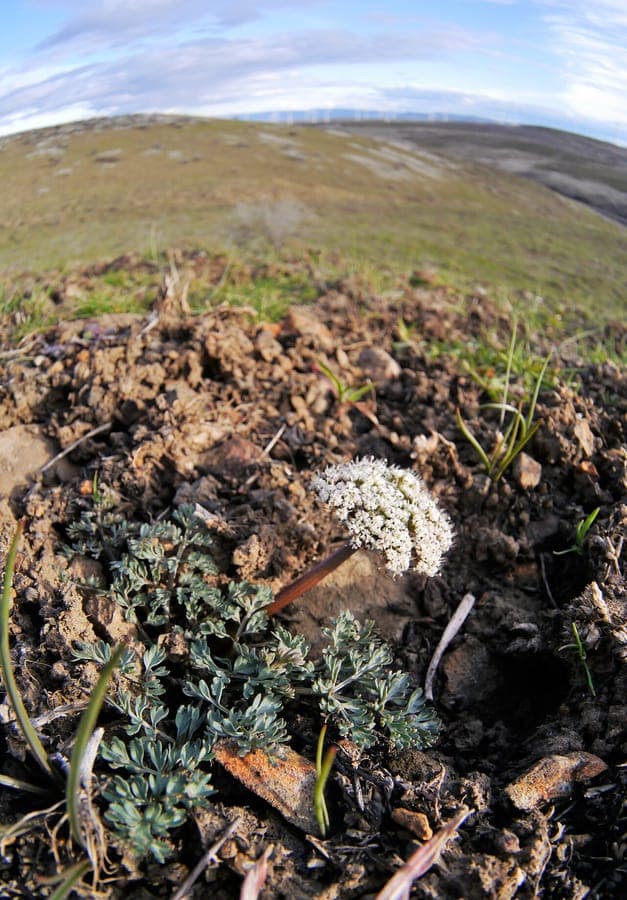
Thayne Tuason / CC BY-SA 4.0, via Wikimedia Commons
Canby's biscuitroot: complete guide
Lomatium canbyi
Want to see Canby's biscuitroot: complete guide in your garden?
1 minute, no credit card
Overview
Lomatium canbyi, commonly known as Canby's biscuitroot or Canby's desert-parsley, is a perennial herb belonging to the carrot family (Apiaceae). First formally described in 1900 by botanists Coulter and Rose, it was named in honour of William Canby, a nineteenth-century American botanist and plant collector. Native to the western United States - specifically California, Idaho, Nevada, Oregon, and Washington - this plant has evolved to thrive in some of the most challenging growing conditions in North America.
In its native range, Lomatium canbyi occupies open, rocky or gravelly slopes, dry grasslands, and shrub-steppe communities at various elevations. It is an ecologically important plant, providing early-season nectar to native pollinators and forming part of the structural plant community in semiarid landscapes. For gardeners interested in drought-tolerant, ecologically meaningful plants, it represents a genuinely interesting option. At gardenworld.app you can explore how plants like this one can transform a dry, sunny front garden into a low-maintenance, wildlife-friendly space.
Appearance and bloom cycle
Lomatium canbyi grows as a rhizomatous herb, meaning it forms underground rhizomes from which fresh stems emerge each spring. This growth habit gives it excellent persistence: even if the above-ground portions die back in summer heat or winter cold, the plant regenerates reliably from its root system.
The foliage is finely textured and deeply divided, with the feathery appearance typical of Apiaceae family members. The leaves are bright green and bear a resemblance to the foliage of wild parsley or fennel, although considerably more compact. The overall plant size remains modest, rarely producing broad masses of vegetation.
Flowers are white and conspicuous, arranged in the characteristic compound umbels of the carrot family - flat-topped or slightly convex clusters composed of dozens of tiny individual florets. These blooms appear in early spring to early summer, providing one of the earlier nectar sources for bees and small pollinating insects at a time when flowering plants are still scarce. After flowering, small brown fruits develop; they are not showy but contain viable seed that can be used for propagation.
The white flowers create an attractive contrast when planted alongside blue or purple companions, and the fine-textured foliage remains attractive for several weeks even outside the bloom period.
Ideal location
Full sun is the non-negotiable requirement for Lomatium canbyi. In its native habitat it grows in open, unshaded terrain, and it performs poorly in partial shade. A south-facing or southwest-facing position is ideal in European gardens, providing maximum light intensity and warmth through the growing season.
The plant is at home in dry, open settings - rocky gardens, gravel gardens, dry prairie borders, and xeriscapes. It dislikes sheltered, humid spots where air circulation is poor. Good airflow around the plant reduces the risk of fungal problems, which can be the main health threat in wetter climates.
Hardiness-wise, Lomatium canbyi is rated for USDA zones 5 through 9. This means it can survive winter temperatures down to around -15 degrees Celsius, making it suitable for most of Western and Central Europe. The key condition is well-drained soil; cold combined with waterlogged roots is the most common cause of failure in cultivation.
Soil
Lomatium canbyi strongly prefers lean, free-draining soil with a pH ranging from 6.0 to 8.5. It is adapted to rocky, sandy, or gravelly substrates and performs poorly in fertile, moisture-retentive soils. Rich soil tends to produce lush but floppy growth and can reduce flowering.
When planting in heavier garden soil, work in generous amounts of grit, coarse horticultural sand, or perlite to improve drainage. Raised beds or rock garden pockets are excellent environments, as they allow water to move away from the root zone rapidly after rain. A layer of gravel mulch at the soil surface can further protect the crown from sitting in moisture.
Fertilising is generally counterproductive for this plant. If the soil is genuinely impoverished beyond even its tolerance, a light application of a low-nitrogen granular fertiliser in early spring is sufficient. Avoid high-nitrogen feeds, which promote soft, disease-prone growth at the expense of the compact, drought-adapted habit that makes this plant valuable.
Watering
Once established, Lomatium canbyi requires very little supplemental water. This is one of its most valuable traits for low-maintenance gardening in dry climates or during summer drought periods. The plant's rhizomatous root system stores moisture efficiently and allows it to persist through extended dry spells.
During the first growing season after planting, more regular watering is needed to help the plant develop a strong root system. Water thoroughly once or twice per week in the absence of rain, allowing the soil to dry out between sessions. Avoid keeping the soil constantly moist, as this encourages shallow rooting and reduces the plant's drought adaptation.
Once established - typically after a full growing season - the plant can largely fend for itself through dry summers. In prolonged drought, a deep watering once a month is enough to sustain it. In Northern European climates with moderate summer rainfall, additional irrigation is rarely needed at all.
Free design
Want to see Canby's biscuitroot: complete guide in your garden? Make a free design now.
Pruning
Lomatium canbyi requires minimal pruning. The plant is naturally compact and does not need cutting back to maintain its shape. After flowering, spent flower stems can be removed if a tidier appearance is preferred, but leaving them provides seed for natural regeneration and attractive winter structure.
In autumn, as the plant dies back, the old stems can be cut to near ground level. This encourages a clean start in spring. In mild-winter areas where some foliage persists, wait until late February or early March before cutting back, just as new growth is beginning to emerge from the rhizomes.
Always clean your cutting tools after working with Apiaceae family members. The sap of many plants in this family can cause photosensitive skin reactions - a condition where the skin becomes irritated when exposed to sunlight after contact with the plant. Wearing gloves is a sensible precaution.
Maintenance calendar
February to March: Clear away old stems if not already done in autumn. Refresh the gravel mulch layer if it has thinned over winter. Check drainage around the plant base.
April: Watch for the emergence of new growth from the rhizomes. If planting this year, this is a good time to install young plants before hot weather arrives.
May to June: Peak bloom period. Enjoy the white umbel flowers and observe the insect activity they attract. No intervention needed unless plants show signs of disease or pest damage.
July to August: Fruit ripening and seed dispersal. If collecting seed for propagation, harvest the heads just as they begin to turn brown but before they scatter. In dry summers, one deep watering per month may be beneficial.
September to October: The plant begins to die back naturally. This is a good time to assess expansion of the rhizome colony and divide if needed.
November to January: Dormancy. Ensure drainage remains good through wet winter periods. No other action needed.
Winter hardiness
Lomatium canbyi is reliably hardy in USDA zones 5 to 9, tolerating temperatures down to approximately -15 degrees Celsius. In the UK, the Netherlands, Belgium, and much of France and Germany, it should overwinter without any special protection, provided it is grown in well-drained soil.
The greatest winter threat in Northwestern European climates is not cold but persistent moisture. Wet, poorly drained soil around the rhizomes through winter can cause rot. A gravel mulch over the root zone, applied in October, significantly reduces this risk by keeping the crown area drier and preventing soil compaction from rain.
Young plants in their first winter are more vulnerable than established specimens. Covering with a light layer of dry bracken or open-structured straw provides some insurance against severe frost while still allowing air movement. Remove this protection as soon as temperatures rise above freezing in late winter.
Companion plants
Lomatium canbyi combines well with other drought-tolerant plants that share its preference for lean, sunny conditions. In a prairie or steppe-style planting, consider pairing it with blue oat grass (Helictotrichon sempervirens), blue fescue (Festuca glauca), and low-growing sages such as Salvia nemorosa. The white umbels of Lomatium stand out beautifully against blue and purple companions.
For a rock garden, combine it with stonecrop (Sedum), thyme (Thymus), and other mat-forming xerophytes. Its fine, feathery foliage provides a textural contrast to the broader leaves of sedums or the needle-like foliage of some alpine plants.
Other Apiaceae relatives make natural partners - species like Eryngium (sea holly) or native umbellifers complement the white flowers and fine foliage. Ornamental bulbs such as alliums also pair well, as they share the same dry, sunny preferences and offer visual interest at different points in the season. You can see examples of dry, flowering front garden designs at gardenworld.app, where real garden projects combine these kinds of plants into cohesive, low-water landscapes.
Closing
Lomatium canbyi is a plant that rewards those willing to look beyond the usual garden centre offerings. It is resilient, drought-tolerant, and ecologically meaningful - providing early nectar to pollinators at a time when little else is in bloom. Its compact habit, white spring flowers, and low maintenance requirements make it an excellent candidate for dry borders, rock gardens, gravel gardens, and prairie-style plantings.
While it may not be a household name in European gardens, specialist nurseries focusing on native and prairie plants carry it or can source it. Once established, it is a reliable long-term resident that returns faithfully year after year with minimal attention. In an era when water-wise, ecologically sound gardening is increasingly valued, plants like Lomatium canbyi deserve a wider audience.
Want to see Canby's biscuitroot: complete guide in your garden? Make a free design now.
Upload a photo, pick a style, and get a photorealistic design with plant list in under a minute.
10,000+ gardens designed already
No credit card required


Similar plants
Meadow vetchling (Lathyrus pratensis): complete guide
Lathyrus pratensis
Discover meadow vetchling, a vital host plant for butterflies. Growing tips, June-July bloom, and role in biodiversity gardens.
English Lavender: complete guide
Lavandula angustifolia
Everything about English Lavender (Lavandula angustifolia): planting, pruning, care and overwintering. Practical tips for lush purple blooms.
Oxeye daisy: complete guide
Leucanthemum vulgare
Oxeye daisy is a robust perennial flower with classic white-yellow flower heads. Learn how to grow this abundant wildflower for summer meadows.