
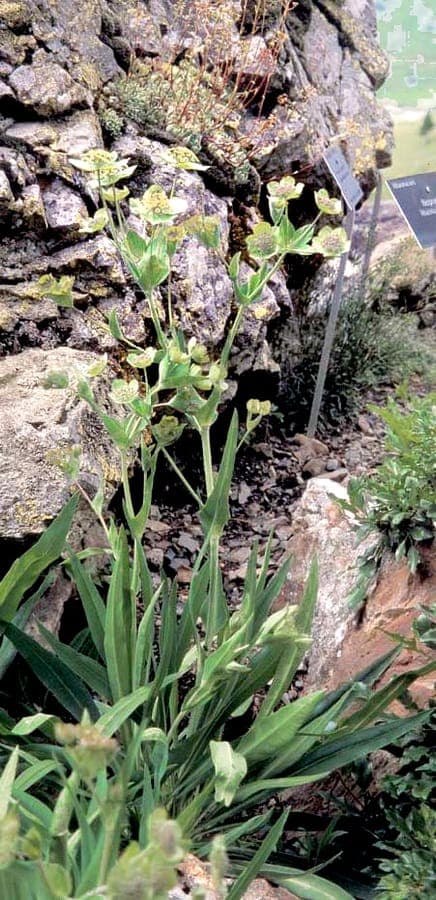
Meneerke bloem / CC BY-SA 3.0, via Wikimedia Commons
Bupleurum angulosum: complete guide
Bupleurum angulosum
Want to see Bupleurum angulosum: complete guide in your garden?
1 minute, no credit card
Overview
Bupleurum angulosum, commonly called thoroughwax, is an elegant perennial belonging to the carrot family (Apiaceae). Native to the Pyrenees and northeastern Spain, it grows wild on rocky slopes and alpine meadows at elevations often exceeding 2000 metres. The specific epithet 'angulosum' refers to its distinctively angled stems, a feature immediately noticeable when the plant is examined up close. In garden settings, thoroughwax is valued for its long-lasting ornamental value: the blue-green foliage provides structural interest throughout the season, while the bright yellow umbel flowers appear in midsummer and are accompanied by showy yellow-green bracts that remain attractive well after the flowers fade. The plant is well suited to low-maintenance gardens where drought tolerance and architectural form matter. If you are planning a dry border or a rock garden design, gardenworld.app is an excellent place to visualise how thoroughwax could work within your front garden scheme.
Appearance and bloom cycle
Bupleurum angulosum forms a neat, upright clump reaching 20 to 40 cm in height. The stems are distinctly angular and rigid, providing an architectural quality. Leaves are blue-green to grey-green, elongated and somewhat leathery in texture. They partially clasp the stem, creating a structural, layered effect. The plant blooms from July to August, producing compound umbels of small yellow flowers held above the foliage on erect stems. What makes thoroughwax particularly distinctive is the presence of prominent yellowish-green bracts beneath each umbel - these bracts have ornamental value that persists long after the flowers themselves have finished. After flowering, small oval fruits develop and ripen by late August or September. The plant grows from a sturdy rootstock, allowing it to regenerate reliably each spring. The combination of interesting foliage, attractive flowers and long-lasting bracts gives thoroughwax an extended season of visual interest from April through October.
Ideal location
Thoroughwax performs best in a sunny to lightly shaded position. In the wild it occupies fully exposed rocky hillsides bathed in sunshine for most of the day. In garden conditions, a south-facing or south-east facing border suits it well. Rock gardens, gravel gardens, dry borders and raised beds all provide the fast drainage this plant requires. It will tolerate a small amount of afternoon shade without much impact on flowering, but heavy shade produces lax growth and significantly reduces the number of blooms. The plant is well adapted to exposed and windy sites given its natural habitat, making it suitable for roof gardens and terraces as well as open borders. Its compact size also makes it viable in larger containers placed in a sunny position, though adequate watering in the first season is then more important.
Soil
The key requirement for Bupleurum angulosum is excellent drainage. In the Pyrenees it grows on poor, often calcareous, stony soils - exactly the opposite of the rich, moisture-retentive soils found in most cultivated gardens. Heavy clay soils are unsuitable without significant amendment. To create suitable conditions, incorporate generous amounts of coarse grit or fine gravel into the planting hole and the surrounding soil. A mix of one part garden soil, one part coarse sand and one part fine gravel works well in a rock garden or raised bed. Nutrient-poor conditions are actually beneficial - in overly fertile soil the plant tends to produce lush foliage at the expense of flowers. A surface mulch of pea gravel around the base of the plant helps maintain drainage and reduces the risk of crown rot in wet winters.
Watering
Once established, thoroughwax is highly drought tolerant and requires very little additional watering. Newly planted specimens need more regular attention during their first growing season - water once a week in dry spells to encourage root development. From the second year onward, established plants cope well with extended dry periods and rarely need supplementary watering except during prolonged heatwaves. When you do water, water deeply and infrequently rather than lightly and often - deep watering encourages roots to extend further into the soil, improving long-term drought resistance. Standing water around the crown is the main cause of plant loss, so always ensure excess water can drain away freely. In containers, ensure the pot has adequate drainage holes and never allow the container to stand in a saucer of water.
Free design
Want to see Bupleurum angulosum: complete guide in your garden? Make a free design now.
Pruning
Thoroughwax needs minimal pruning. The spent flower stems can be removed in late summer or early autumn once they have lost their decorative value, or they can be left to stand through winter - the dried stems and seed heads add structure to the border and provide food for seed-eating birds. In spring, as new growth begins to emerge from the base, any dead or damaged stems and leaves can be cleanly removed. Wait until you are sure the last frosts have passed before doing this - typically from mid-April onward in most of northwest Europe. Hard pruning back into old wood is not recommended and can set the plant back considerably. Always cut cleanly above a healthy bud or leaf joint, and avoid cutting into the crown.
Maintenance calendar
March - April: Assess the plant after winter. Remove any dead stems once new growth is clearly underway. Apply a top-dressing of coarse grit around the crown to improve drainage.
May - June: Active growth phase. Flower buds begin to form. Remove any competing weeds carefully. Newly planted specimens benefit from a weekly watering in dry weather.
July - August: Peak flowering period. The yellow umbels are at their most striking. Established plants need no irrigation. Observe seed development from late August.
September - October: Leave stems and seed heads in place for wildlife, or cut them back to tidy the plant. Reduce watering in containers.
November - February: The plant is dormant. Ensure drainage remains good. No protective covering is needed in most climates where this guide applies. Check that waterlogging has not occurred after prolonged wet spells.
Winter hardiness
As a high-altitude Pyrenean native, Bupleurum angulosum is hardy to USDA zone 6, tolerating minimum temperatures of approximately -23 degrees Celsius. In the climate of the British Isles, the Netherlands, Belgium and northern France, the plant is fully winter hardy without any protective covering. The only serious winter risk comes from wet soils rather than cold: waterlogging combined with cold temperatures can cause crown rot, which is the main reason plants fail to return in spring. A well-drained planting position and a surface mulch of grit virtually eliminate this risk. The plant dies back to its rootstock in winter and re-sprouts reliably in spring once temperatures rise.
Companion plants
Bupleurum angulosum combines well with other drought-tolerant, sun-loving perennials. Lavender (Lavandula angustifolia) provides complementary purple-blue flowers alongside the yellow of thoroughwax. Creeping thyme (Thymus serpyllum) covers the ground between taller specimens and suppresses weeds. Blue fescue (Festuca glauca) mirrors the blue-green leaf colour and adds a fine-textured contrast. Sun roses (Helianthemum species) bring vivid colour to a rock garden planting. Ornamental onions (Allium species) provide interesting spherical heads in early summer before thoroughwax comes into bloom. Stonecrop (Sedum species) and houseleeks (Sempervivum) are natural companions in a rock garden or gravel garden. On gardenworld.app you can explore planting combinations and see how thoroughwax fits into a broader garden design before committing to a plan. Local garden centres in the UK and specialist perennial nurseries are the most reliable sources for Bupleurum angulosum plants.
Closing
Thoroughwax is a plant that rewards the gardener who values architectural form, seasonal interest and low maintenance over showy spectacle. Its combination of blue-green foliage, long-lasting ornamental bracts and yellow umbel flowers provides interest from spring through autumn. Fully winter hardy, drought tolerant and unfussy about soil as long as it drains well - thoroughwax is a genuine low-effort, high-reward choice for rock gardens, gravel beds and dry borders. It may not be the most common plant at garden centres, but specialist perennial nurseries often stock it, and it is well worth seeking out.
Want to see Bupleurum angulosum: complete guide in your garden? Make a free design now.
Upload a photo, pick a style, and get a photorealistic design with plant list in under a minute.
10,000+ gardens designed already
No credit card required


Similar plants
Whorled carrot: complete guide
Daucus involucratus
Daucus involucratus is a Mediterranean umbellifer with white flower heads framed by lacy bracts. Growing this gravel garden gem.
Daucus muricatus: complete guide
Daucus muricatus
Daucus muricatus, the spiny wild carrot, grows wild on Mediterranean coasts. Discover sowing, June-July bloom, and wildflower meadow use.
Daucus pumilus: complete guide
Daucus pumilus
Daucus pumilus is a dwarf wild carrot relative with white lacy umbels, thriving on dunes and coastal rock in poor, fast-draining soil.